
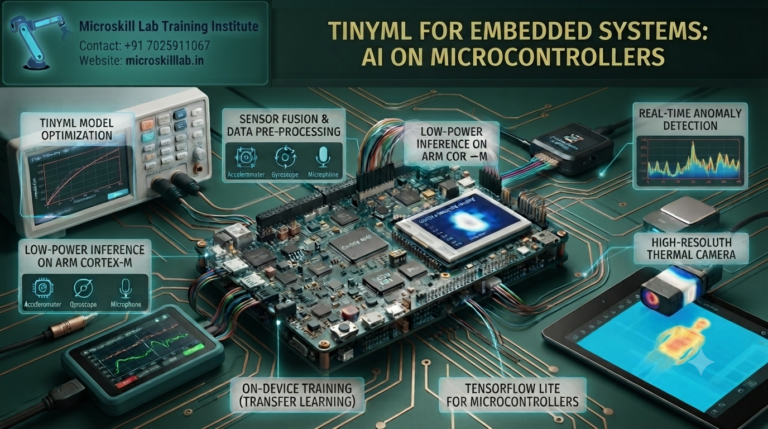
TinyML for Embedded Systems: AI on Microcontrollers
TinyML brings machine learning to microcontrollers, letting tiny, low-power chips run AI models directly on the device without the cloud. For AI students and embedded developers in Bangalore and across India, TinyML is the fast-growing bridge between machine learning and embedded systems. It powers keyword spotting, gesture recognition, and predictive maintenance on ARM Cortex-M boards drawing only milliwatts of power.
At Microskill Lab Training Institute, we teach TinyML as a practical extension of embedded programming. You build real inference models that run on hardware you can hold in your hand. This guide explains what it is, why it matters for your career, and how our curriculum turns you into a job-ready edge AI developer.
⚡ Key Takeaways
- TinyML runs machine learning models on microcontrollers using kilobytes of memory, no cloud required.
- You gain hands-on skills in TensorFlow Lite Micro, model quantization, and ARM Cortex-M deployment.
- Edge AI roles in Bangalore command strong salaries as demand for on-device intelligence grows.
- Our curriculum pairs embedded C/C++ with practical machine learning for real hardware projects.
- A capstone project gives you a portfolio-ready TinyML application to show employers.
- We prepare you for hiring across Karnataka, Kerala, Tamil Nadu, Telangana, Andhra Pradesh, and Pondicherry.
What Is TinyML and Who Is It For?
TinyML is a field of machine learning that runs trained AI models on resource-constrained microcontrollers rather than powerful servers. These devices often have less than a megabyte of memory and run on battery power for months. The goal is to bring intelligence directly to the sensor, cutting latency, protecting privacy, and slashing energy use.
TinyML sits at the intersection of two disciplines, and mastering both is what makes a developer valuable. Our trainers guide learners from embedded fundamentals through applied machine learning in a single structured path.
The Core Idea Behind Edge AI
Edge AI means processing data where it is generated instead of sending it to a distant data centre. A microcontroller running a TinyML model can detect a spoken keyword or an unusual vibration in milliseconds. This local processing removes network dependency and keeps sensitive data on the device.
For students building this foundation, our embedded systems training programme covers the microcontroller skills that TinyML depends on. Understanding memory, interrupts, and peripherals comes first, and our curriculum sequences these before model deployment.
The advantages compound quickly once intelligence moves to the edge. Battery-powered nodes last far longer when they avoid constant wireless transmission. Privacy improves because raw audio or video never leaves the device, which matters for medical and consumer products alike.
Who Should Learn TinyML
TinyML suits AI students who want to move beyond notebooks and embedded developers who want to add intelligence to their devices. ECE, EEE, and CSE graduates across India find it a natural next step after learning microcontrollers. Working professionals in Bangalore’s electronics sector also use it to upgrade existing products.
The ideal learner has some programming background and curiosity about hardware. Our beginners start with C and Python basics, then progress to model training and on-device inference. This mixed audience is exactly who our batches are designed to serve.
Career changers from software backgrounds also do well in this field. Their coding skills transfer, and the hardware layer becomes a new and marketable specialisation. We see graduates from across South India join with varied starting points and still reach deployment confidently.
Why TinyML Matters for Your Career in 2026
TinyML matters because on-device intelligence is becoming standard across consumer, industrial, and medical products. Companies want engineers who can shrink AI models to fit tiny chips without losing accuracy. This skill is scarce, which makes it valuable in the Indian job market.
Bangalore, as India’s electronics and IoT hub, is a natural centre for this demand. Firms in Electronic City and Whitefield increasingly embed AI into their hardware roadmaps. Our curriculum is built to meet exactly this market need.
The Growing Edge AI Job Market in India
The edge AI and embedded machine learning market is expanding as IoT deployments scale across India. Manufacturers, automotive suppliers, and smart-device startups all need on-device inference skills. Karnataka’s strong IT and ITES sector concentrates many of these opportunities in Bangalore.
Companies such as Bosch, Siemens, Wipro, and L&T run embedded and IoT teams that increasingly touch edge AI work. Our IoT training programme connects TinyML to the wider connected-device ecosystem these employers build. Learners see how a smart sensor fits into a full IoT system.
India’s push toward domestic electronics manufacturing widens this demand further. Initiatives supported by the Ministry of Electronics and IT encourage local product design, and that design increasingly includes on-device AI. Startups across Manyata Tech Park and Whitefield are hiring for exactly these blended skill sets.
Salary Benchmarks for Edge AI Skills
Embedded engineers with machine learning skills tend to earn more than those with embedded experience alone. Indicative ranges suggest embedded AI roles in Bangalore fall around ₹6–16 LPA depending on experience. These figures are approximate and should be verified against current market data before you rely on them, and senior edge AI specialists can command higher packages.
Salary depends heavily on portfolio strength, which is why we emphasise live projects. A demonstrable TinyML application often matters more to hiring managers than certificates alone. Our trainers help you build that evidence during the course.
Course Curriculum: What You Learn at Microskill Lab
Our TinyML curriculum blends embedded programming with applied machine learning in a project-driven sequence. You start with microcontroller fundamentals, move through model training, and finish with on-device deployment. Every module ends with hands-on work on real hardware.
We designed the syllabus so that no prior AI experience is required to begin. Our trainers, who work with embedded systems daily, translate complex concepts into practical steps. This experience-led teaching is central to how we build capable developers.
Foundations: Embedded C and Microcontroller Basics
The course opens with embedded C and C++ on ARM Cortex-M microcontrollers. You learn to control peripherals, manage memory, and read sensor data efficiently. These skills are the bedrock on which every TinyML model runs.
Learners who need extra grounding can strengthen basics through our Arduino programming course before advancing. Solid fundamentals prevent the frustration many self-learners hit when deploying models. Our curriculum builds this base deliberately.
You also learn to read datasheets and reason about clock speeds, flash, and RAM budgets. These numbers decide whether a model will fit and run in real time. Treating the datasheet as a design tool is a habit our trainers instil early.
Applied Machine Learning and Model Deployment
Next, you learn to train models and convert them for microcontrollers using TensorFlow Lite Micro. The syllabus covers quantization, which shrinks models to fit kilobytes of flash memory. You then deploy and test inference directly on embedded boards.
Tools and technologies you will work with include:
- TensorFlow Lite Micro for on-device inference
- Model quantization and optimization techniques
- ARM Cortex-M development boards and toolchains
- Sensor data collection and preprocessing pipelines
- Edge Impulse-style workflows for rapid prototyping
Tools, Technologies, and Hardware You Will Master
TinyML development combines software frameworks with specific microcontroller hardware. Learning the full toolchain is what lets you move from a trained model to a running device. Our curriculum covers each layer with hands-on labs.
We keep the tool set aligned with what Indian employers actually use. This practical focus means your skills transfer directly to workplace projects. Our trainers update the stack as the field evolves.
Software Frameworks for On-Device AI
TensorFlow Lite Micro is the core framework for running neural networks on microcontrollers. It has no dynamic memory allocation and no operating system dependency, making it ideal for constrained chips. You learn to interpret models and manage the tensor arena that holds working memory.
Alongside the framework, you practise the full model pipeline from training to conversion. Our PIC microcontroller programming course complements this by deepening low-level embedded understanding. Knowing the hardware constraints makes your models leaner and faster.
Quantization is where much of the real craft lives in this field. Converting weights from floating point to eight-bit integers shrinks a model dramatically. Our labs show you how to do this while measuring the small accuracy trade-off it introduces.
Microcontroller Hardware and Sensors
ARM Cortex-M is the dominant architecture for TinyML because it balances performance and power. You work with development boards that include accelerometers, microphones, and other sensors. These sensors feed the real-world data your models learn to interpret.
Understanding hardware limits shapes every design decision in this field. A model that ignores memory and clock-speed constraints will simply fail to run. Our labs teach you to design within these limits from the start.
Power budgeting is a skill worth calling out on its own. Many edge devices must survive months on a coin cell, so every inference cycle counts. You learn to profile power draw and choose model sizes that respect the energy envelope.
Ready to build AI that runs on real hardware? Our project-based TinyML training gives you portfolio-ready skills that Bangalore employers value, taught by trainers with hands-on embedded experience. Enrol in our Embedded Systems Programme →
Real-World Applications and Live Projects
TinyML powers products people use every day, and our course connects theory to these applications. You build projects that mirror real industry use cases. This grounding helps you speak confidently in interviews.
Practical output is the heart of our teaching philosophy. Every learner leaves with a working application, not just lecture notes. Our trainers mentor each project from concept to demonstration.
Common TinyML Use Cases
TinyML appears in wake-word detection, gesture recognition, and predictive maintenance systems. Wearables use it to classify activity without draining the battery. Factories use it to catch equipment faults before they cause downtime.
Agriculture and healthcare are opening fresh use cases across India too. Low-cost sensors can flag crop stress or monitor patient vitals without reliable internet. These applications suit rural deployments where connectivity is limited but sensing needs are real.
Career roles you can target after the course include:
- Embedded AI engineer building on-device inference systems
- Edge AI developer for IoT and smart-device products
- Firmware engineer with machine learning specialisation
- Embedded systems engineer in automotive or industrial teams
- IoT solutions developer combining sensors and intelligence
Your Capstone TinyML Project
The course culminates in a capstone project you design and deploy yourself. You choose a problem, collect data, train a model, and run it on a microcontroller. This end-to-end experience is what employers most want to see.
Our trainers review each capstone for technical soundness and presentation quality. A polished project becomes the centrepiece of your portfolio and interviews. This hands-on outcome is what sets our learners apart in the Karnataka job market.
How to Choose the Right TinyML Training in Bangalore
Choosing a training institute means weighing curriculum depth, hardware access, and trainer experience. Many programmes teach machine learning or embedded systems, but few integrate both well. The right choice gives you genuine on-device deployment practice.
We built our programme specifically to close that integration gap. Comparing your options carefully saves time and money. The table below shows how a structured institute compares with alternatives.
Structured Training Versus Self-Learning
Self-learning is possible but slow, because the toolchain and hardware quirks are unforgiving. A structured course removes guesswork and gives you mentor support when you get stuck. Access to real boards also matters more than most beginners expect.
Peer learning adds value that solo study cannot easily match. Working alongside other learners exposes you to different problems and debugging approaches. Our Bangalore batches create that shared environment, with trainers on hand to unblock you fast.
Comparison of Learning Paths
| Factor | Microskill Lab | Self-Learning | Generic Online Course |
|---|---|---|---|
| Hardware access | Provided in labs | You buy your own | Rarely included |
| Trainer mentorship | Direct and ongoing | None | Limited or forum-based |
| Embedded + ML integration | Fully integrated | Fragmented | Often ML-only |
| Live capstone project | Yes, mentored | Self-directed | Sometimes |
| Local job-market alignment | Bangalore-focused | Generic | Generic |
To begin your journey, reach out through our enquiry and enrolment page and our team will guide you on batches. We help you pick the right starting point based on your background. Your path into edge AI can start with a single conversation.
Frequently Asked Questions
Do I need machine learning experience to learn TinyML?
No, you do not need prior machine learning experience to start. Our curriculum begins with the fundamentals of both embedded programming and machine learning. A background in ECE, EEE, CSE, or basic programming helps, but our trainers guide beginners step by step.
What hardware do I need for TinyML?
Most TinyML work uses ARM Cortex-M development boards with onboard sensors. In our labs, we provide the boards so you can focus on learning rather than sourcing hardware. This lets you practise real deployment from the first project.
Is TinyML a good career choice in India?
Edge AI and embedded machine learning are growing areas as IoT expands across India. Demand concentrates in hubs like Bangalore, where electronics and IT sectors overlap. Combining embedded and ML skills makes you a stronger candidate than either skill alone.