
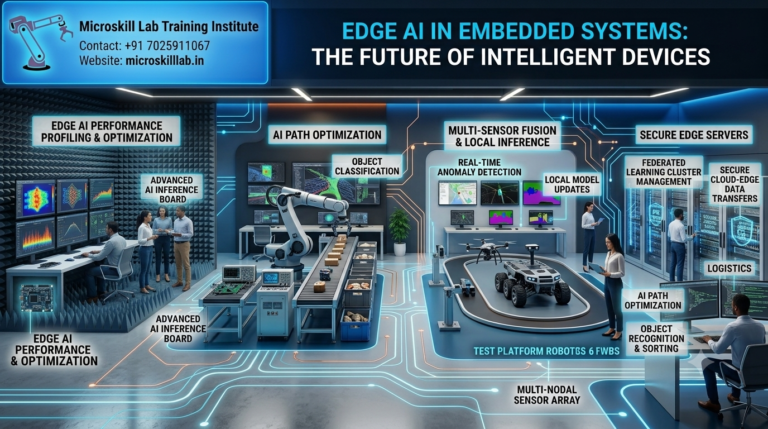
Edge AI in embedded systems runs machine learning models directly on microcontrollers and processors inside a device, rather than sending data to the cloud for inference. For AI and embedded engineers in Bangalore and across India, this shift matters because it delivers low-latency, private, power-efficient intelligence at the device level. At Microskill Lab Training Institute, we train engineers from Karnataka, Kerala, Tamil Nadu, Telangana, Andhra Pradesh, and Pondicherry to build these intelligent systems. This guide explains what Edge AI is and why it defines the next decade of embedded design. It also shows how you can build the skills that Bangalore’s hardware and IoT companies now actively hire for.
⚡ Key Takeaways
- You learn how Edge AI moves machine learning inference from the cloud onto embedded hardware for faster, private, offline decisions.
- You understand where TinyML, ARM processors, and edge computing fit inside modern IoT product design.
- You see realistic Bangalore salary benchmarks and the roles Edge AI skills unlock across South India.
- You get a clear curriculum path from electronics fundamentals to deploying models on real embedded devices.
- You discover how to choose a training institute that offers hands-on, project-based Edge AI learning.
What Is Edge AI in Embedded Systems?
Edge AI is the practice of running artificial intelligence and machine learning workloads directly on embedded hardware at the “edge” of a network. Instead of streaming sensor data to a remote server, the device itself interprets that data and acts on it. This reduces latency, protects privacy, and keeps products working even without connectivity.
For embedded engineers, this represents a genuine change in how devices are architected. Traditional embedded software focused on control loops and signal processing. Modern embedded software now embeds trained neural networks that classify sound, detect motion, or recognise patterns on-chip. Our trainers help learners bridge this gap between classic firmware and applied machine learning.
Cloud AI Versus Edge AI
Cloud AI sends data to powerful data centres for inference, which works well when latency and bandwidth are not concerns. Edge AI keeps computation local, which suits battery devices, factory sensors, and safety systems that cannot wait for a round trip. Understanding this trade-off is a core part of our embedded curriculum.
For Indian product teams building for rural connectivity or cost-sensitive markets, Edge AI often wins. A device that works offline is more reliable across Karnataka’s varied network conditions. Our curriculum in embedded systems teaches learners to weigh these design decisions carefully.
Who Should Learn Edge AI
This field suits AI and embedded engineers, ECE and EEE graduates, and developers moving from application software into hardware. Freshers from engineering colleges across South India find it a strong entry point into a growing specialisation. Working professionals in Bangalore’s IT sector also use it to pivot toward hardware-adjacent roles.
You need a foundation in electronics and basic programming to start comfortably. Our electronics fundamentals programme prepares learners who lack that base before they advance into applied AI topics.
Why Edge AI Matters for Your Career in Bangalore in 2026
Bangalore remains India’s hardware and semiconductor hub, home to design centres in Electronic City, Whitefield, and Manyata Tech Park. As global firms expand chip and IoT design work here, demand for engineers who understand both embedded systems and machine learning keeps rising. Edge AI sits precisely at that intersection.
Companies such as Bosch, Siemens, Wipro, and L&T maintain significant embedded and R&D operations in Karnataka. These teams increasingly seek engineers who can deploy models on constrained devices. Our trainers see this demand reflected directly in the roles our learners are interviewed for.
Salary Benchmarks in India
Edge AI and embedded machine learning engineers in Bangalore earn roughly ₹6–16 LPA depending on experience, with senior specialists commanding more. Freshers with strong project portfolios typically start in the ₹4–7 LPA range. These figures are indicative and should be verified against current market data before you rely on them.
Salaries in Hyderabad, Chennai, and Kochi trend slightly lower but follow the same upward curve. The scarcity of engineers who combine firmware and ML skills keeps compensation competitive across South India. Our IoT programme builds exactly this rare skill combination.
Industry Demand and Hiring Trends
NASSCOM and industry reports consistently highlight AI and IoT as high-growth areas for Indian engineering talent. Karnataka’s IT and MSME electronics sector continues to add embedded design roles year on year. Edge AI capability makes a candidate stand out in this competitive pool.
The Ministry of Electronics and IT has also pushed domestic semiconductor and electronics manufacturing, which expands local hardware jobs. Engineers trained in on-device intelligence are well positioned for this shift. We align our curriculum to these emerging national priorities.
Core Technologies Behind Edge AI
Edge AI rests on a small stack of enabling technologies that every engineer should understand. These include efficient hardware, compact model formats, and specialised software frameworks. Mastering them is what separates a hobbyist from a job-ready professional.
Our curriculum treats each layer methodically rather than superficially. Learners build working knowledge of the silicon, the models, and the tooling. This depth is what Bangalore employers expect from serious candidates.
TinyML and Model Optimisation
TinyML is the discipline of running machine learning on microcontrollers with only kilobytes of memory. It relies on techniques like quantisation and pruning to shrink models without destroying accuracy. These methods make it possible to run inference on tiny, low-power chips.
Learners in our programmes practise converting and compressing real models for constrained targets. This hands-on optimisation work is central to employability in Edge AI. Our Arduino programming course offers an accessible on-ramp to these concepts.
ARM Processors and Edge Hardware
ARM processors dominate the embedded and mobile world because of their power efficiency. Cortex-M and Cortex-A families, along with dedicated neural accelerators, power most Edge AI devices today. Understanding this hardware is essential for writing efficient embedded software.
Learners study how memory, clock speed, and accelerators shape what models a device can run. This grounding helps engineers make realistic architecture choices. Our trainers draw on real deployment experience to teach these trade-offs.
Tools and technologies you will work with:
- TensorFlow Lite for Microcontrollers and similar inference runtimes
- ARM Cortex-M and Cortex-A development boards
- Quantisation and model-compression workflows
- C and C++ for embedded software development
- Common IoT sensors and communication protocols
Course Curriculum: What You Will Learn at Microskill Lab
Our Edge AI-oriented curriculum builds from foundations upward so no learner is left behind. We begin with electronics and embedded programming before layering on machine learning deployment. This structure suits both freshers and working professionals retraining for hardware AI roles.
Every module pairs theory with lab work on real boards. Learners leave with a portfolio of deployed projects rather than only certificates. Our trainers, drawn from industry, guide each stage personally.
From Fundamentals to Deployment
The learning path moves through electronics, microcontrollers, embedded C, and finally on-device ML. Learners who need firmware depth can extend into embedded Linux development for more capable edge devices. Those focused on bare-metal work strengthen their microcontroller skills first.
We also cover PIC and other microcontroller families for learners who want broad exposure across architectures. This breadth helps engineers adapt to whatever hardware an employer uses. Flexibility is a deliberate design goal of our curriculum.
Hands-On Capstone Projects
Every learner completes a capstone that deploys a working model to a real device. Past projects include keyword-spotting, gesture recognition, and predictive-maintenance sensors. These live projects give learners concrete outcomes to show recruiters.
Capstones are reviewed by our trainers against practical engineering standards. Learners defend their design choices, which builds interview confidence. This project-first approach reflects how real Bangalore product teams work.
Build job-ready Edge AI skills with hands-on training designed for South India’s hardware sector. Our industry trainers guide you from electronics basics to deploying live models on real devices. Explore our Embedded Systems Pro Programme →
Fees, Duration, and Batch Options in Bangalore
We offer flexible batch options to suit students, freshers, and working professionals across Bangalore and South India. Weekend and weekday batches let learners fit training around college or employment. Blended and onsite modes are both available.
Course duration varies with the depth a learner chooses, from focused short programmes to comprehensive tracks. Our advisors help each learner pick the right pathway. Exact fees depend on the programme and should be confirmed directly with our team.
Comparing Learning Modes
Choosing between self-learning, online, and instructor-led training shapes your outcomes significantly. The table below compares these paths so you can decide what suits your goals and schedule.
Table: Comparing Edge AI learning approaches
| Factor | Self-Learning | Generic Online Course | Microskill Lab Instructor-Led |
|---|---|---|---|
| Hands-on hardware access | Limited | Rare | Extensive lab time |
| Trainer mentorship | None | Minimal | Direct and personal |
| Capstone project review | Self-assessed | Automated only | Reviewed by trainers |
| Local hiring context | Absent | Generic | Bangalore-specific |
| Doubt resolution speed | Slow | Delayed | Same-session |
Enrolment and Getting Started
Enrolling is straightforward, and our advisors walk each learner through the options. We assess your background and recommend the right starting point. This ensures you neither struggle nor repeat material you already know.
To begin, simply reach out through our contact and enquiry page and our team will respond. We discuss goals, schedules, and suitable batches before you commit. This consultative approach reflects our focus on learner success.
Documents and prerequisites for enrolment:
- A basic background in electronics or programming (helpful but not always mandatory)
- Government-issued identity proof for registration
- A personal laptop for practical sessions where required
- Willingness to commit to project and lab work
Career Roles After Learning Edge AI
Edge AI skills open several distinct and growing career paths in the Indian market. Because the skill set is rare, trained engineers often have strong bargaining positions. Our curriculum maps directly to the roles employers actively recruit for.
These roles span product companies, startups, and R&D centres across South India. Each values the combination of embedded and machine learning ability. Our trainers prepare learners for the specific expectations of each path.
In-Demand Job Titles
Graduates move into roles such as embedded ML engineer, edge computing developer, and IoT firmware engineer. Others specialise in model optimisation or embedded software development for AI devices. Bangalore’s product ecosystem hires steadily across all of these.
Startups in particular value engineers who can own a device end to end. This breadth is exactly what our project-based training develops. Learners graduate able to contribute from their first week.
Building a Standout Portfolio
Recruiters in Bangalore increasingly weigh demonstrated projects over certificates alone. A portfolio of deployed Edge AI projects signals real capability. Our capstone structure is designed to produce exactly this evidence.
We coach learners on presenting their work clearly to technical interviewers. Strong communication of design decisions sets candidates apart. This soft-skill layer complements the technical depth of our curriculum.
How to Choose the Right Edge AI Training Institute in Bangalore
Selecting an institute is a decision that shapes your career trajectory, so choose carefully. Look beyond marketing claims to the substance of what is actually taught. The right choice combines hardware access, expert trainers, and real projects.
We encourage prospective learners to visit, ask questions, and speak with trainers. Transparency is a signal of a serious institute. Our team welcomes this scrutiny because our teaching stands up to it.
Questions to Ask Before Enrolling
Ask whether learners get genuine hands-on hardware time or only simulations. Enquire about trainer industry experience and how projects are reviewed. These questions quickly reveal the depth behind any programme.
Also ask about the local hiring context and how the curriculum stays current. Edge AI moves fast, and stale material hurts employability. Our curriculum is updated to reflect the tools employers use today, including PCB design skills that round out a hardware engineer’s profile.
Why Learners Across South India Choose Us
Learners from Karnataka, Kerala, Tamil Nadu, Telangana, Andhra Pradesh, and Pondicherry train with us for our practical, industry-aligned approach. Our Bangalore location places learners close to the companies hiring them. This proximity to Electronic City and Whitefield employers is a real advantage.
Our trainers bring genuine deployment experience rather than only theory. Learners value the honest, hands-on culture we maintain. That reputation is why so many join through referrals from past learners.
Frequently Asked Questions
What is Edge AI in simple terms?
Edge AI means running machine learning directly on a device instead of in the cloud. The device makes intelligent decisions locally, which is faster and more private. This is increasingly common in IoT products, wearables, and industrial sensors.
Do I need a machine learning background to start?
You need basic electronics and programming knowledge, but not deep machine learning expertise upfront. Our curriculum builds ML deployment skills step by step. Motivated freshers and career changers regularly succeed in these programmes.
Is Edge AI a good career choice in India?
Yes, because the combination of embedded and machine learning skills is rare and in demand. Bangalore and other South Indian tech hubs actively recruit for these roles. Salaries are competitive and the field is growing steadily.
Which hardware will I learn to work with?
You work with ARM-based boards, microcontrollers, and common IoT sensors. Our labs give you hands-on time with real hardware rather than only simulators. This practical experience is what recruiters value most.