
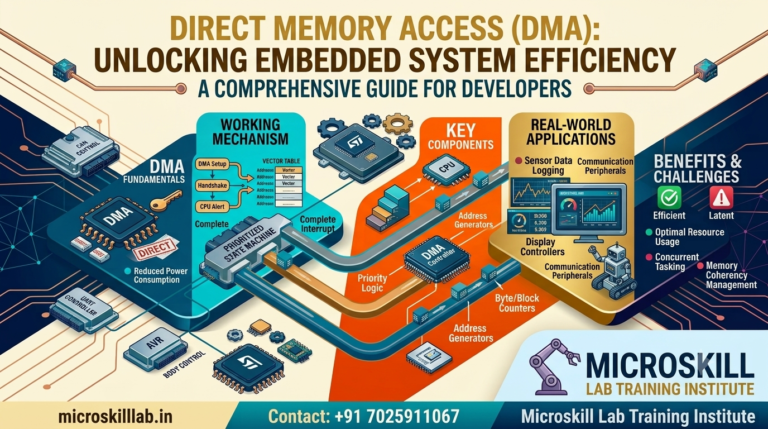
DMA in Embedded Systems: Boost Performance the Smart Way
DMA in embedded systems is a hardware mechanism that lets peripherals move data to and from memory without involving the CPU on every single byte. For embedded developers across Bangalore and India working on ARM Cortex-M microcontrollers, mastering direct memory access is the difference between a sluggish firmware loop and a responsive, power-efficient product. At Microskill Lab Training Institute, our trainers treat DMA as a core competency because it unlocks real throughput gains in data-heavy applications that constrained hardware would otherwise struggle to handle.
Whether you build motor controllers in Electronic City or IoT gateways in Whitefield, a solid grasp of direct memory access sharpens your embedded programming judgement. This guide explains how the mechanism works, when it earns its place in a design, and how to configure it safely alongside interrupts and an RTOS. We will walk through channels, transfers, cache coherency, and the pitfalls that most often trip up newer developers.
⚡ Key Takeaways
- You learn how DMA offloads data movement from the CPU, freeing valuable cycles for real application work.
- You understand which peripherals and workloads benefit most from direct memory access.
- You gain a practical configuration sequence for ARM Cortex-M DMA controllers.
- You see how DMA cooperates with an RTOS and interrupt-driven firmware designs.
- You avoid common bugs like cache coherency mismatches and buffer alignment errors.
- You connect these skills to embedded engineering roles hiring across Karnataka and South India.
What Is DMA in Embedded Systems?
Direct memory access is a dedicated hardware unit that transfers data between memory and peripherals independently of the processor core. Instead of the CPU copying each byte inside a polling loop, the DMA controller handles the bulk movement and signals completion through an interrupt. This arrangement frees the processor to run application logic, enter a low-power sleep state, or service other time-critical tasks.
Our trainers introduce this concept early in every embedded module because it fundamentally reshapes how you architect firmware. Once you stop thinking of the CPU as the only thing that can touch memory, whole categories of performance problems dissolve. That shift in mindset is exactly what separates a beginner from a capable embedded engineer.
Who Should Learn DMA
DMA knowledge suits embedded developers, firmware engineers, and electronics graduates from ECE, EEE, and CSE backgrounds who want to work closer to the hardware. If you already write bare-metal C or interact with microcontroller peripherals, direct memory access is your next logical efficiency lever. Freshers across Kerala, Tamil Nadu, and Andhra Pradesh find that this skill opens doors to product-based companies rather than only service roles.
Working professionals looking to move into embedded product teams also benefit from formalising what they may have only seen in passing. Our Embedded Systems Pro Programme builds this foundation methodically from registers upward. The goal is confidence with real silicon, not just familiarity with slides.
The Core Building Blocks
A DMA transfer needs four things: a source address, a destination address, a transfer size, and a channel to carry it. The controller supports several modes, including memory-to-peripheral, peripheral-to-memory, and memory-to-memory movement. Understanding these building blocks lets you map the mechanism cleanly onto the real workloads in front of you.
Each mode fits a different problem, and choosing correctly is part of the engineering craft. Memory-to-peripheral suits transmitting a buffer over a serial line, while peripheral-to-memory captures incoming sensor samples. We reinforce every concept with hands-on labs on STM32 and other widely used Cortex-M boards.
Why Direct Memory Access Matters for Your Career in 2026
Embedded product companies in Bangalore increasingly expect DMA fluency for any role involving high-speed data acquisition or communication. Engineers who can move data efficiently write firmware that meets timing budgets and battery targets that polling-based code simply cannot reach. This capability is now a baseline expectation rather than an advanced nicety in many product teams.
As of 2026, embedded firmware engineers in Bangalore earn roughly ₹6–15 LPA depending on experience and domain, with signal-processing roles often at the upper end. These figures are indicative and should be verified against current market data before you rely on them for planning. Still, the trend is clear: hardware-fluent engineers command a premium.
The Bangalore Embedded Hiring Landscape
Karnataka’s electronics and semiconductor sector continues to expand, supported by India’s growing focus on domestic chip design and MeitY-backed initiatives. Employers hiring embedded talent range from automotive and industrial automation firms to lean IoT product startups clustered around Manyata Tech Park. Each of these employers values engineers who can extract performance from constrained microcontrollers.
DMA expertise signals to an interviewer that you genuinely understand how hardware and firmware interact. It is a concrete, testable skill that is hard to fake in a technical discussion. We prepare learners for exactly these conversations, drilling the reasoning as much as the syntax.
From Theory to Employable Skill
Knowing DMA in isolation is not enough; you must be able to apply it inside real, messy projects. Our trainers connect the concept directly to ADC sampling, UART streaming, and SPI display drivers that mirror production work. This project-based approach reflects what hiring managers actually probe during technical rounds.
Learners finish the programme with portfolio-ready work that demonstrates genuine, defensible capability. A candidate who can walk through a working circular-DMA audio pipeline stands out immediately. That tangible proof of skill is what converts interviews into offers.
How DMA Works Inside a Microcontroller
At the hardware level, the DMA controller shares the memory bus with the CPU and arbitrates access according to configured priorities. When a peripheral raises a request, the controller performs the transfer during available bus cycles using a technique often called cycle stealing. The CPU only pauses briefly in the rare moments when both it and the controller need the bus at the same instant.
This cooperative sharing is precisely why DMA delivers throughput without fully halting the processor. The core keeps executing instructions while data flows underneath it, almost invisibly. Understanding this arbitration model helps you reason about worst-case timing in real-time systems.
Channels, Streams, and Requests
Modern ARM Cortex-M devices expose multiple DMA channels, each mappable to specific peripheral requests. On many STM32 parts, streams and channels together route requests from timers, ADCs, and serial peripherals to the controller. Configuring the correct mapping is essential, because a wrong entry produces silent failure rather than a helpful error.
Our labs walk through the device reference manual line by line so you learn to read datasheets with confidence. That skill outlasts any single chip and transfers across vendors. Reading hardware documentation well is one of the most durable abilities an embedded engineer can build.
Interrupts and Completion Handling
DMA typically raises an interrupt on full transfer completion, and often on half-completion as well, which enables double-buffering schemes. Your interrupt service routine then processes the filled buffer while the controller quietly fills the next one. This ping-pong pattern keeps data flowing continuously without dropped samples or gaps.
We teach you to write lean, deterministic ISRs that respect tight real-time constraints. A bloated interrupt handler can destroy the very timing benefits DMA was meant to deliver. Discipline inside the ISR is therefore as important as the DMA setup itself.
Configuring DMA on ARM Cortex-M Devices
Setting up DMA follows a predictable sequence: enable the controller clock, configure the channel, set addresses and length, then enable the transfer. Vendor libraries such as the STM32 HAL abstract some of these steps, but our trainers ensure you understand the registers underneath. Register-level fluency is what lets you debug effectively when a convenient abstraction inevitably leaks.
This depth is what separates competent embedded developers from those who can only copy and paste example code. When something breaks at three in the afternoon before a demo, understanding beats guessing every time. We build that understanding deliberately, layer by layer.
A Typical Configuration Sequence
The essential steps for a peripheral-to-memory transfer follow a clear, repeatable order:
- Enable the DMA controller and peripheral clocks in the RCC registers.
- Select the correct channel or stream for your specific peripheral request.
- Set the source address, destination address, and number of data items to transfer.
- Configure data width, address increment mode, and circular or normal operation.
- Enable the transfer-complete interrupt and then start the DMA channel.
Circular Mode and Double Buffering
Circular mode makes the controller restart automatically at the buffer’s end, which is ideal for continuous ADC sampling or audio streaming. Combined with half-transfer interrupts, it enables seamless double buffering without any CPU intervention between blocks. This pattern is a genuine staple of real-time embedded hardware design.
Our capstone projects use circular DMA to build live sensor-data pipelines that run indefinitely. Learners see firsthand how a correctly configured buffer keeps a system stable for hours. That reliability is the whole point of investing effort in DMA.
Master DMA and other performance techniques through structured, hands-on training trusted by learners across South India. Our trainers guide you from register basics to live project deployment on real ARM Cortex-M boards, not simulators. Explore the Embedded Systems Pro Programme →
DMA and RTOS: Working Together Safely
In an RTOS environment, DMA and task scheduling must cooperate carefully to avoid data races and priority inversions. Because DMA runs independently of the scheduler, completion interrupts usually signal tasks through semaphores or message queues. This decoupling lets high-throughput transfers proceed while the RTOS continues managing application logic elsewhere.
Our trainers show precisely how to bridge low-level hardware events and higher-level RTOS primitives cleanly. Done well, the two systems reinforce each other instead of competing. Done poorly, you get the intermittent bugs that haunt embedded projects for weeks.
Synchronising DMA with Tasks
A common and robust pattern uses a DMA completion interrupt to release a semaphore that unblocks a waiting task. The task then processes the freshly filled data without any busy-waiting, saving both CPU cycles and power. This design keeps the whole system responsive even under heavy data load.
We practise these exact patterns using FreeRTOS on Cortex-M targets during lab sessions. Learners implement the producer-consumer handoff themselves rather than merely reading about it. Building it by hand cements the concept far more effectively than any lecture.
Avoiding Concurrency Pitfalls
Shared buffers between DMA and application tasks demand careful synchronisation to prevent reading half-written data. Memory barriers and clear buffer-ownership rules become essential once two independent agents touch the same memory. Skipping this discipline produces bugs that appear only under specific, hard-to-reproduce timing.
Our Embedded Linux Development track extends these ideas to driver-level DMA on larger, cache-rich systems. There, the same principles scale up with additional complexity around the memory management unit. Getting concurrency right at both scales is a hallmark of senior embedded engineers.
Common DMA Pitfalls and Performance Optimization
Even experienced developers hit subtle DMA bugs around cache coherency, buffer alignment, and address configuration. On Cortex-M7 and higher parts that include data caches, DMA writes to memory can remain invisible to the CPU unless you manage cache maintenance explicitly. Aligning buffers correctly and using non-cacheable regions where appropriate prevents these corrupted-data failures.
Our trainers dedicate real lab time to reproducing and then diagnosing these exact failure modes. Seeing a coherency bug appear and then fixing it teaches more than any warning in a textbook. That experiential learning is central to how performance optimization actually sticks.
Cache Coherency and Alignment
When a cache sits between the CPU and main memory, the processor and the DMA controller can briefly hold different views of the same buffer. You must clean or invalidate the relevant cache lines around DMA operations to keep both views consistent. Aligning buffers to cache-line boundaries additionally avoids partial-line hazards that corrupt neighbouring data.
We demonstrate measurable performance gains once these issues are understood and handled correctly. Learners compare a broken run against a corrected one on the same board. The contrast makes the abstract idea of coherency concrete and memorable.
Debugging DMA Effectively
Silent DMA failures very often trace back to a wrong peripheral-request mapping or a missing clock-enable step. Using a debugger to inspect the DMA status and error registers reveals stalled or errored transfers within minutes rather than hours. This systematic inspection habit turns frustrating, mysterious bugs into quick, confident fixes.
Our Arduino Programming foundation course introduces peripheral debugging gently before learners progress to advanced DMA work. Starting with approachable hardware lowers the barrier without lowering the standard. From there, the step up to register-level DMA debugging feels natural.
Choosing the Right Embedded Training Institute in Bangalore
Selecting the right training partner strongly shapes how quickly you become genuinely job-ready in embedded programming. Look for hands-on labs, real hardware, and trainers with authentic industry experience rather than slide-only teaching. A good institute consistently connects concepts like DMA to employable outcomes across Bangalore’s product ecosystem.
We built our entire curriculum around this practical, outcome-driven philosophy from the start. The measure of a programme is what learners can build afterward, not what they were told. That principle guides every module we teach.
What Separates Strong Programmes
The strongest embedded programmes emphasise real boards, debugging discipline, and project depth over rote memorisation of theory. They keep pace with current ARM Cortex-M tooling and modern RTOS practice instead of teaching outdated workflows. Small batch sizes ensure trainers can guide each learner’s individual hardware work closely.
Our approach reflects each of these priorities for learners drawn from across Karnataka and South India. Mentoring works best when a trainer can actually see your oscilloscope trace and your code together. That closeness is difficult to replicate in a purely online, one-to-many format.
Comparison: Learning Paths for DMA Mastery
Different paths suit different learners, and the table below contrasts the main options clearly.
| Learning Path | Hands-On Hardware | Trainer Guidance | Job Readiness |
|---|---|---|---|
| Self-study from datasheets | Limited to what you own | None | Slow and uneven |
| Free online video courses | Rare, mostly simulation | Minimal | Moderate |
| Structured institute training | Real Cortex-M boards | Direct mentoring | Strong |
Ready to build these skills with expert guidance and real hardware? Talk to our team about enrolment and start your embedded engineering journey with a clear plan.
Frequently Asked Questions
Is DMA difficult to learn for beginners?
DMA does have a real learning curve, but with structured guidance and hands-on hardware it becomes genuinely approachable. Our trainers break it into channels, transfers, and interrupts so each piece makes sense on its own before you combine them. Most learners with basic C and some microcontroller experience grasp the essentials within a single focused module.
Do I need DMA for every embedded project?
No, DMA earns its place mainly when you are moving significant data or when freeing the CPU genuinely matters, such as ADC sampling or serial streaming. For simple, low-rate tasks, straightforward polling or interrupts may be perfectly sufficient. Knowing precisely when to reach for DMA is itself a valuable and marketable engineering skill.
Which microcontrollers support DMA?
Most modern 32-bit microcontrollers, including the ARM Cortex-M families from ST, NXP, and other vendors, include capable DMA controllers. The exact feature depth varies by device, so reading the specific datasheet always matters before you design around it. Our courses use widely available Cortex-M boards so the skills you build transfer smoothly across vendors.