
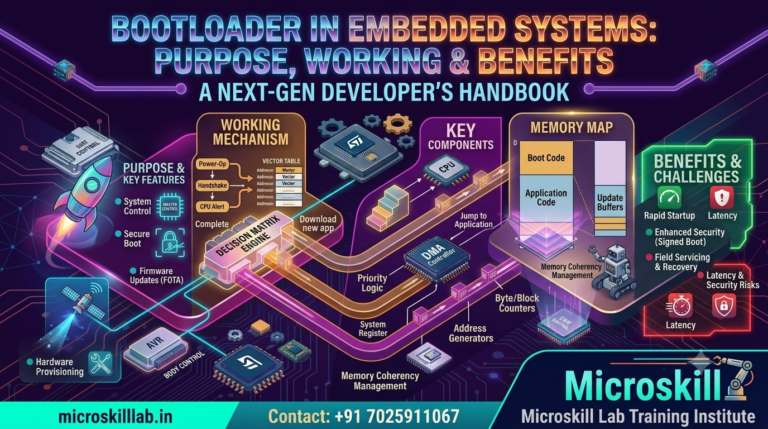
A bootloader in embedded systems is a small program that runs first at power-on, preparing the hardware and loading the main firmware before handing control to your application. For embedded developers across Bangalore and India, this program governs how firmware updates, secure boot, and recovery behave on ARM and other architectures. At Microskill Lab Training Institute, our trainers treat it as a core skill for building production-grade embedded software, and this guide explains its purpose and working.
⚡ Key Takeaways
- You will understand exactly what a bootloader does during the embedded boot process.
- You will learn how bootloaders enable safe firmware update and field recovery.
- You will see how ARM microcontrollers and embedded Linux handle multi-stage booting.
- You will gain clarity on security features like secure boot and integrity checks.
- You will discover how these skills map to real embedded software roles in Bangalore.
- You will know how our hands-on curriculum builds this expertise through live projects.
What Is a Bootloader in Embedded Systems?
A bootloader is the first code a microcontroller executes after reset, sitting between the hardware and your application firmware. Its job is to initialise essential peripherals, set up memory, and then locate and launch the main embedded software. Without this program, a chip would have no structured way to start a complex application reliably.
The bootloader lives in a protected region of flash memory that the application usually cannot overwrite. This separation matters because it lets a device recover even when the main firmware becomes corrupted. Our trainers stress this design principle in every embedded module we teach.
Why Embedded Systems Need a Dedicated Boot Program
Every reliable product needs a predictable startup path, and the bootloader provides exactly that. It guarantees the processor reaches a known state before user code runs, which reduces field failures. For teams shipping devices across Karnataka and Tamil Nadu, this reliability directly protects brand reputation.
A dedicated boot program also decouples firmware from the update mechanism itself. This means a device can accept new firmware without a programmer or physical access. We build this concept into our Embedded Systems Pro Programme from the very first week.
Who Should Learn Bootloader Concepts
Bootloader knowledge suits engineering freshers from ECE, EEE, and CSE backgrounds who want strong embedded fundamentals. It also serves working developers moving from application code into low-level firmware roles. Career changers targeting Bangalore product companies benefit greatly from this specialisation.
Many learners in Kerala, Andhra Pradesh, and Pondicherry join us specifically to fill this gap. Our curriculum assumes only basic C knowledge and builds the rest through practice. This inclusive design has helped a wide range of students grow into confident embedded engineers.
How the Bootloader Works in the Boot Process
The boot process begins the instant power reaches the microcontroller and the reset vector points execution to the loader. This code configures clocks, initialises RAM, and checks whether valid application firmware exists in flash. If the firmware passes its checks, the bootloader jumps to the application entry point.
On ARM Cortex-M devices, the vector table location determines where execution starts after reset. The bootloader relocates this table so the application controls interrupts once it takes over. Our trainers demonstrate this handoff live on real development boards during every batch.
Single-Stage Versus Multi-Stage Booting
Simple microcontrollers often use a single-stage loader that loads one application directly. This approach is compact and fast, which suits small IoT sensor nodes well. We cover this model early so students grasp the fundamentals before adding complexity.
Larger systems, especially those running embedded Linux, use multi-stage booting instead. A primary loader initialises DRAM, then a secondary loader such as U-Boot loads the kernel. Our Embedded Linux Development course walks learners through this full chain on ARM hardware.
The Role of Memory and the Reset Vector
Memory layout planning is central to any working loader design. The developer must reserve flash for the loader, the application, and often a configuration area. Overlapping these regions is a common mistake we help students avoid through guided labs.
The reset vector is the fixed address the processor reads first at startup. Getting this mapping wrong prevents the chip from booting at all, which frustrates many beginners. We dedicate focused sessions to linker scripts and memory maps so this becomes second nature.
Firmware Update and Field Recovery
One of the strongest reasons to master bootloaders is enabling remote firmware update. A well-designed loader can receive new embedded software over UART, USB, CAN, or a network link. This capability lets companies patch deployed devices without costly site visits.
Field recovery is the safety net that keeps a botched update from bricking a product. If a new image fails validation, the loader keeps the previous working firmware active. Our trainers show learners how to build this fail-safe logic step by step.
Over-the-Air Updates for Connected Devices
Connected products increasingly rely on over-the-air, or OTA, firmware delivery. The loader coordinates downloading, verifying, and swapping images while the device stays usable. This skill is highly valued in Bangalore’s growing IoT product sector.
Companies building smart meters and industrial sensors across Manyata Tech Park depend on robust OTA pipelines. We connect boot theory to these real deployment patterns in class. Learners finish able to reason about update safety on genuine hardware.
Dual-Bank and A/B Update Strategies
Modern designs often use two firmware slots, commonly called A/B or dual-bank updates. The loader writes the new image to the inactive slot while the current one keeps running. After a successful check, it switches the active slot on the next reboot.
This strategy almost eliminates the risk of a failed update disabling a device. Many Electronic City product teams treat it as a baseline requirement now. Our hands-on labs let students implement a simplified A/B scheme themselves.
Security and Trust in the Boot Chain
Security starts at the very first instruction the processor runs, which makes the boot code critical. A compromised loader can defeat every protection layered above it in the application. This is why secure boot has become a standard expectation in serious embedded software.
Secure boot verifies a cryptographic signature on the firmware before allowing it to run. If the signature check fails, the loader refuses to launch the untrusted image. Our curriculum introduces these concepts using accessible, practical examples on ARM chips.
Secure Boot and Firmware Signing
Firmware signing links each image to a private key held only by the manufacturer. The loader stores the matching public key and validates every image against it. This chain of trust prevents attackers from loading modified or malicious firmware.
We teach the principles of signing and verification without assuming a cryptography background. Students learn why key management matters as much as the algorithm itself. This awareness sets our graduates apart in security-conscious Bangalore product teams.
Preventing Rollback and Tamper Attacks
Attackers sometimes try to install older, vulnerable firmware to reopen fixed flaws. Anti-rollback protection lets the loader reject images below a minimum version. We explain how version counters and secure storage make this enforcement reliable.
Tamper detection adds another layer by watching for physical or logical interference. A careful boot design can lock down debug ports and sensitive memory regions. Our trainers frame these defences around realistic threat models learners can understand.
Build production-ready embedded skills with trainers who ship real firmware, not just slides. Our Bangalore-based curriculum turns bootloader theory into hands-on capability across ARM, IoT, and Linux systems. Enrol in the Embedded Systems Pro Programme →
Bootloader Types Compared for Embedded Developers
Choosing the right boot approach depends on your device class and update needs. Small microcontroller projects favour lean custom loaders, while Linux systems adopt full frameworks. Understanding these trade-offs helps developers design maintainable products.
We guide learners through this decision with clear criteria rather than rigid rules. Each project in our labs asks students to justify their loader choice. This reasoning skill matters as much as the code itself in professional work.
Custom Versus Off-the-Shelf Loaders
A custom loader gives full control over size, features, and boot timing. It suits constrained IoT nodes where every kilobyte of flash counts. Our PIC Microcontroller Programming course covers writing compact loaders from scratch.
Off-the-shelf loaders like U-Boot bring rich features and broad hardware support. They save time on complex ARM platforms running embedded Linux. We help students weigh maintenance effort against development speed for each scenario.
Comparison Table: Common Bootloader Approaches
The table below summarises how three common approaches differ in practice.
| Approach | Best For | Update Support | Complexity |
|---|---|---|---|
| Custom minimal loader | Small MCU and IoT nodes | UART or CAN firmware update | Low |
| Feature-rich MCU loader | Mid-range ARM products | OTA and A/B updates | Medium |
| U-Boot on embedded Linux | Gateways and rich devices | Network and storage boot | High |
Learners use this framework to match tools to real project constraints. Our trainers reinforce it through repeated hands-on practice.
Career Scope for Embedded Firmware Skills in Bangalore
Strong firmware and boot-process skills open doors across India’s embedded industry. Bangalore remains the country’s largest hub for product engineering and electronics R&D. Companies such as Bosch, Wipro, and L&T actively hire for low-level firmware roles.
Demand extends well beyond Bangalore into Hyderabad, Chennai, and Kochi product teams. Engineers who understand the boot process and secure update pipelines stand out clearly. We align our curriculum with these hiring expectations through continuous industry feedback.
Roles and Salary Benchmarks in INR
Firmware and embedded roles reward specialised low-level knowledge with competitive pay. The following indicative ranges reflect the Bangalore market and require verification before publication.
- Embedded firmware engineer (fresher): ₹4–7 LPA (indicative, verify)
- Embedded software engineer (mid-level): ₹8–16 LPA (indicative, verify)
- Firmware or platform lead: ₹18–30 LPA (indicative, verify)
These figures shift with company tier, skills, and demand. We coach learners to target the right band with a strong project portfolio.
How Our Curriculum Builds Job-Ready Skills
Our teaching centres on live projects rather than passive lectures alone. Students flash real boards, debug boot failures, and implement update logic themselves. This experience mirrors the daily work of a professional embedded developer.
We also weave career guidance into every batch through mock interviews and portfolio reviews. Learners join us from across Telangana and Tamil Nadu for this practical focus. Explore our full Electronics Fundamentals course to build the base these roles need.
How to Start Learning Bootloader Development
Beginning your bootloader journey needs a clear, structured path rather than scattered tutorials. Start with solid C and microcontroller basics before touching low-level boot code. A guided programme shortens this curve significantly for most learners.
Hands-on practice on real hardware is what turns theory into durable skill. We provide boards, tooling, and mentor support throughout every module. This structure has helped many South India learners transition into embedded careers.
Prerequisites and Learning Path
The right foundation makes advanced boot topics far easier to absorb. Learners typically need a few core building blocks before starting.
- Comfort with C programming and pointers
- Basic understanding of microcontroller peripherals
- Familiarity with flashing and debugging tools
- Willingness to work hands-on with real boards
We assess each learner and fill gaps early so nobody falls behind. This tailored approach keeps our batches engaged and productive.
Enrol and Talk to Our Team
Choosing the right institute shapes how quickly you become job-ready. We combine experienced trainers, real hardware, and steady mentorship in one programme. Learners across Karnataka and Kerala consistently value this practical model.
If you are ready to build serious embedded software skills, we would like to help. Reach out through our contact and enquiry page to discuss batches and goals. Our team will guide you toward the right starting point for your background.
Frequently Asked Questions
What is the main purpose of a bootloader in embedded systems?
The main purpose is to prepare the hardware at startup and load the application firmware safely. It also enables firmware update and recovery when the main image fails. This makes it foundational to reliable embedded software.
Is a bootloader needed on every microcontroller?
Not every project needs a custom loader, but most production devices benefit from one. Simple learning boards can run application code directly without a loader. Field-updatable products almost always include one for safety.
How does a bootloader relate to embedded Linux?
On embedded Linux systems, a multi-stage loader such as U-Boot initialises hardware and loads the kernel. It handles DRAM setup, device trees, and boot arguments. This differs from the lean loaders used on bare-metal microcontrollers.
Can I learn bootloader development as a fresher in Bangalore?
Yes, freshers can learn bootloader development with the right guided path and hands-on practice. Our trainers start from C and microcontroller basics before advancing to boot code. Many freshers across India build these skills successfully with us.