
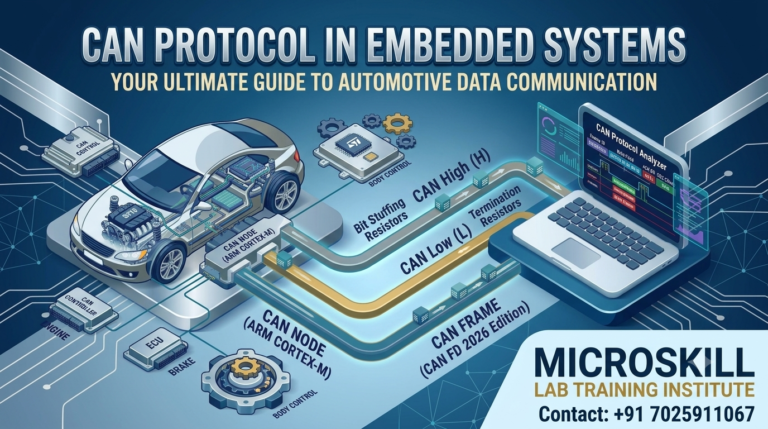
The CAN protocol is a robust serial communication standard that lets microcontrollers and electronic control units exchange data without a host computer. Automotive and embedded engineers across Bangalore, Karnataka, and wider India rely on the CAN bus to connect sensors, actuators, and control units inside vehicles, industrial machines, and IoT systems. If you design automotive embedded systems, understanding how CAN handles arbitration, error detection, and real-time messaging is essential. This guide from our trainers at Microskill Lab Training Institute explains CAN features, working, and applications with practical depth. We built it for freshers and working professionals who want job-ready embedded skills.
⚡ Key Takeaways
- You will understand how the CAN protocol moves data reliably between electronic control units without a central host.
- You will learn the CAN bus physical layer, message frames, and bit-level arbitration that prevents data collisions.
- You will see why automotive embedded systems in India depend on CAN for engine, braking, and comfort control.
- You will connect CAN knowledge to real careers in Bangalore’s automotive and industrial automation sector.
- You will discover how our hands-on curriculum turns protocol theory into deployable embedded projects.
What Is the CAN Protocol in Embedded Systems?
The CAN protocol, short for Controller Area Network, is a message-based serial communication standard originally developed by Bosch for vehicles. It allows multiple microcontrollers and electronic control units to talk over a shared two-wire bus without a master device coordinating traffic. Every node can broadcast, and every node decides which messages to accept based on identifiers. This decentralised design makes the CAN bus dependable even when individual nodes fail.
Who Should Learn the CAN Bus
Automotive and embedded engineers form the core audience for CAN skills, but the reach is wider. Freshers from ECE, EEE, and CSE backgrounds across Karnataka, Kerala, Tamil Nadu, and Andhra Pradesh find CAN a strong entry point into vehicle electronics. Working developers moving into industrial automation also benefit, since CAN appears in factory robots and medical equipment. Our trainers structure lessons so beginners and career changers can both keep pace. You can build this foundation through our Embedded Systems Pro Programme.
Where CAN Fits Among Communication Protocols
CAN is one of several communication protocols an embedded engineer must know, alongside UART, SPI, and I2C. Unlike those short-range options, CAN is designed for noisy, long-distance environments such as a car chassis. It trades raw speed for reliability, priority handling, and fault tolerance. Understanding these trade-offs helps you pick the right protocol for each design. Our Electronics Fundamentals course lays this groundwork before you specialise.
How the CAN Bus Works at the Signal Level
The CAN bus uses two wires, CAN High and CAN Low, that carry differential signals. This differential approach cancels electrical noise, which matters greatly inside a vehicle full of motors and ignition systems. A dominant bit pulls the lines apart in voltage, while a recessive bit lets them settle together. Nodes read the difference rather than absolute voltage, so interference affects both wires equally and cancels out. This is why CAN survives harsh automotive and industrial conditions.
Bit Arbitration and Message Priority
When two nodes transmit at once, CAN resolves the clash through non-destructive bitwise arbitration. Each message carries an identifier, and lower identifier values win priority automatically. The losing node stops and retries later without any data being corrupted or lost. This mechanism guarantees that urgent messages, such as a braking signal, always reach the bus first. Our trainers demonstrate arbitration live using oscilloscopes so learners see the theory in action.
Error Detection and Fault Confinement
CAN includes five layered error-checking methods, including cyclic redundancy checks and frame acknowledgement. When a node detects repeated faults, it moves itself into an error-passive or bus-off state to protect the network. This fault confinement keeps one broken node from flooding the entire bus. For safety-critical automotive embedded systems, this behaviour is invaluable. We cover error handling in depth within our Embedded Systems Pro Programme.
CAN Frame Structure and Message Types
Every CAN message travels inside a structured frame with defined fields. The frame includes a start bit, an arbitration identifier, a control field, a data field of up to eight bytes, a CRC field, and an acknowledgement slot. This tight structure keeps overhead low while guaranteeing integrity. Engineers who understand each field can debug bus traffic quickly. Frame literacy separates a confident embedded developer from a guessing one.
Standard and Extended Frames
CAN offers two frame formats to suit different systems. The standard frame uses an eleven-bit identifier, giving room for 2,048 message types. The extended frame uses a twenty-nine-bit identifier for complex networks with many nodes, common in heavy vehicles and industrial automation. Choosing the right format affects bus efficiency and future scalability. Our curriculum walks learners through both formats with hands-on decoding exercises.
Data, Remote, and Error Frames
Beyond the data frame, CAN uses remote frames to request information and error frames to flag problems. Overload frames add delay when a node needs more processing time. Knowing when each frame type appears helps engineers interpret real bus logs. This skill is central to diagnosing faults in a working vehicle. You can practise this analysis inside our Arduino Programming sessions that introduce serial buses.
Why CAN Matters for Automotive Careers in Bangalore
Bangalore anchors India’s automotive electronics and R&D ecosystem, from Electronic City to Whitefield. Global suppliers and vehicle makers run engineering centres here that hire embedded talent fluent in CAN. As electric vehicles and ADAS features expand, demand for CAN-literate engineers keeps climbing. Karnataka’s strong IT and ESDM base makes the city a natural launchpad. Learning CAN early positions you for this growing market.
Salary Benchmarks and Roles in India
Embedded engineers who know CAN and automotive protocols command competitive pay in Bangalore. Entry-level roles often start around ₹4–7 LPA, while experienced protocol specialists can reach ₹12–20 LPA as of 2026. (Indicative ranges — verify against current market data before publication.) Roles include embedded firmware engineer, AUTOSAR developer, and validation engineer. These figures reflect the premium placed on real hardware experience.
Industries Hiring CAN Engineers
CAN skills open doors well beyond passenger cars. Commercial vehicles, agricultural machinery, medical devices, and factory automation all use the protocol. This breadth protects your career against slowdowns in any single sector. Firms across automotive, aerospace, and industrial automation actively seek this expertise. Our PIC Microcontroller Programming course builds the microcontroller base these roles demand.
Ready to build real automotive embedded skills? Learn CAN, SPI, and RTOS from trainers with live-project experience, then graduate with a deployable capstone. Our hands-on labs turn protocol theory into job-ready confidence for Bangalore’s hiring market. Explore the Embedded Systems Pro Programme →
CAN in Industrial Automation and IoT
CAN moved beyond cars long ago and now underpins many industrial systems. Higher-layer protocols such as CANopen and DeviceNet build on the base CAN standard for factory networks. These extensions add device profiles and configuration tools suited to automation. Engineers who grasp base CAN adapt to these layers quickly. This versatility makes CAN a lasting skill in a changing field.
CAN Meets the Internet of Things
Modern IoT gateways often bridge CAN networks to cloud platforms over Wi-Fi or cellular links. A factory machine can stream CAN sensor data upward for predictive maintenance and analytics. This convergence of embedded buses and connectivity defines much of Industry 4.0. Understanding both sides makes you valuable to Indian manufacturers modernising their plants. Our IoT Programme connects these embedded and cloud layers.
ARM Microcontrollers and CAN Peripherals
Most modern automotive microcontrollers use ARM Cortex cores with built-in CAN controllers. These integrated peripherals handle framing and error checking in hardware, freeing the processor for application logic. Learning to configure ARM CAN peripherals is a core industry skill. It bridges low-level protocol theory with practical firmware development. Our trainers guide learners through register-level configuration on real boards.
Building CAN Skills at Microskill Lab
Turning CAN theory into employable skill requires structured, hands-on practice. Our curriculum starts with electronics fundamentals, then moves through microcontrollers, serial protocols, and full CAN networks. Learners wire real nodes, capture bus traffic, and debug faults on physical hardware. This experience-first approach reflects what employers in Manyata Tech Park and Electronic City expect. We designed the path for both freshers and upskilling professionals.
Our Hands-On Curriculum Approach
We believe engineers learn protocols by building them, not just reading about them. Each module pairs concept lessons with lab exercises on genuine development boards. Learners progress from blinking an LED to running multi-node CAN communication. This steady build of complexity keeps motivation and retention high. You can begin with our Embedded Systems Pro Programme and specialise from there.
Eligibility and How to Enrol
Our embedded courses welcome a broad range of learners across South India. Typical eligibility includes:
- A diploma or degree in ECE, EEE, CSE, or a related engineering branch.
- Basic familiarity with C programming, which we reinforce during the course.
- A genuine interest in hardware, vehicles, or industrial systems.
- No prior CAN experience required, since we start from fundamentals.
Getting started is straightforward, and our team guides every step:
- Reach out through our enquiry form to discuss your goals.
- Attend a counselling session to pick the right course and batch.
- Confirm your seat and receive the pre-course preparation material.
To begin, simply contact our admissions team for batch dates and guidance.
Choosing the Right Embedded Training in Bangalore
Not every embedded course delivers real protocol experience, so choose carefully. Look for hands-on labs, current curriculum, and trainers with genuine industry background. Placement support and live projects matter far more than glossy marketing. The table below contrasts three common learning paths for CAN and embedded skills. Use it to judge where your time and money go furthest.
Structured Training Versus Self-Learning
The comparison below highlights why guided, hands-on training often outperforms going it alone.
Comparison: Ways to Learn CAN and Embedded Systems
| Factor | Self-Learning | Generic Online Course | Microskill Lab Training |
|---|---|---|---|
| Hardware practice | Rare, self-funded | Simulated only | Real boards and CAN nodes |
| Trainer support | None | Limited forums | Direct mentor access |
| Live projects | Uncommon | Occasional | Capstone included |
| Local hiring links | None | Weak | Bangalore-focused |
| Structured path | Self-built | Fixed but generic | Guided and updated |
Questions to Ask Before Enrolling
Before you commit to any institute, ask a few pointed questions. Confirm whether you get physical hardware time, not just simulations. Ask about class sizes, trainer experience, and post-course support. A quality provider answers these openly and specifically. Compare course tiers carefully, as shown below.
Comparison: Beginner Versus Advanced Embedded Tracks
| Aspect | Beginner Track | Advanced Track |
|---|---|---|
| Focus | Fundamentals and C | CAN, RTOS, ARM firmware |
| Duration | Shorter | Longer, project-heavy |
| Ideal learner | Fresher | Working professional |
| Outcome | Solid basics | Job-ready specialisation |
Frequently Asked Questions
Is the CAN protocol difficult to learn for beginners?
CAN is very approachable when taught in the right order. If you understand basic electronics and C programming, the protocol logic follows naturally. Our trainers start with fundamentals before introducing arbitration and framing. Most learners grasp practical CAN within a few structured lab sessions.
Do I need automotive experience to learn CAN?
No automotive background is required to start learning CAN. The protocol appears in industrial automation, medical devices, and IoT systems too. What matters is a willingness to work with real hardware. Our curriculum builds the needed context from the ground up.
Which microcontrollers should I use to practise CAN?
ARM Cortex-based boards with built-in CAN controllers are ideal for practice. Many popular development boards include CAN peripherals suited to learning. Our labs provide the right hardware so you need not buy everything yourself. We guide you through setup and configuration step by step.
How long does it take to become job-ready with CAN skills?
Timelines vary with your starting point and effort. Freshers usually need a few focused months covering electronics, microcontrollers, and protocols. Working professionals with a base can specialise faster. Our structured path and live projects accelerate genuine readiness.