
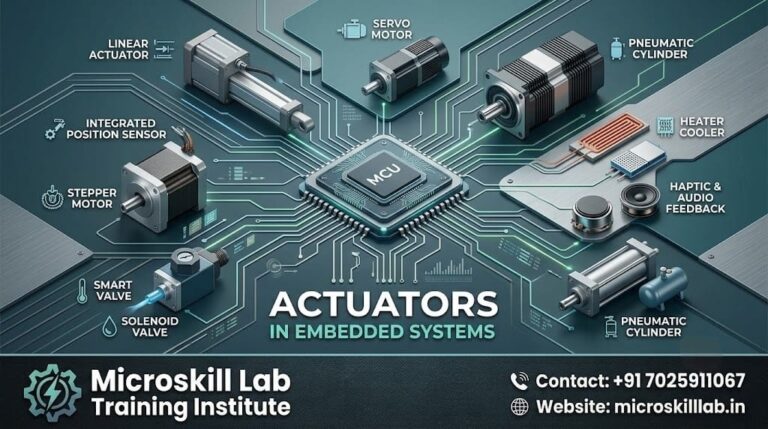
Actuators in embedded systems are the components that convert electrical signals from a microcontroller into physical action, such as motion, force, or heat. For engineering students in Bangalore and across India, understanding actuators is essential because they form the output side of every automation and IoT project you will build. Whether you are studying at a college in Karnataka or upskilling for an embedded systems role, actuators are where your code finally touches the real world. This guide explains the main actuator types, how they interface with microcontrollers, and how to master them through hands-on practice.
At Microskill Lab Training Institute, our trainers have watched hundreds of students grasp sensors quickly, then struggle when it is time to make a motor spin or a valve open. This guide closes that gap. We walk through motors, relays, and servo motors with the same practical, project-first approach our curriculum uses in our Electronic City and Whitefield batches.
⚡ Key Takeaways
- You will learn what actuators are and how they differ from sensors in an embedded system.
- You will understand the main actuator families: DC motors, servo motors, stepper motors, relays, and solenoids.
- You will see how microcontrollers drive actuators safely using drivers, PWM, and isolation.
- You will discover the real career value of actuator skills for embedded and IoT roles across India.
- You will get a clear path to hands-on practice through structured, project-based training.
What Are Actuators in Embedded Systems?
An actuator is any device that takes a control signal and produces a physical output. In an embedded system, the microcontroller reads inputs from sensors, runs logic, and then commands actuators to act on the environment. Sensors are the input side; actuators are the output side. Together they close the loop that makes automation possible.
The signal a microcontroller produces is usually weak, often just a few milliamps at 3.3V or 5V. Actuators, by contrast, frequently need far more current or a different voltage entirely. This mismatch is why driver circuits sit between the controller and the actuator in almost every real design.
How Actuators Differ From Sensors
Students often blur the line between the two because both connect to microcontroller pins. A sensor converts a physical quantity into a readable electrical signal, while an actuator turns an electrical command into physical work. In our Embedded Systems Pro Programme, we teach this input-process-output model early so learners can architect projects with confidence. Mastering the distinction helps you debug faster, because you immediately know whether a fault sits on the sensing side or the acting side.
The Role of Actuators in Automation and IoT
Actuators are what make an IoT system useful rather than merely observant. A smart irrigation controller does not just measure soil moisture; it opens a valve. A factory line in a Bangalore manufacturing unit does not just count parts; it moves them. Our IoT programme builds every capstone around this action-oriented thinking, so students see actuators as the point of the whole exercise.
Types of Actuators Every Student Must Know
Embedded projects across India rely on a handful of actuator families. Knowing when to reach for each one is a skill that separates a hobbyist from a job-ready engineer. Our Arduino programming course introduces these families through small, testable builds rather than theory alone.
The most common categories are electric motors, relays, solenoids, and specialised motion devices like servos and steppers. Each has a distinct control method and a distinct set of trade-offs in cost, precision, and power. We map these trade-offs explicitly in our Arduino programming course so students choose deliberately rather than by habit. This deliberate selection mindset is one of the clearest markers of an engineer who is ready for industry work.
Electric Motors: DC, Servo, and Stepper
DC motors offer simple, continuous rotation and are driven with PWM for speed control, making them the workhorse of beginner robotics. Servo motors add a feedback loop and internal gearing, letting you command a precise angle, which is ideal for robotic arms and steering. Stepper motors move in discrete steps, giving open-loop positional accuracy that suits 3D printers and CNC machines built in student labs across Karnataka. We introduce all three in ascending order of complexity, so learners build intuition for torque, speed, and control before combining them in a capstone.
Relays and Solenoids
A relay is an electrically operated switch that lets a low-power microcontroller signal control a high-power load like a pump or a light. A solenoid converts current into a short linear push or pull, used in door locks and fluid valves. Because both switch heavy loads, our trainers emphasise flyback diodes and isolation from day one to protect the controller. Our PIC microcontroller programming programme reinforces these same principles, treating safe load switching as a recurring theme throughout.
How Microcontrollers Drive Actuators Safely
A microcontroller pin cannot power a motor directly without risking permanent damage. The pin supplies too little current and no protection against the voltage spikes that inductive loads generate. Every reliable embedded design therefore places a driver stage between the logic and the load.
This is one of the most common failure points we see in student projects. Learners wire a motor straight to an Arduino pin, the board resets or dies, and the lesson lands hard. Our curriculum front-loads this topic so nobody learns it by burning hardware.
Motor Drivers, Transistors, and H-Bridges
A transistor or MOSFET acts as a switch that handles the actuator’s current while the microcontroller only controls the transistor’s gate. An H-bridge, such as the L298N or DRV8833, lets you reverse a DC motor’s direction and is standard in our robotics builds. We teach students to read driver datasheets so they can size components for their own designs rather than copying a tutorial blindly. This datasheet literacy is a quietly powerful skill, because it lets a graduate work with unfamiliar parts long after the course ends.
PWM Control and Protection Circuits
Pulse Width Modulation switches power on and off rapidly to control motor speed or servo position without wasting energy as heat. Flyback diodes, opto-isolators, and separate power rails protect the sensitive logic side from the noisy actuator side. These protection habits are exactly what industrial employers in Bangalore expect from a competent embedded engineer. In our labs, students measure PWM signals on an oscilloscope so the abstract duty-cycle concept becomes something they can see, adjust, and truly understand.
Choosing the Right Actuator for Your Project
Selecting an actuator is an engineering decision, not a default. The right choice depends on the motion type you need, the precision required, the available power, and the budget. Our project mentors guide students through this decision on every build so it becomes second nature.
A quick comparison helps clarify when each type earns its place in a design. The table below summarises the trade-offs our students learn to weigh in the electronics fundamentals stage.
Comparison of Common Actuator Types
Table: Common Actuators Compared
| Actuator | Motion | Precision | Typical Use | Control Method |
|---|---|---|---|---|
| DC Motor | Continuous rotation | Low | Fans, wheels | PWM + driver |
| Servo Motor | Angular (0–180°) | High | Robotic arms, steering | PWM signal |
| Stepper Motor | Stepped rotation | Very high | 3D printers, CNC | Step/direction driver |
| Relay | On/off switching | N/A | High-power loads | Digital pin + driver |
| Solenoid | Linear push/pull | Low | Locks, valves | Transistor + diode |
Matching Actuators to Real Project Goals
Beyond the table, context decides everything. A battery-powered wearable favours low-current actuators, while a mains-driven appliance can afford a relay and a heftier motor. In our PCB designing programme, students lay out boards that account for these actuator current demands from the very first schematic. Trace width, connector choice, and thermal relief all flow from the actuator decision, so getting it right early saves costly board revisions later.
Ready to build real hardware, not just read about it? Master motors, servos, and relays through guided, project-based labs led by industry trainers. Our curriculum takes you from your first blinking LED to a fully actuated capstone. Explore the Embedded Systems Pro Programme →
Actuators in Real IoT and Automation Projects
Theory sticks when students see actuators inside complete systems. Across our batches in Bangalore, learners build projects where sensors, logic, and actuators work as one. This systems view is what employers across Karnataka, Kerala, and Tamil Nadu genuinely value.
Real projects also teach the messy parts textbooks skip: power budgeting, noise, mechanical mounting, and thermal limits. We deliberately include these challenges so graduates arrive at work already familiar with them.
Home Automation and Smart Devices
A smart home node might read a temperature sensor and switch a fan or heater through a relay. Students in our IoT programme wire exactly these systems, connecting cloud dashboards to physical actuators. This mirrors the connected-device work happening in tech parks like Manyata and Whitefield. Learners finish these builds able to explain the full journey of a command, from a phone tap to a relay click, which is a compelling story in any job interview.
Industrial and Robotics Applications
Industrial automation leans heavily on steppers, servos, and solenoids for precise, repeatable motion. Robotics capstones in our labs combine several actuators under one controller, coordinated in real time. Learners who advance to our embedded Linux development track can push this into higher-level control on single-board computers. That step opens doors to complex robotics and industrial roles where actuator coordination happens alongside networking and data processing.
Career Scope: Actuator and Embedded Skills in India
Embedded and IoT hiring in India remains strong, and actuator fluency is a core expectation for hardware-facing roles. Employers want engineers who can make systems act, not just sense. Our placement-focused training is built around exactly these job-ready competencies.
The demand spans product companies, EV startups, industrial automation firms, and robotics ventures clustered around Bangalore, with further hiring across Kerala, Tamil Nadu, Telangana, Andhra Pradesh, and Pondicherry. Freshers from ECE, EEE, and mechatronics backgrounds are especially well positioned when they can demonstrate real actuator projects. A portfolio that shows a working motor-control build often speaks louder than a transcript, because it proves you can deliver.
In-Demand Roles and Skills
Common roles include the following:
- Embedded Systems Engineer working on motor control and firmware
- IoT Developer integrating actuators with cloud platforms
- Robotics Engineer coordinating multi-actuator motion
- Automation Engineer for industrial control systems
- Firmware Developer specialising in real-time actuator drivers
Salary Benchmarks in Bangalore
Indicative figures suggest embedded engineers in Bangalore earn roughly ₹4–8 LPA at entry level, rising toward ₹12–20 LPA with experience in motor control and robotics, as of 2026. (Salary ranges are indicative and should be verified against current market data before relying on them.) Skills in motor drivers, PWM, and real-time control tend to command the upper end. Our trainers help students target these specialisations deliberately.
How to Learn Actuators the Right Way
Reading about actuators is not the same as controlling one. The fastest route to competence is repeated, hands-on building with real motors, drivers, and microcontrollers. Our entire teaching model is structured around this principle.
Structured guidance also matters, because self-learners often skip the protection and driver fundamentals that prevent hardware damage. A mentored path saves months of trial and error. That is precisely what our project-based batches provide.
Self-Study Versus Structured Training
Table: Self-Study vs Structured Training for Actuators
| Factor | Self-Study | Structured Training |
|---|---|---|
| Hardware access | Buy your own, trial and error | Lab equipment provided |
| Driver and safety basics | Often skipped | Taught upfront |
| Project feedback | None | Mentor-reviewed |
| Career support | None | Placement-focused guidance |
| Time to competence | Long, uneven | Structured and faster |
Getting Started With Microskill Lab
The best first step is a foundation in electronics, then Arduino, then a full embedded or IoT track. Students can begin with our electronics fundamentals course and progress toward advanced actuator and robotics work. To map a path that fits your background, reach out through our enquiry page and speak with a mentor. A short conversation about your goals, whether that is a product company role or a robotics startup, lets us recommend the right sequence rather than a generic one.
Frequently Asked Questions
What is an actuator in an embedded system?
An actuator is a device that converts a microcontroller’s electrical signal into physical action such as rotation, linear motion, or switching. It is the output side of an embedded system, working opposite to sensors. Common examples include motors, servos, relays, and solenoids.
Can I connect a motor directly to a microcontroller pin?
No, you should not connect most motors directly to a microcontroller pin. The pin cannot supply enough current and has no protection against voltage spikes from inductive loads. You need a driver circuit using a transistor, MOSFET, or H-bridge, plus a flyback diode.
Which actuator is best for precise positioning?
Servo motors and stepper motors are best for precise positioning. Servos hold a commanded angle using internal feedback, while steppers move in exact discrete steps. The right choice depends on whether you need holding torque, speed, or open-loop repeatability.
Do I need to know actuators for an IoT career in India?
Yes, actuator knowledge is important for most IoT and embedded roles in India. Employers expect engineers to build systems that act on the world, not just collect data. Demonstrating real actuator projects strengthens your profile significantly.