
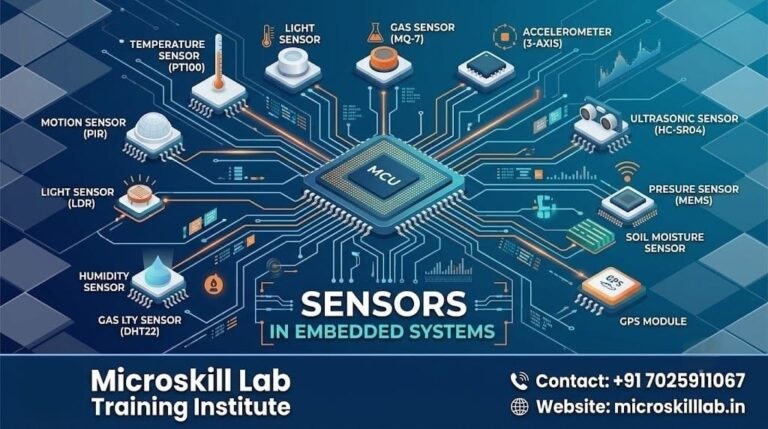
Sensors in embedded systems are electronic components that detect physical conditions like temperature, motion, light, or pressure and convert them into signals a microcontroller can read. For students and IoT learners in Bangalore and across India, understanding sensors is the foundation of building real embedded projects. At Microskill Lab Training Institute, our trainers teach sensor interfacing through hands-on labs, so you learn how a temperature sensor, motion sensor, or gas sensor actually talks to hardware. This guide explains sensor types, how they work, and where they are used in modern connected devices.
⚡ Key Takeaways
- You will understand what sensors in embedded systems are and why every IoT device depends on them.
- You will learn the main sensor types, including analog, digital, temperature, and motion sensors.
- You will see how sensor interfacing works with a microcontroller through ADC, I2C, and SPI.
- You will discover practical embedded projects that use real IoT sensors.
- You will get Bangalore salary benchmarks and career paths for embedded and IoT engineers.
- You will know how to choose a training path that builds genuine hardware skills.
What Are Sensors in Embedded Systems?
Sensors in embedded systems are input devices that measure a physical quantity and hand that data to a microcontroller for processing. They act as the “senses” of any embedded product, turning real-world events into readable electrical signals. Without sensors, a smart device would be blind to its environment, unable to react to heat, movement, light, or pressure. This is why every serious embedded and IoT curriculum, including ours, treats sensor knowledge as a core foundation.
The Role of Sensors in Modern Devices
Every connected product you use relies on sensors working quietly in the background. A fitness band reads your pulse, a smart AC senses room temperature, and a car airbag detects a sudden impact within milliseconds. Our curriculum shows students how these signals travel from a sensor into embedded hardware, a concept we cover deeply in our Embedded Systems Pro Programme. This grounding matters because India’s electronics manufacturing sector, backed by MeitY schemes, keeps expanding demand for engineers who genuinely understand sensors.
Analog Versus Digital Sensors
Sensors broadly fall into two families, and knowing the difference directly shapes how you write firmware. An analog sensor outputs a continuous voltage, such as an LM35 temperature sensor giving ten millivolts per degree Celsius. A digital sensor instead sends discrete data, often over I2C or SPI, like a DHT22 humidity and temperature module. Our trainers help students practise reading both types on real boards in our Bangalore labs, which builds practical confidence quickly.
How Sensors Work With a Microcontroller
A sensor is only useful when a microcontroller can read and interpret its output correctly. The microcontroller receives the incoming signal, converts it if needed, and then runs logic based on the measured value. This interaction sits at the heart of every embedded project, from a simple LED alarm to a full industrial monitoring system. Understanding it well is what lets you move from copying tutorials to designing your own reliable devices.
Signal Conversion and the ADC
Most microcontrollers cannot read analog voltage directly, so they use an Analog-to-Digital Converter, or ADC. The ADC turns a continuous voltage into a discrete number the processor can compare, store, and act upon. We teach learners to calculate ADC resolution and scale readings accurately, a skill reinforced in our Arduino Programming course. Getting this maths right is what separates a stable working prototype from a faulty one that fails during live demonstrations and college evaluations.
Communication Protocols for Sensors
Digital sensors talk to microcontrollers using standard communication protocols. The three you meet most often are I2C, SPI, and UART, each with its own speed, pin count, and wiring style. Our curriculum walks students through wiring a real sensor over I2C and then debugging it with a logic analyser when the readings look wrong. This protocol knowledge is exactly what Bangalore hardware firms look for when hiring embedded freshers from ECE, EEE, and CSE backgrounds.
Here is a quick comparison of the protocols you will use most:
Comparison: Common Sensor Communication Protocols
| Protocol | Wires | Typical Speed | Best For |
|---|---|---|---|
| I2C | 2 (SDA, SCL) | Up to 400 kHz | Multiple sensors on one bus |
| SPI | 4 (MOSI, MISO, SCK, CS) | Several MHz | Fast, single high-speed sensors |
| UART | 2 (TX, RX) | Configurable baud | Simple point-to-point links |
| Analog | 1 (signal) | Continuous | Basic sensors read via ADC |
Common Types of Sensors You Will Use
Embedded engineers work with a wide family of sensors, each suited to a specific measurement job. Choosing the right one depends on what you need to measure, the accuracy you require, and your project budget. Below are the sensor categories students meet most often in embedded and IoT projects across our labs. Getting familiar with these early makes later project work faster and far less confusing.
Temperature and Environmental Sensors
Temperature sensors are among the first components any beginner interfaces. The LM35, DHT11, and DS18B20 are popular choices in Indian student projects and low-cost hobby kits. Our trainers guide learners through reading a temperature sensor and displaying live values on an LCD, a classic first exercise in our labs. Environmental sensing also covers humidity, gas, and air-quality modules, which power many smart-city and agriculture ideas across Karnataka and neighbouring states.
Motion, Proximity, and Light Sensors
A motion sensor detects movement and sits at the centre of most security and home-automation projects. The PIR sensor, ultrasonic HC-SR04, and IR proximity modules are everyday tools in embedded coursework and student builds. Students combine these with a microcontroller to build automatic lights, distance meters, and obstacle-avoiding robots that impress in project reviews. Light sensors like the LDR add another useful layer, letting devices respond to changing brightness in real time.
Here are common sensor types embedded learners work with:
- Temperature sensors: LM35, DHT11, DS18B20
- Motion and proximity: PIR, HC-SR04 ultrasonic, IR modules
- Light and optical: LDR, photodiode, colour sensors
- Gas and air quality: MQ-2, MQ-135
- Pressure and force: BMP280, load cells
Sensor Interfacing: Connecting Hardware Correctly
Sensor interfacing is the practical skill of wiring a sensor to a microcontroller and reading it reliably. It combines hardware wiring, firmware code, and careful calibration into one connected workflow. Many student projects stumble at exactly this stage, which is why we give it heavy, repeated lab focus. Building real fluency here is what turns a nervous beginner into a confident embedded developer.
Wiring, Pull-Ups, and Power
Correct wiring is the first step, and small mistakes here cause the most frustration for new learners. Sensors need the right supply voltage, a solid ground connection, and often pull-up resistors on their data lines. Our trainers show students how to read a datasheet properly and wire a sensor safely on a breadboard before moving to a PCB. This attention to detail is what our PCB Designing course later builds on for clean, production-ready boards.
Reading Data in Firmware
Once wired, the sensor needs firmware to read, interpret, and act on its output. Learners write embedded C code to poll the sensor, convert raw values into real units, and trigger actions like alarms or logging. We guide students through debugging common problems such as noisy readings, timing errors, and incorrect scaling. Mastering this stage makes the leap into full IoT systems far smoother, a path we continue in our IoT Programme.
Ready to build real hardware skills? Learn sensor interfacing hands-on with boards, live projects, and expert mentors trusted by learners across South India. Our trainers take you from your first LED blink to a working IoT prototype. Explore the IoT Programme →
Real Embedded and IoT Projects Using Sensors
Sensors truly come alive when you build something real with them, and projects cement your learning. Practical work also gives you a portfolio, which recruiters in Bangalore value far more than theory alone. These project ideas range from beginner-friendly starters to advanced, cloud-connected IoT builds. Working through them in order is the fastest way to turn classroom knowledge into demonstrable skill.
Beginner Sensor Projects
Beginners should start with small, achievable builds that teach one core concept at a time. A digital thermometer, an automatic night lamp, or an ultrasonic distance-measuring device are excellent first steps. Our curriculum sequences these carefully so each project adds a single new skill without overwhelming the learner. Students often showcase these very builds in college mini-project submissions and early internship interviews.
Advanced IoT Sensor Projects
Once comfortable, learners move to cloud-connected IoT builds that closely mirror real industry work. A smart home monitor, an air-quality tracker, or a soil-moisture farming system make strong, resume-worthy capstone projects. These builds combine multiple sensors, a microcontroller, and wireless data upload to a live dashboard or mobile app. Such capstones, guided by our trainers, give students in Kerala, Tamil Nadu, and Andhra Pradesh a genuine edge during competitive placement drives.
Careers, Salaries, and Skills in Embedded Systems
Sensor and embedded skills open real career doors in India’s fast-growing electronics economy. Bangalore alone hosts hundreds of hardware, product, and IoT firms hiring both freshers and experienced engineers. Understanding this landscape early helps you plan your learning with a clear, motivating goal. It also tells you which skills to prioritise so your effort translates directly into hireable strengths.
Job Roles and Bangalore Salary Benchmarks
Embedded skills lead to roles such as embedded engineer, IoT developer, firmware engineer, and hardware test engineer. Freshers in Bangalore typically earn ₹3–6 LPA, while experienced embedded engineers can reach ₹8–18 LPA. These are indicative ranges only and should be verified against current market data before you rely on them. Companies across Manyata Tech Park, Electronic City, and Whitefield regularly recruit for these roles throughout the year.
Skills That Get You Hired
Recruiters look for a practical blend of hardware understanding and clean, reliable firmware coding. Strong candidates know sensor interfacing, embedded C programming, and at least one communication protocol in real depth. We help students build this exact profile step by step, and beginners often start with our Electronics Fundamentals course. Add a solid portfolio of working projects, and you quickly become a serious contender for embedded and IoT roles.
Skills that improve your hiring chances:
- Confident sensor interfacing across analog and digital types
- C and embedded C programming for microcontrollers
- Knowledge of I2C, SPI, and UART protocols
- A portfolio of two to three working hardware projects
- Basic PCB and circuit-reading ability
How to Learn Sensors and Embedded Systems in Bangalore
Choosing the right learning path decides how quickly you gain real, job-ready sensor skills. Theory-heavy courses often leave practical gaps that only genuine hands-on hardware practice can fill. This section helps you compare your main options honestly and without hype. The right fit depends on your budget, your schedule, and how much guided support you need to stay on track.
Self-Study Versus Structured Training
Self-study is a perfectly valid start, with free tutorials and inexpensive sensor kits widely available online. However, learners often stall badly when hardware misbehaves and no mentor is nearby to explain why. Structured training gives you guided labs, peer learning, and quick debugging support when a sensor simply refuses to work. The table below compares three common routes learners take when studying embedded sensors in India.
Comparison: Ways to Learn Embedded Sensors
| Factor | Self-Study | Generic Online Course | Microskill Lab Training |
|---|---|---|---|
| Hands-on hardware | Limited | Rare | Core focus |
| Mentor support | None | Slow | Direct and fast |
| Live projects | Self-arranged | Few | Guided capstones |
| Placement help | None | Minimal | Structured support |
| Local Bangalore context | None | None | Strong |
Enrolling at Microskill Lab
Enrolling is straightforward, and our team guides you to the right course for your current level. Beginners usually begin with electronics basics before advancing into the embedded and IoT tracks at a comfortable pace. You can ask about batch timings, fees, and project details directly on our contact page. Our advisors help learners across Karnataka, Telangana, and Pondicherry choose a path matched to their background and career goals.
Frequently Asked Questions
What are sensors in embedded systems?
Sensors in embedded systems are input devices that detect physical conditions and convert them into electrical signals for a microcontroller. They let embedded products sense temperature, motion, light, and more. Every IoT device depends on them to interact with the real world.
Do I need programming knowledge to learn sensor interfacing?
Basic programming helps, but complete beginners can start with fundamentals first. Our trainers teach embedded C alongside sensor interfacing, so you build both skills together. Many students begin with no coding background and progress steadily.
Which sensors should a beginner learn first?
Beginners should start with a temperature sensor like the LM35 and a motion sensor like the PIR. These are cheap, forgiving, and teach core concepts clearly. From there, learners move to ultrasonic, gas, and IoT-connected sensors.
Are embedded and IoT skills in demand in Bangalore?
Yes, Bangalore has strong demand for embedded and IoT engineers across its hardware and product firms. Roles like embedded engineer and IoT developer are actively hired. Solid sensor and firmware skills make freshers competitive in these drives.