
How Embedded Systems Power IoT Devices: A Beginner’s Guide
Embedded systems power IoT devices by giving everyday objects the ability to sense, process, and act on data without human input. This tiny computing layer is what makes a device “smart” in the first place.
If you have ever wondered how a smart thermostat adjusts itself or how a fitness band tracks your heartbeat, the answer lies inside a small embedded system running quietly in the background of the device.
For learners in Bangalore and across India exploring careers in the Internet of Things, understanding this connection is the first real step toward building smart, connected products. This guide breaks down exactly how embedded hardware and software work together to bring IoT devices to life.
Whether you are an engineering student, a fresher exploring career options, or a working professional planning an upskilling move, this beginner-friendly breakdown will give you a clear mental model before you touch any hardware.
⚡ Key Takeaways
- Learn exactly how embedded systems act as the “brain” behind every IoT device
- Understand the role microcontrollers play in sensing, processing, and controlling data
- Get a clear breakdown of communication protocols like I2C, SPI, UART, and MQTT
- See real Bangalore industry examples of embedded IoT in action
- Compare embedded systems and IoT side by side to avoid common beginner confusion
- Discover a practical starting point for building your own IoT career
What Is IoT and Why Embedded Systems Matter
The Internet of Things, or IoT, refers to a network of physical devices that collect data through sensors and share it over the internet. These devices talk to each other, to mobile apps, and to cloud servers, creating systems that respond automatically to real-world conditions.
But IoT does not work on its own. Every smart device needs a small computing unit inside it to make sense of the data it collects before that data ever reaches the cloud. That unit is an embedded system, and it is the true starting point of any IoT product.
Defining IoT for Beginners
IoT devices range from smart bulbs and fitness trackers to industrial sensors monitoring machine health in a Whitefield manufacturing plant. Each device follows the same basic loop: sense, process, transmit.
Without an embedded system managing this loop, a device would just be a collection of disconnected hardware parts with no way to interpret what it is sensing. The embedded layer is what turns raw electrical signals into meaningful, actionable data.
Why the Embedded Layer Is the Real Engine of IoT
Cloud dashboards and mobile apps get most of the attention in IoT marketing, but the actual intelligence starts at the edge, inside the embedded system. It decides when to read a sensor, how to filter noisy data, and what to send over the network.
In our Embedded Systems Pro Programme, we teach learners to think from the hardware layer upward, because that is where IoT products actually come to life. Understanding this layer first makes every higher-level IoT concept easier to grasp later.
What Is an Embedded System? Core Building Blocks
An embedded system is a combination of hardware and software designed to perform one or a few dedicated functions, usually as part of a larger device. Unlike a general-purpose computer, it is built for a specific job and nothing else.
This focused design is exactly why embedded systems are efficient, low-power, and reliable enough to run inside millions of IoT devices deployed across homes, factories, and hospitals in India and beyond.
Hardware Components That Make Up an Embedded System
Every embedded system typically includes a microcontroller or microprocessor, memory, input sensors, output actuators, and a power supply circuit. These components are chosen carefully based on the product’s size, power budget, and performance needs.
A wearable fitness tracker, for example, uses a tiny low-power microcontroller and a compact battery, while an industrial monitoring unit may use a more powerful chip with a stable mains power supply. Component selection always follows the use case.
Sensors act as the system’s eyes and ears, converting physical signals like light, heat, or motion into electrical data, while actuators such as motors, relays, or buzzers translate decisions back into physical action.
Software That Brings the Hardware to Life
The software side includes firmware written in C or embedded C, and in more complex products, a real-time operating system to manage multiple tasks simultaneously. Firmware controls exactly how the hardware behaves at every clock cycle.
Bangalore-based product companies in Electronic City rely heavily on engineers who understand both layers, not just one. Strong embedded C skills combined with hardware knowledge remain one of the most requested skill combinations in local hiring.
How Microcontrollers Power IoT Devices
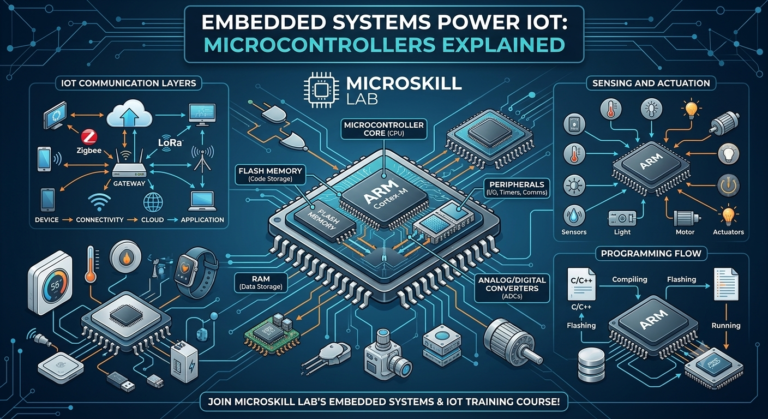
A microcontroller is the compact chip that reads sensor data, runs decision logic, and controls outputs, all on a single piece of silicon. It is the component most directly responsible for turning a plain device into a smart one.
Think of the microcontroller as the coordinator inside an IoT device, constantly checking inputs, running programmed logic, and triggering the right response, whether that means switching on a motor or sending an alert.
Sensing and Processing Data at the Edge
Microcontrollers constantly poll or listen to sensors such as temperature, motion, or gas sensors. They process this raw data locally, often filtering out noise before it is ever sent to the cloud.
This local processing, commonly called edge processing, saves both power and network bandwidth. It also means the device can react to important changes in milliseconds rather than waiting for a round trip to a distant server.
Making Decisions Without Constant Cloud Dependence
Modern IoT products increasingly rely on edge intelligence, where the microcontroller makes basic decisions on its own, such as triggering an alarm, without waiting for a server response. This approach reduces latency significantly.
It also keeps devices functional even during network interruptions, a key requirement in Karnataka’s growing industrial IoT sector, where factory connectivity can be inconsistent in certain plant locations.
Communication Protocols That Connect IoT Devices
Once an embedded system processes data, it needs a way to share that data, either with nearby components on the same board or with the wider internet. This is where communication protocols come in.
Choosing the right protocol affects speed, power consumption, range, and even the overall cost of the final IoT product, which is why understanding protocol trade-offs is a core embedded skill.
Short-Range Protocols Inside the Device
Protocols like I2C, SPI, and UART connect the microcontroller to sensors and modules sitting on the same circuit board. I2C is popular for connecting multiple low-speed sensors using just two wires, keeping board design simple.
SPI, on the other hand, is preferred when higher-speed data transfer is required, such as reading data quickly from a display or a memory module. UART remains common for simple point-to-point serial communication.
Long-Range and Internet-Facing Protocols
For sending data to the cloud, IoT devices commonly use Wi-Fi, Bluetooth Low Energy, Zigbee, or cellular modules, paired with lightweight messaging protocols such as MQTT for actual data transport.
MQTT in particular is popular because it works well on low-power devices with unreliable network connections, making it a favourite for battery-powered sensors deployed across large industrial or agricultural sites.
Embedded Systems vs IoT: Understanding the Relationship
Many beginners use the terms embedded systems and IoT interchangeably, but they describe different layers of the same technology stack. Getting this distinction right early helps you choose the right learning path.
Embedded Systems vs IoT at a Glance
| Aspect | Embedded Systems | IoT |
|---|---|---|
| Core focus | Dedicated hardware-software control of a specific function | Network of connected devices sharing data |
| Connectivity | Optional, often standalone | Mandatory, internet or network-based |
| Example | A washing machine’s control board | A smart washing machine that sends usage data to an app |
| Skill emphasis | C programming, microcontrollers, circuit design | Embedded skills plus networking, cloud, and protocols |
Where the Two Fields Overlap
Every IoT device contains an embedded system, but not every embedded system is part of an IoT network. A car’s airbag controller is a classic embedded system with no need for internet connectivity at all.
A smart parking sensor in an IoT deployment, by contrast, needs both embedded logic and network connectivity to function as intended. The overlap between the two fields is where most modern product innovation happens.
Why This Matters for Your Learning Path
Understanding this overlap helps you plan your skill-building sequence sensibly instead of jumping between unrelated topics. Most learners benefit from mastering embedded fundamentals first.
Once the fundamentals are solid, layering IoT-specific skills like protocol handling and cloud integration on top becomes much easier, which is exactly the sequence we follow in our IoT Programme at Microskill Lab.
Ready to move from theory to hands-on hardware? Get practical, project-based training that takes you from microcontroller basics to fully connected IoT devices. Our trainers guide you through real circuit builds and live sensor projects from day one. Enrol in our IoT Programme →
Real-World Applications: Embedded IoT in Bangalore Industries
Bangalore’s status as India’s electronics and technology hub means embedded IoT skills are in active demand across multiple sectors, from manufacturing to healthcare to smart infrastructure development.
Seeing how these systems work in real deployments helps beginners connect classroom concepts to actual engineering jobs available in the local market today.
Industrial and Manufacturing Use Cases
Factories around Electronic City and Peenya use embedded IoT systems for predictive maintenance, monitoring vibration and temperature on machines to flag failures before they actually happen on the shop floor.
This proactive approach reduces unplanned downtime and is a growing focus area for Karnataka’s manufacturing sector as more plants modernise their monitoring infrastructure with connected sensors.
Warehouse and logistics operations across Bangalore’s outer ring road corridor are also adopting embedded IoT for asset tracking, using low-power sensor tags to monitor inventory movement in real time.
Smart City and Healthcare Applications
Smart city projects use embedded IoT for traffic monitoring and streetlight automation, adjusting brightness and timing based on real-time conditions rather than fixed schedules alone.
Healthcare device makers use similar embedded IoT principles for remote patient monitoring wearables. Companies with technology campuses in Manyata Tech Park and Whitefield are increasingly hiring engineers who can bridge hardware and connected software.
How to Start Learning Embedded Systems for IoT Careers
Breaking into embedded IoT does not require a specific degree, but it does require structured, hands-on learning that builds real project experience alongside solid theoretical foundations.
Employers in Bangalore’s electronics sector consistently tell us they value candidates who can demonstrate working projects over those with only theoretical, exam-based knowledge.
Skills and Tools You Will Need
- Strong fundamentals in C programming and digital electronics
- Hands-on practice with microcontroller boards through our Arduino Programming course or PIC-based projects
- Working knowledge of communication protocols including I2C, SPI, and MQTT
- Basic exposure to cloud platforms for storing and visualising sensor data
- Debugging skills using multimeters, oscilloscopes, and serial monitors
Typical Career Roles After Learning Embedded IoT
- Embedded Systems Engineer
- IoT Firmware Developer
- Hardware Design Engineer
- IoT Solutions Engineer
- Product Test and Validation Engineer
Choosing the Right Training Path
Look for a training institute that combines circuit-level teaching with real project builds rather than slide-based theory alone. Practical exposure is what separates job-ready candidates from those who only understand concepts on paper.
At Microskill Lab, our curriculum starts with Electronics Fundamentals and progresses through microcontroller programming into full IoT system design. Learners graduate with a working project portfolio, not just certificates.
You can explore our full range of programmes, including our PIC Microcontroller Programming course, or reach out to our team with any questions about which learning path fits your background and career goals best.
Frequently Asked Questions
Is embedded systems knowledge necessary before learning IoT?
Yes. IoT devices run on embedded hardware, so understanding microcontrollers, sensors, and basic circuit design gives you a much stronger foundation than jumping straight into cloud and app-layer IoT tools.
Which microcontroller should a beginner start with?
Arduino boards are a popular starting point because of their simple programming environment, while PIC microcontrollers are widely used in Indian industry, making both worth learning early in your journey.
How long does it take to learn embedded systems for IoT?
With focused, hands-on training, most learners can build a solid foundation in three to six months, though ongoing project practice is what truly builds job-ready skills over time.
Do I need a degree in electronics to learn embedded IoT?
No. Many successful embedded IoT engineers come from diverse academic backgrounds and build their skills through structured courses, personal projects, and consistent hands-on practice rather than a specific degree alone.
What is the difference between I2C and SPI protocols?
I2C uses two wires to connect multiple devices at moderate speed, while SPI uses more wires but offers faster data transfer, making it better suited for high-speed sensor or display connections.
Can I learn embedded systems for IoT while working a full-time job?
Yes. Many working professionals in Bangalore complete embedded and IoT training through weekend or evening batches, balancing structured coursework with their existing job commitments.