
RTOS in Embedded Systems: The Complete 2026 Guide
RTOS in embedded systems refers to specialized operating systems that manage hardware resources with predictable, time-bound responses — the backbone of every automotive controller, medical device, and industrial sensor you encounter. If you’re a developer or student trying to understand embedded operating systems, this guide breaks down RTOS architecture, scheduling, and real-world use in plain terms. We designed this resource for engineering students in Bangalore, Kerala, and Tamil Nadu who want to move from theory into job-ready embedded software skills.
⚡ Key Takeaways
- Understand exactly what separates an RTOS from a general-purpose embedded operating system
- Learn how task scheduling, interrupt latency, and memory management work inside real embedded software
- Compare popular RTOS platforms like FreeRTOS, Zephyr, and VxWorks used across Indian industry today
- See how RTOS powers automotive, medical, and industrial systems built in Bangalore’s electronics sector
- Get a clear career roadmap for becoming an embedded systems or RTOS developer in India
What Is an Embedded Operating System?
An embedded operating system is software written to run on a dedicated hardware device rather than a general-purpose computer. Unlike Windows or macOS, it manages a single application or a tightly defined set of tasks — think of a washing machine controller, a car’s ECU, or a fitness band.
These systems are built for constrained environments. Memory footprints range from a few kilobytes to a few megabytes, and the OS itself is often invisible to the end user. Our trainers at Microskill Lab Training Institute walk students through real embedded OS source code so the concept stops feeling abstract.
Core Characteristics of Embedded Software
Embedded software differs from desktop software in three important ways: it runs on fixed hardware, it has strict timing requirements, and it usually cannot be updated as easily post-deployment. This makes reliability testing far more critical than in typical app development.
Bangalore’s electronics manufacturing corridor around Peenya and Electronic City relies heavily on this class of software for industrial automation panels and IoT gateways. Students who understand embedded software fundamentals through our Electronics Fundamentals Programme find it much easier to transition into specialized work later.
Most embedded operating systems fall into one of three broad categories: bare-metal loops with no formal OS, real-time schedulers, and general-purpose systems like Embedded Linux. Choosing the wrong category for a product early on is one of the most expensive mistakes a hardware team can make, since switching later often means rewriting drivers and application logic from scratch.
Why Embedded Operating Systems Matter for Developers
For developers, embedded operating systems matter because they abstract away hardware complexity while still giving fine-grained control over timing and resources. A developer who understands this layer can debug issues that application-only programmers never encounter, such as race conditions in interrupt service routines.
This is exactly why companies hiring for embedded roles in Karnataka’s IT-ITES sector test candidates on OS fundamentals during technical interviews, not just C syntax.
Beyond interviews, this foundation matters daily on the job. A developer who only knows application-level programming will struggle to explain why a sensor reading occasionally arrives late, while someone with OS-level understanding can trace the delay to scheduling priority or an unoptimized interrupt handler within minutes.
What Is RTOS? Understanding Real-Time Operating Systems
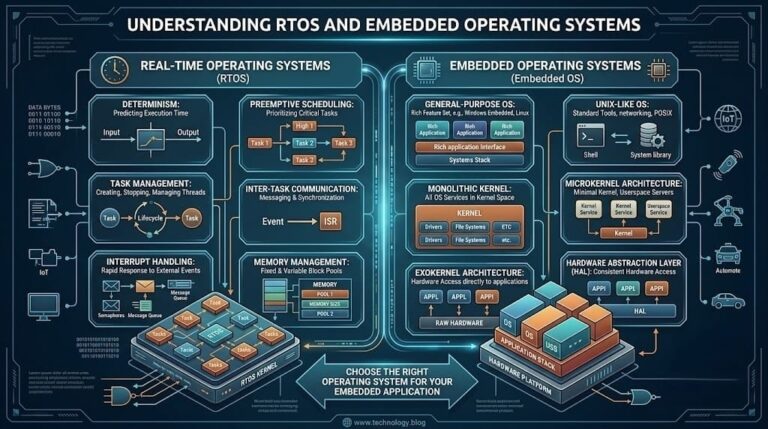
RTOS stands for Real-Time Operating System — a class of embedded operating system engineered to guarantee that a task completes within a specified deadline. The “real-time” guarantee is what separates it from a regular embedded OS that merely runs efficiently without deadline promises.
RTOS in embedded systems is typically classified into hard real-time (where a missed deadline is a system failure, like an airbag controller) and soft real-time (where a missed deadline degrades quality but doesn’t cause failure, like a video stream).
Hard vs Soft Real-Time Systems
- Hard real-time: Anti-lock braking systems, pacemakers, industrial robotic arms
- Soft real-time: Audio/video playback devices, some consumer IoT sensors
- Firm real-time: Systems where occasional missed deadlines are tolerated but degrade output quality
Understanding this classification helps developers choose the right combination of scheduler and hardware for a project brief, which is a core module in our Embedded Systems Pro Programme.
The distinction also shapes testing strategy. Hard real-time systems typically require worst-case execution time analysis and extensive stress testing under peak interrupt load, while soft real-time products can rely on statistical performance benchmarking instead.
RTOS Task Scheduling Explained
An RTOS scheduler decides which task runs at any given moment using priority-based preemptive scheduling in most cases. Higher-priority tasks interrupt lower-priority ones instantly, ensuring time-critical operations like sensor polling never get delayed by background housekeeping tasks.
Common scheduling algorithms taught in embedded courses include Rate Monotonic Scheduling and Earliest Deadline First, both of which our curriculum covers with hands-on labs on ARM Cortex-M boards.
Round-robin scheduling is also used for tasks of equal priority, giving each an equal time slice so no single task monopolizes the processor. Choosing between these algorithms depends on how many tasks a system runs and how strict their individual deadlines are.
RTOS vs General-Purpose Embedded Operating Systems
Choosing between an RTOS and a general-purpose embedded OS like Embedded Linux depends entirely on the application’s timing needs, hardware budget, and feature requirements.
Comparison: RTOS vs Embedded Linux vs General-Purpose OS
| Factor | RTOS (e.g. FreeRTOS) | Embedded Linux | General-Purpose OS |
|---|---|---|---|
| Timing guarantee | Deterministic, microsecond-level | Best-effort, less predictable | Not designed for real-time |
| Memory footprint | Kilobytes to low megabytes | Tens of megabytes+ | Hundreds of megabytes+ |
| Typical use case | Sensors, motor control, medical devices | Gateways, infotainment, networked devices | Desktops, servers |
| Development complexity | Lower, single-purpose | Higher, full OS stack | Highest for embedded contexts |
| Boot time | Milliseconds | Seconds | Not applicable |
When to Choose Embedded Linux Instead
Embedded Linux makes sense when a device needs networking stacks, a file system, multitasking user applications, or a graphical interface — think of an industrial HMI panel or a connected gateway device. It sacrifices hard real-time guarantees but gains flexibility and a massive open-source ecosystem.
Students exploring this path often pair our Embedded Linux Development course with core RTOS training to become versatile across both worlds, a combination increasingly requested by Bangalore-based product companies.
When RTOS Is the Right Choice
A deterministic scheduler is the right choice whenever missing a deadline has real consequences — braking systems, patient monitors, robotic controllers, and precision manufacturing equipment all fall into this category. The tighter memory footprint also suits cost-sensitive, high-volume consumer electronics.
Cost is a practical factor too. A microcontroller running a lightweight scheduler can cost a fraction of the bill-of-materials required for a Linux-capable processor with external RAM and storage, which matters significantly for products manufactured at scale in India.
Core Components of Embedded Software Architecture
Every embedded software stack, whether RTOS-based or not, is built from a consistent set of architectural layers that developers must understand to debug or optimize a system.
At the bottom sits the hardware abstraction layer, followed by device drivers, the OS kernel (or scheduler in bare-metal RTOS setups), middleware, and finally the application logic. Each layer has a specific job, and clean separation between them makes embedded software easier to port across hardware revisions.
Memory Management in RTOS Environments
- Static memory allocation for predictable, safety-critical tasks
- Dynamic memory pools for flexible but still bounded allocation
- Stack overflow protection per task, since each RTOS task gets its own stack
Poor memory management is one of the most common causes of embedded system crashes, which is why our lab sessions dedicate significant time to stack sizing and heap fragmentation analysis.
Fragmentation becomes a serious concern in long-running devices that allocate and free memory repeatedly over months of continuous operation. Many production systems avoid dynamic allocation altogether after initialization, relying instead on pre-sized memory pools to guarantee predictable behavior for the device’s entire operating life.
Interrupt Handling and Task Communication
Interrupt Service Routines (ISRs) must execute quickly and hand off longer processing to a deferred task using mechanisms like semaphores, message queues, or mutexes. Getting this wrong causes priority inversion, a classic embedded bug where a low-priority task blocks a high-priority one.
Our PIC Microcontroller Programming course covers interrupt-driven design patterns extensively, since this is where most beginner embedded developers struggle first.
Priority inheritance protocols help mitigate priority inversion by temporarily boosting a lower-priority task’s priority when it holds a resource needed by a higher-priority one. Understanding this single concept resolves a large share of the timing bugs students encounter in their first real embedded project.
Popular RTOS Platforms and Embedded OS Choices in 2026
The RTOS landscape has consolidated around a handful of platforms that dominate industry job postings across India’s electronics and automotive sectors.
FreeRTOS remains the most widely taught and deployed option due to its open-source license and massive community support, especially on ARM Cortex-M microcontrollers. Zephyr OS has gained significant traction for IoT projects backed by the Linux Foundation, while VxWorks and QNX continue to dominate safety-critical aerospace, medical, and automotive certifications.
Comparing FreeRTOS, Zephyr, and VxWorks
- FreeRTOS: Free, lightweight, ideal for learning and most commercial microcontroller projects
- Zephyr OS: Growing IoT focus, built-in networking stack, active Linux Foundation backing
- VxWorks: Commercial, certified for aerospace and medical use, higher licensing cost
Bangalore-based embedded teams working with companies like Bosch and Continental frequently use a mix of FreeRTOS for cost-sensitive products and certified platforms for safety-critical automotive modules.
Micrium OS and ThreadX (now part of Microsoft’s Azure RTOS family) round out the list of platforms commonly referenced in Indian job postings, particularly for industrial and consumer electronics roles that need commercial support contracts alongside the source code.
Get hands-on with the RTOS platforms actual employers use. Our trainers bring real FreeRTOS and ARM Cortex-M project boards into every batch, so you graduate with deployable code, not just theory. Enrol in the Embedded Systems Pro Programme →
How to Choose an RTOS for Your Project
Choosing the right scheduler depends on licensing budget, certification needs (like ISO 26262 for automotive or IEC 62304 for medical), community support, and available hardware ports. Student projects almost always start with FreeRTOS given its zero cost and extensive documentation.
Hardware compatibility matters just as much as the software license. A platform with a mature board support package for your target microcontroller family will save weeks of development time compared to porting drivers from scratch, especially for students working on tight academic project deadlines.
RTOS Applications Across Automotive, Medical, and Industrial Sectors
RTOS-driven embedded systems quietly run some of the most safety-critical machinery in daily life, and India’s manufacturing and automotive base has significant demand for engineers who understand this domain.
Karnataka’s automotive electronics cluster, along with industrial automation units near Electronic City and Whitefield, regularly hires embedded engineers with real-time systems experience for roles spanning ECU firmware, motor control, and factory sensor networks.
Manyata Tech Park’s product engineering teams have also expanded embedded hiring in recent years, particularly for connected industrial equipment that blends deterministic control loops with cloud-connected monitoring dashboards.
Automotive and Industrial Use Cases
Automotive applications include engine control units, anti-lock braking systems, and infotainment gateways, each running different real-time tiers of the same vehicle’s software stack. Industrial use cases include programmable logic controllers, robotic arm coordination, and predictive maintenance sensor nodes on factory floors.
Embedded engineers in Bangalore working on these systems typically earn between ₹5–12 LPA at entry to mid-level, with RTOS-specific experience commanding a premium during hiring negotiations.
Medical Device Applications
Patient monitors, infusion pumps, and portable diagnostic devices all depend on hard real-time guarantees where a missed deadline is unacceptable. These devices go through rigorous certification, and developers working in this space need to understand both scheduler internals and regulatory documentation practices.
India’s growing medical device manufacturing base, supported by government initiatives around domestic electronics production, has created a steady pipeline of openings for engineers who can bridge firmware development with the documentation rigor that health regulators require.
How to Learn RTOS and Embedded OS Development: Career Roadmap
Building genuine RTOS skills requires a structured path rather than scattered tutorials, since the subject spans C programming, hardware knowledge, and systems thinking simultaneously.
Most successful learners start with strong C fundamentals and microcontroller basics before layering scheduling concepts on top. Skipping straight to advanced topics without understanding interrupts, memory maps, and peripheral registers usually leads to confusion later.
Practical project work matters more than passive video watching at this stage. Learners who build even a simple multi-task blinking-LED-plus-sensor project internalize scheduling concepts far faster than those who only read about task priorities in a textbook.
Recommended Learning Sequence
- C programming and microcontroller fundamentals
- Bare-metal embedded programming on ARM boards
- FreeRTOS task creation, queues, and semaphores
- Real hardware projects combining sensors, RTOS tasks, and communication protocols
- Exposure to Embedded Linux for networked or GUI-based devices
Career Paths and Skills Employers Look For
- Embedded software engineer
- RTOS/firmware developer
- Automotive embedded systems engineer
- IoT device firmware engineer
- Embedded test and validation engineer
Employers across Bangalore’s product companies consistently look for candidates who can demonstrate a working RTOS project, not just certificates. Our IoT Programme pairs well with core embedded training for students targeting connected-device roles.
If you’re serious about breaking into this field, reach out to our team to discuss which learning track fits your current experience level.
Frequently Asked Questions
Is RTOS the same as embedded operating system?
No. RTOS is a specific category of embedded operating system that guarantees deadline-bound task execution. Not every embedded operating system is real-time; some simply run efficiently without hard timing guarantees.
Which RTOS should beginners learn first?
Most training programmes, including ours, recommend starting with FreeRTOS due to its open-source availability, strong documentation, and wide use across ARM Cortex-M development boards.
Do I need to know Embedded Linux to work with RTOS?
Not necessarily. Many RTOS roles focus purely on microcontroller-level firmware. However, understanding Embedded Linux broadens your career options toward gateway devices, infotainment systems, and networked embedded products.
What programming language is used for RTOS development?
C remains the dominant language for RTOS and embedded software development, with C++ used in some larger or object-oriented embedded projects.
Is embedded systems with RTOS a good career choice in India?
Yes. Demand spans automotive, medical devices, industrial automation, and IoT sectors, with Bangalore serving as a major hub for embedded product development and hiring.