
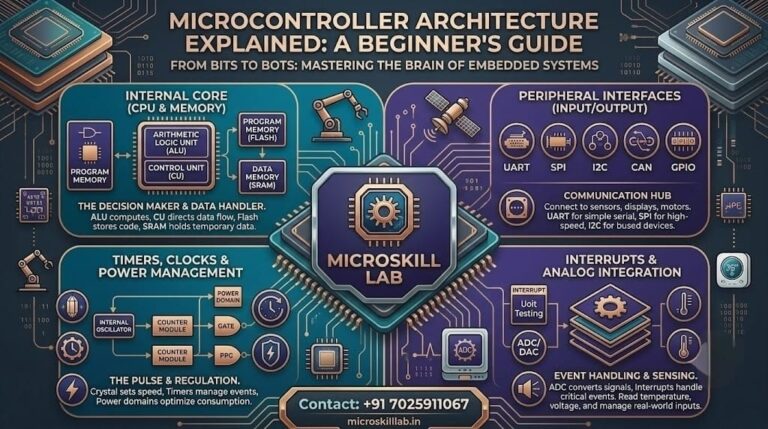
Microcontroller Architecture Explained: A Beginner’s Guide
Microcontroller architecture is the internal design that decides how a microcontroller processes instructions, stores data, and talks to the outside world. If you are an ECE, EEE, or diploma student trying to understand how a single chip runs an entire embedded system, this guide breaks it down in plain language. We cover the CPU, memory, I/O ports, and ARM-based designs that power everything from washing machines to industrial sensors used across Karnataka’s electronics sector.
Most students first meet this topic through a textbook block diagram that feels abstract until it is connected to a real chip on a breadboard. This guide walks through each block step by step, using the same sequence our trainers follow in Bangalore classrooms, so the theory maps directly onto hardware you can touch. By the end, you should be able to explain the architecture confidently in a viva or a technical interview.
⚡ Key Takeaways
- You will understand the five core blocks inside every microcontroller.
- You will learn how ARM architecture differs from older 8-bit designs.
- You will see how microcontroller architecture connects directly to embedded systems careers.
- You will get a clear microcontroller vs microprocessor comparison.
- You will know which skills Bangalore employers expect from freshers.
- You will get a practical path to build real microcontroller projects.
What Is Microcontroller Architecture? A Definition For Beginners
Microcontroller architecture refers to how a chip’s CPU, memory, and input-output circuits are arranged and connected on a single piece of silicon. Unlike a general-purpose computer, a microcontroller packs everything needed to run a dedicated task into one compact unit. This design choice is what makes microcontrollers cheap, low-power, and ideal for embedded systems.
The word “architecture” simply describes the blueprint connecting these blocks together, similar to how a building’s floor plan connects rooms and corridors. Once a student can sketch this blueprint from memory, most embedded systems coursework becomes far more approachable.
Why This Definition Matters For Students
Many students memorise the term without understanding why the architecture matters. Once you see how the CPU fetches an instruction from memory and executes it through the I/O ports, the entire embedded systems subject becomes far easier to follow. Our trainers at Microskill Lab start every batch with this foundation before moving to ARM boards.
This foundation also pays off directly in academic projects. Final-year students who understand the underlying architecture debug hardware faults far faster than those who only copied code from online tutorials without understanding what each register controls.
Common Beginner Confusion To Avoid
Students often confuse microcontroller architecture with software architecture. The former is about physical hardware blocks; the latter is about how firmware code is organised.
Both matter, but you must master the hardware picture first. We clear this confusion in the first week of our embedded systems pro programme.
A second common mix-up is treating all microcontrollers as identical. Architecture varies meaningfully between an 8-bit chip used in a simple appliance and a 32-bit ARM Cortex-M chip used in a connected sensor node. That difference shapes what to learn first.
A third mix-up is assuming architecture knowledge only matters for hardware roles. Firmware and embedded software engineers rely on the same understanding daily, since every line of code eventually maps to a specific register or memory address on the chip.
Why Microcontroller Architecture Matters For Your Career In Bangalore
Bangalore’s electronics corridor, from Electronic City to Whitefield, runs on embedded product design. Companies hiring embedded engineers expect candidates to explain microcontroller internals confidently in interviews, not just write Arduino sketches. Understanding architecture is what separates a hobbyist from a job-ready engineer.
This distinction shows up early in campus placement drives across Karnataka, where written tests increasingly include architecture-level questions rather than only C programming syntax. Students who treat architecture as a core subject, not an afterthought, consistently perform better in these rounds.
What Recruiters Actually Test
Interviewers frequently ask candidates to draw the CPU-memory-I/O block diagram from memory and explain interrupt handling. Weak architecture knowledge is one of the most common reasons freshers get rejected at the technical round, even when their coding skills are decent.
Recruiters also probe how a candidate would debug a non-responsive peripheral, which requires understanding register-level behaviour rather than high-level library calls. This is precisely why our lab sessions emphasise datasheet reading alongside coding.
Salary Expectations For Embedded Roles
Entry-level embedded engineer salaries in Bangalore’s Karnataka IT sector shift every hiring season, so exact INR figures should be confirmed against current market data before publishing. What stays constant is this: architecture fundamentals directly influence how quickly you move from a testing role to a design role.
Engineers who can independently read a microcontroller datasheet and configure peripherals without hand-holding tend to move into design and firmware roles faster than those limited to library-based coding.
Core Components Inside A Microcontroller
Every microcontroller, regardless of brand, shares five essential blocks: the CPU core, program memory (Flash), data memory (RAM), input-output ports, and peripheral modules such as timers and ADCs. Learning to identify these blocks on a datasheet is a core skill we teach hands-on.
Recognising these blocks quickly also speeds up project selection. When a student knows exactly which peripheral a project needs, choosing between microcontroller families becomes a much faster and more confident decision.
The CPU Core And Instruction Cycle
The CPU core fetches, decodes, and executes instructions in a repeating cycle. Clock speed determines how many cycles happen per second, which directly affects how fast your embedded application responds to real-world events like a button press or a sensor trigger.
Understanding this cycle also explains why some embedded tasks feel instant while others introduce noticeable lag. A slower clock speed paired with a complex task can create delays that students often mistake for a software bug.
Memory, Registers, And Peripheral Blocks
Flash memory stores your compiled program permanently, while RAM holds temporary variables during execution. Special function registers control peripherals like UART, SPI, and timers. Our PIC microcontroller programming sessions walk students through mapping these registers to real hardware behaviour.
Here are the peripheral blocks students must recognise on any microcontroller datasheet:
- CPU core and arithmetic logic unit (ALU)
- Flash program memory and RAM data memory
- General purpose input-output (GPIO) pins
- Timers, counters, and PWM modules
- Analog-to-digital converter (ADC) channels
- Communication interfaces: UART, I2C, and SPI
ARM Architecture: The Backbone Of Modern Microcontrollers
ARM architecture dominates today’s microcontroller market because it balances processing power with low energy consumption. Most modern embedded products, from fitness bands to industrial controllers used in Manyata Tech Park facilities, run on an ARM Cortex-M core rather than older 8-bit designs.
This shift toward ARM has changed what employers expect from freshers too. A working knowledge of Cortex-M peripherals is now treated as a baseline skill for embedded roles across Bangalore’s product companies, not an advanced specialisation.
RISC Design And Why It Matters
ARM uses a Reduced Instruction Set Computer, or RISC, design. This means each instruction is simple and executes in a fixed number of cycles, which makes programs more predictable and easier to optimise compared to older complex instruction set designs.
This predictability matters most in time-critical applications, where engineers must guarantee a task completes within a fixed window, such as reading a safety sensor in an industrial control system.
Cortex-M Series Explained Simply
The Cortex-M0, M3, and M4 cores are the most common in student projects and industrial products alike. Each step up adds more processing power and additional peripherals, letting engineers choose the right balance between cost and performance for a given embedded system.
Students building their first project often start on a Cortex-M0 or M3 board, since reduced complexity makes register-level learning easier before progressing to M4-based designs.
Get hands-on with real ARM development boards and industry-relevant projects. Our trainers guide you from register-level basics to a working capstone build. Explore our Embedded Systems Pro Programme →
Microcontroller Architecture Versus Microprocessor Architecture
A microcontroller integrates the CPU, memory, and I/O on one chip, while a microprocessor needs external memory and peripheral chips to function. This distinction is one of the most frequently asked embedded systems interview questions among ECE and EEE graduates.
Confusing the two is common because both terms appear together in textbooks. The clearest way to remember the difference is that a microcontroller is a complete, self-contained system, while a microprocessor is only the processing core within a larger system.
When Engineers Choose A Microcontroller
Engineers pick a microcontroller when the application is dedicated and cost-sensitive, such as a washing machine controller or an IoT sensor node. The single-chip design keeps the bill of materials low and simplifies board layout for PCB designers.
This is also why microcontrollers dominate consumer electronics and industrial automation, where thousands of identical units are manufactured and every rupee saved per unit matters at scale.
When Engineers Choose A Microprocessor
Microprocessors are chosen when an application needs a full operating system, such as embedded Linux running on a Raspberry Pi style board. Our embedded Linux development course covers exactly this transition from bare-metal microcontroller code to OS-level thinking.
Students moving to microprocessor-based systems often find the biggest adjustment is learning to think in terms of processes and an operating system scheduler, not a single continuous loop.
Compare the two approaches below:
| Feature | Microcontroller | Microprocessor |
|---|---|---|
| Integration | CPU, memory, I/O on one chip | Needs external memory and chips |
| Power consumption | Very low | Higher |
| Typical use case | Dedicated embedded task | General computing, OS-based systems |
| Cost | Lower per unit | Higher per unit |
| Example application | Washing machine controller | Embedded Linux gateway device |
How Microskill Lab Teaches Microcontroller Architecture Hands-On
Classroom theory alone does not prepare students for design interviews. We built our curriculum around physical boards, oscilloscopes, and register-level debugging so students leave with practical confidence, not just textbook definitions.
Every batch works with individual hardware kits rather than shared demo boards, so each student gets uninterrupted practice time to internalise how architecture concepts translate into working circuits.
Lab Sessions And Live Projects
Every architecture concept is paired with a lab exercise, from configuring GPIO registers to setting up a timer interrupt on an ARM Cortex-M board. Students in our PIC microcontroller programming and Arduino programming tracks build a working capstone project before graduation.
These capstone projects double as portfolio pieces students can walk interviewers through, which consistently strengthens their confidence during Bangalore’s technical interview rounds.
Curriculum Alignment With Industry Needs
Our curriculum is reviewed against embedded hiring trends across Karnataka, Kerala, Tamil Nadu, and Telangana. Students learn tools that Bangalore-based embedded teams actually use, including debuggers and register maps.
We also expose students to real datasheets from multiple microcontroller families rather than a single simplified textbook chip, since employers expect new hires to adapt quickly across hardware platforms.
Students frequently ask which skills to prioritise. Here is what we recommend learning in sequence:
- Microcontroller architecture fundamentals and datasheet reading
- C programming for embedded systems and register manipulation
- ARM Cortex-M programming and peripheral configuration
- Communication protocols: I2C, SPI, and UART
- Real-time operating system basics for advanced projects
How To Choose The Right Microcontroller Course In Bangalore
Not every training institute teaches architecture at the register level. Before enrolling, students should verify that a course includes hands-on ARM boards, not just simulation software, since simulators alone cannot teach real debugging skills.
Students should also check whether the syllabus builds from fundamentals toward a capstone project, or simply covers disconnected topics without a clear skill progression.
Questions To Ask Before Enrolling
Ask whether the institute provides individual hardware kits, how many students share one board, and whether the trainers have real embedded product design experience rather than only teaching experience. These answers reveal the actual quality of hands-on exposure you will receive.
It is also worth asking how the course structures doubt-clearing sessions, since architecture concepts often need one-on-one clarification that large lecture formats cannot provide.
Why Hands-On Training Beats Video-Only Learning
Architecture concepts like interrupt latency and register mapping are difficult to grasp from video alone. Physically probing a GPIO pin with an oscilloscope during a live class builds intuition that self-paced videos cannot replicate for most students.
Our classroom sessions in Bangalore are designed around this principle, pairing every concept explained on the whiteboard with an immediate hands-on lab exercise on the same day.
Frequently Asked Questions
What is microcontroller architecture in simple terms?
It is the internal layout of a microcontroller’s CPU, memory, and input-output blocks, all combined on a single chip to run one dedicated embedded task efficiently.
Is ARM architecture better than 8-bit microcontrollers for beginners?
ARM Cortex-M boards are now standard for most new embedded projects, but starting with an 8-bit microcontroller can still help students grasp basic architecture concepts before moving to ARM.
Do I need to know microprocessor architecture before learning microcontrollers?
No, you can start directly with microcontroller architecture. Understanding microprocessors later becomes useful once you work on embedded Linux or OS-based embedded systems.
How long does it take to learn microcontroller architecture as a beginner?
With structured hands-on classes, most students grasp core architecture concepts within a few weeks, though real fluency comes from building multiple projects over a full course.
Ready to move from theory to hands-on embedded design? Contact our team to discuss the right course path for your background and career goals.