
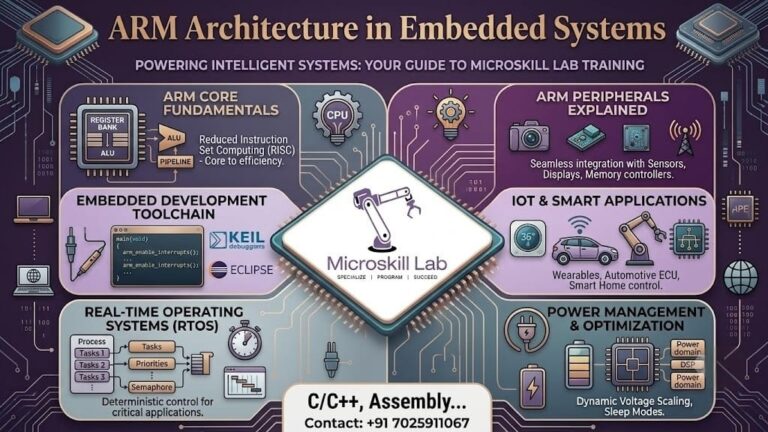
ARM Architecture in Embedded Systems: A Developer’s Guide
ARM architecture in embedded system design is the reduced-instruction-set (RISC) processor blueprint that powers most microcontrollers, smartphones, and IoT devices built today. For developers in Bangalore and across India, understanding ARM is now a baseline skill, not an optional extra.
This guide breaks down how ARM processors work, why they dominate embedded system design in 2026, and what you need to learn to build ARM-based products professionally.
⚡ Key Takeaways
- You will learn how ARM’s RISC design delivers lower power draw than CISC alternatives.
- You will understand the difference between Cortex-M, Cortex-A, and Cortex-R families.
- You will see why ARM processors dominate embedded system design in Bangalore’s IoT and automotive sectors.
- You will get a practical roadmap for learning ARM programming as a developer.
- You will find real INR salary benchmarks for ARM-skilled embedded engineers in India.
What Is ARM Architecture in Embedded Systems?
ARM architecture in embedded system design refers to a family of RISC (Reduced Instruction Set Computer) processor designs licensed by Arm Holdings. Instead of manufacturing chips directly, Arm licenses its instruction set architecture (ISA) to companies like STMicroelectronics, NXP, and Texas Instruments.
These licensee companies then build custom microcontrollers and microprocessors around the ARM core.
This licensing model is why ARM in embedded system projects shows up everywhere, from a ₹200 fitness band to a ₹2 crore industrial robot. Developers get a consistent instruction set across thousands of chip variants, which shortens the learning curve for learners starting our Embedded Systems Pro Programme.
Unlike proprietary architectures owned by a single company, ARM’s licensing model creates vendor competition on price, peripherals, and power performance. The underlying instruction set stays consistent across vendors. A developer who learns register-level programming on one Cortex-M chip can move to a different vendor’s board with minimal retraining.
Who Uses ARM Architecture
ARM cores are the default choice for firmware developers, IoT product teams, and automotive electronics engineers. Our trainers at Microskill Lab see growing demand from Bangalore-based startups building wearables and smart-home products on ARM Cortex-M chips.
Working developers switching from web or app roles into embedded work also gravitate toward ARM first. Abundant tutorials, forums, and vendor documentation cut the ramp-up time compared to older 8-bit platforms. Diploma and B.E./B.Tech ECE students now list ARM project experience alongside C programming on placement resumes.
Core Design Principles of ARM
ARM processors rely on a load-store architecture, meaning only load and store instructions can access memory directly. Every other operation happens on registers. This design choice reduces instruction cycles and directly lowers power consumption, which matters most in battery-powered embedded products.
A fixed-length instruction format also makes ARM code easier to pipeline than variable-length CISC instructions. Compilers can predict instruction boundaries more reliably, which speeds up both compilation and runtime execution. For developers, this translates into more predictable timing behaviour when writing interrupt handlers.
Most modern ARM cores also support Thumb and Thumb-2 instruction sets, which mix 16-bit and 32-bit instructions to save flash memory. This matters directly for cost-sensitive embedded products, where every kilobyte of flash affects the bill of materials.
Why ARM Processors Dominate Embedded System Design in 2026
ARM processors now sit inside more than 99% of the world’s smartphones and a growing share of industrial and automotive embedded systems. This dominance comes down to three factors: power efficiency, licensing flexibility, and a mature software ecosystem, all of which we cover from first principles in our Electronics Fundamentals course.
Karnataka’s electronics sector, concentrated around Electronic City and Whitefield, has shifted almost entirely toward ARM-based microcontroller designs over the past five years. Global chipmakers with India R&D centres, including Bosch and Texas Instruments, now build most new embedded product lines on Cortex-M or Cortex-A cores.
Job postings from Bangalore-based product companies increasingly name “ARM Cortex-M” or “ARM Cortex-A” directly in required-skills sections. This specificity has replaced the older generic term “microcontroller programming.” Hiring managers now expect candidates to know which ARM family fits which product category before day one.
Power Efficiency vs x86 and Legacy Architectures
ARM’s RISC design executes simpler instructions per cycle compared to x86’s CISC approach. For a battery-powered IoT sensor node, this efficiency difference can extend runtime from days to months on a single coin-cell battery.
Ecosystem Maturity and Toolchain Support
Free toolchains such as ARM GCC, along with vendor IDEs like STM32CubeIDE, have matured quickly. A junior developer can now flash a working prototype within a single training session. This accessibility is one reason our Embedded Systems Pro Programme uses ARM Cortex-M boards as the primary hardware platform.
Community documentation is another factor. Because so many vendors license the same core designs, a debugging solution written for one Cortex-M4 chip often transfers directly to another vendor’s board. This cross-vendor consistency rarely exists with proprietary 8-bit architectures.
Government-backed electronics manufacturing initiatives have also pushed several Indian companies toward local ARM-based product design rather than importing finished boards. Bangalore-headquartered product companies increasingly run their entire embedded design cycle, from schematic to firmware, on ARM Cortex-M silicon.
Developers who understand ARM architecture in embedded system design are better positioned for roles that extend beyond firmware coding into board bring-up work.
ARM Architecture Families: Cortex-M, Cortex-A, and Cortex-R Explained
Not every ARM chip is built for the same job. Arm Holdings groups its designs into three main families, and developers need to match the right family to the right embedded application.
- Cortex-M: Microcontroller-class cores built for real-time control, low power, and deterministic response times.
- Cortex-A: Application-class cores built for running full operating systems like embedded Linux or Android.
- Cortex-R: Real-time cores built for safety-critical systems such as automotive braking controllers and hard drive controllers.
Cortex-M Series for Microcontroller Projects
Most beginner and mid-level microcontroller projects in India run on Cortex-M0, M3, M4, or M7 cores. The M4 core adds a floating-point unit and DSP instructions, making it popular for motor control and audio processing work.
The Cortex-M0 and M0+ variants target the lowest-cost, lowest-power segment, often used in simple sensor nodes and disposable medical devices where every rupee of bill-of-materials cost matters. The Cortex-M7, at the higher end, adds cache memory and a deeper pipeline for signal-processing-heavy applications such as audio codecs and vision preprocessing on the edge.
Cortex-A Series for Application Processors
Cortex-A cores power devices that need a full operating system, such as industrial HMI panels and Android-based point-of-sale terminals. Developers moving from microcontroller work to Cortex-A projects typically need to learn embedded Linux alongside the hardware, which is exactly what our Embedded Linux Development course covers.
Cortex-R cores sit between the two, prioritising deterministic, hard real-time response over raw application performance. Automotive braking systems, industrial drives, and storage controllers commonly rely on Cortex-R for fault-tolerant, predictable operation. Developers targeting automotive embedded roles in Bangalore’s growing EV component sector should expect Cortex-R exposure eventually.
ARM vs Other Microcontroller Architectures: A Developer’s Comparison
Developers frequently ask how ARM processors compare against PIC, AVR, and legacy 8051 microcontroller families before choosing a learning path or a product platform.
| Feature | ARM Cortex-M | PIC Microcontroller | AVR (8-bit) |
|---|---|---|---|
| Architecture type | 32-bit RISC | 8/16-bit | 8-bit RISC |
| Power efficiency | Very high | Moderate | Moderate |
| Toolchain cost | Free (GCC-based) | Mostly free | Free (Arduino IDE) |
| Best use case | IoT, wearables, motor control | Industrial control panels | Hobbyist and education boards |
| Learning curve for beginners | Moderate | Moderate | Low |
This comparison shows why many Bangalore hiring teams now list ARM as a baseline requirement, while PIC and AVR remain relevant for specific legacy and industrial applications. Our PIC Microcontroller Programming course still sees steady enrolment from developers supporting older industrial systems.
Developers who already know PIC or AVR generally find the ARM transition manageable within a few weeks. Core concepts like interrupts, timers, and peripheral registers carry over conceptually. The main adjustment is a 32-bit register set and ARM-specific startup and linker files.
When PIC or AVR Still Make Sense
PIC microcontrollers remain common in industrial automation panels across Karnataka’s MSME manufacturing belt, where existing codebases and hardware are already PIC-based. Replacing a working PIC system purely to use ARM rarely makes commercial sense.
When ARM Is the Clear Choice
Any new product needing Bluetooth, Wi-Fi, or complex sensor fusion should default to an ARM Cortex-M core. The wider driver library support and lower per-unit power draw make ARM the practical choice for connected products.
Recruiters at Bangalore product companies also increasingly screen candidates for ARM-specific register-level knowledge rather than generic microcontroller familiarity. Developers who can demonstrate a completed ARM project during an interview, even a simple sensor logger, tend to stand out against candidates who only list ARM as a resume keyword.
Get hands-on with real ARM Cortex-M hardware and build a working IoT prototype under expert guidance. Our trainers take you from register-level programming to a deployed project. Enrol in the Embedded Systems Pro Programme →
Course Curriculum: What Developers Learn About ARM at Microskill Lab
Our ARM-focused training inside the Embedded Systems Pro Programme is built around live hardware, not simulators alone. Developers move from register-level C programming to real-time operating system integration on Cortex-M boards, the same foundation used by learners in our IoT Programme.
Topics Covered in the ARM Module
- Register-level GPIO, timer, and interrupt programming on Cortex-M
- Memory-mapped peripheral access and bit-banding techniques
- UART, I2C, and SPI driver development on ARM microcontrollers
- RTOS task scheduling using FreeRTOS on Cortex-M hardware
- Debugging with JTAG/SWD and tools such as OpenOCD
Tools and Hardware Used in Training
Learners work directly with STM32-based Cortex-M development boards, using STM32CubeIDE and ARM GCC toolchains. This matches the hardware stack used by embedded teams at Bosch, Siemens, and other Bangalore-based electronics employers.
Class sizes are kept small enough that every learner gets individual debugging time on hardware rather than watching a shared demo board. This hands-on ratio is a deliberate design choice, since ARM debugging skills, particularly reading fault registers and stack traces, are best learned through repeated individual practice rather than observation.
Every learner completes a capstone project on physical ARM hardware before finishing the programme, rather than relying only on simulation. Recent capstone projects have included a Cortex-M-based environmental sensor node and a motor-control demo using the ARM DSP instruction extensions.
ARM Careers in Bangalore: Salaries, Hiring Partners, and Job Roles
Embedded developers with verified ARM programming skills are in strong demand across Bangalore’s electronics corridor, from Electronic City to Manyata Tech Park. Salary figures below should be treated as indicative ranges pending current market verification; developers can connect with our admissions team for the latest batch-specific guidance.
Typical Job Roles Requiring ARM Skills
- Embedded Firmware Engineer (Cortex-M focus)
- Embedded Linux Developer (Cortex-A focus)
- IoT Product Engineer
- Automotive Embedded Systems Engineer (Cortex-R focus)
Salary Expectations for ARM-Skilled Engineers
Entry-level embedded engineers with hands-on ARM project experience tend to get meaningfully better offers than those without a documented portfolio. Exact current-year salary figures should be checked against live job postings before publication. Karnataka’s IT and electronics sector continues to add embedded roles as product companies shift design work toward ARM.
Beyond base compensation, ARM-skilled engineers in Bangalore often move faster into product-ownership roles, since ARM Cortex-A experience opens paths into embedded Linux and Android-based product teams. This career flexibility is a key reason our trainers recommend developers build both Cortex-M and Cortex-A project experience rather than specialising too early.
Portfolio projects that strengthen an ARM-focused resume include:
- A Cortex-M sensor-logging project using I2C or SPI peripherals
- An RTOS-based multi-task demo using FreeRTOS on a Cortex-M board
- A basic embedded Linux build running on a Cortex-A single-board computer
- A low-power design demonstrating sleep-mode current measurement
How to Choose the Right ARM/Embedded Training Institute in Bangalore
Not every training program that mentions ARM actually provides hands-on board time. Developers evaluating options should check for live hardware access, project-based assessment, and instructors with real product development experience.
| Criteria | Classroom Training with Live Hardware | Self-Learning Online |
|---|---|---|
| Hands-on board time | High | Depends on personal setup |
| Debugging guidance | Direct instructor support | Community forums only |
| Project portfolio | Guided, structured | Self-driven |
| Pace | Fixed batch schedule | Fully flexible |
Questions to Ask Before Enrolling
Ask any institute how many hours are spent on actual ARM Cortex-M hardware versus slides. Our curriculum design at Microskill Lab keeps a majority of contact hours on physical boards rather than theory-only sessions.
It also helps to ask whether the institute provides take-home hardware kits or restricts practice to lab hours only. Developers with full-time jobs or college schedules generally progress faster when they can continue debugging outside classroom time, which is why flexible batch options matter as much as syllabus content.
Documents and Prerequisites for Enrolment
- Basic C programming familiarity (or willingness to complete a bridge module)
- Government-issued photo ID for batch registration
- Educational certificates for students seeking eligibility-based batches
- A personal laptop capable of running STM32CubeIDE
Ready to move from ARM theory to a working embedded product? Talk to our admissions team about batch timings across our Bangalore training centre. Contact Microskill Lab →
Frequently Asked Questions
Is ARM architecture the same as a microcontroller?
No. ARM architecture is the instruction set design; a microcontroller is the physical chip built around that design by companies like STMicroelectronics or NXP.
Do I need to know PIC or AVR before learning ARM?
No prior microcontroller experience is required. Our Embedded Systems Pro Programme starts with C fundamentals before moving to ARM-specific register programming.
Which ARM Cortex family should a beginner start with?
Most beginners start with Cortex-M4, since it balances performance, peripheral support, and community documentation for real-time embedded projects.
Is embedded Linux necessary alongside ARM programming?
Only for Cortex-A application-class projects. Cortex-M microcontroller work typically runs bare-metal or on an RTOS like FreeRTOS instead.