
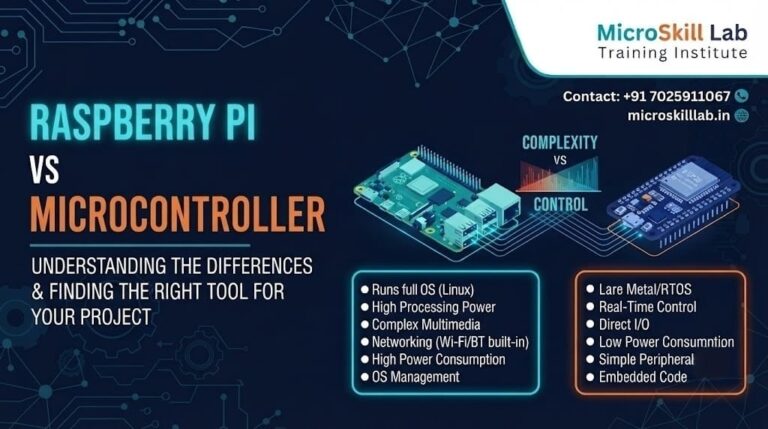
Raspberry Pi vs Microcontroller: Which Should You Pick?
Choosing between a Raspberry Pi vs microcontroller depends on one question: does your project need a full computer or a simple, reliable controller? A Raspberry Pi is a single-board computer running Linux, ideal for cameras, dashboards, and IoT gateways. A microcontroller like Arduino or ESP32 is a low-power chip built for precise, real-time control of sensors and motors. For most beginners in Bangalore and across India starting embedded projects, the answer is: use a microcontroller to learn fundamentals, and a Raspberry Pi when you need software power. This guide from our trainers makes that choice clear.
⚡ Key Takeaways
- You learn how a Raspberry Pi vs microcontroller differ in power, cost, and purpose.
- You discover which board suits beginner embedded projects and IoT builds.
- You understand where Arduino, ESP32, and ARM Linux boards each shine.
- You gain a clear cost and skill comparison relevant to the Indian market.
- You see how our hands-on courses in Bangalore turn theory into working projects.
- You leave ready to pick the right board for your first real build.
What Is a Raspberry Pi vs a Microcontroller?
Understanding the core difference between these two platforms is the first step for any beginner exploring embedded systems. One is a complete computer, while the other is a dedicated control chip. Knowing this distinction saves you money, time, and frustration on your first project.
The Single-Board Computer Explained
A Raspberry Pi is a single-board computer, often shortened to SBC, that runs a full Linux operating system. It has a multi-core ARM processor, RAM, USB ports, HDMI output, and wireless connectivity built in. You can browse the web, write code, and run several programs at once, much like a desktop.
This power makes the Raspberry Pi excellent for projects needing image processing, web servers, or complex logic. Students across Karnataka use it for home automation hubs and AI vision demos. Our trainers introduce it early in our embedded Linux development course so learners grasp real operating systems.
Because it behaves like a small desktop, the Raspberry Pi shortens the leap from software to hardware. Beginners who already know a little Python feel at home almost immediately. That familiarity makes it a comfortable bridge into the wider world of embedded systems.
The Microcontroller Explained
A microcontroller is a compact chip that runs a single program directly, without any operating system. Popular boards include the Arduino Uno and the ESP32, both loved by beginners for their simplicity. They read sensors, switch relays, and drive motors with precise, predictable timing.
Because a microcontroller does one job reliably, it is the backbone of most real embedded systems. Washing machines, fans, and cars all depend on these humble chips. We build strong foundations here through our Arduino programming programme, where students code their first sensor project within days.
The ESP32 adds built-in Wi-Fi and Bluetooth, which makes it a favourite for beginner IoT builds. This single feature lets a tiny chip talk to the internet without extra parts. Many of our learners choose it for their very first connected project.
Raspberry Pi vs Microcontroller: The Key Differences
The gap between these boards comes down to how they run code and what they consume. A clear side-by-side view helps beginners match hardware to their actual goal. This section compares the traits that matter most for your first build.
Power, Speed, and Operating System
A Raspberry Pi draws far more power and boots into Linux over several seconds. A microcontroller powers on instantly and runs its program the moment electricity flows. This instant, deterministic behaviour is why factories in the Electronic City corridor trust microcontrollers for control tasks.
The table below summarises the practical differences beginners should weigh. It reflects how our students in Bangalore actually choose boards for coursework and capstone projects. Use it as a quick reference before you buy any hardware.
Table: Raspberry Pi vs Microcontroller at a Glance
| Feature | Raspberry Pi (SBC) | Microcontroller (Arduino/ESP32) |
|---|---|---|
| Type | Full Linux computer | Single-purpose control chip |
| Operating system | Yes (Linux) | No (runs bare code) |
| Boot time | Several seconds | Instant |
| Power use | Higher (2–5W typical) | Very low (often under 1W) |
| Real-time control | Less precise | Highly precise |
| Best for | Vision, servers, IoT gateways | Sensors, motors, timing tasks |
| Beginner cost (INR) | ₹4,000–₹8,000 | ₹500–₹1,500 |
Cost and Availability in India
Price shapes many beginner decisions, especially for students funding their own kits. A microcontroller board costs a fraction of a Raspberry Pi, making it the friendliest starting point. Local suppliers across Tamil Nadu and Telangana stock Arduino and ESP32 boards widely.
A Raspberry Pi remains a worthwhile investment once your projects grow in ambition. We help learners plan affordable kits inside our electronics fundamentals course. This guidance ensures no student overspends before understanding what a project truly needs.
Availability has improved sharply as maker culture spreads through Indian colleges. Campus clubs in Pondicherry and beyond now stock both board types for student use. This access means beginners can experiment cheaply before committing to a bigger build.
When Should Beginners Choose a Microcontroller?
In the Raspberry Pi vs microcontroller debate, the microcontroller is the smarter first choice for most beginners. It teaches the raw fundamentals of how software talks to hardware. These lessons form the base of every serious embedded systems career.
Starting simple also protects your motivation during those crucial first weeks. A quick, working project builds the confidence to tackle harder builds later. We see this pattern with almost every new learner who joins our labs.
Ideal Beginner Projects
Microcontrollers shine in projects with a clear, focused purpose and direct hardware control. They respond instantly, use little power, and rarely crash unexpectedly. This reliability builds confidence quickly for new learners.
Common beginner-friendly builds include:
- Temperature and humidity monitors using simple sensors.
- LED patterns, buzzers, and basic robotics with motor control.
- Smart plant watering systems that react to soil moisture.
- Line-following robots that teach logic and calibration.
Skills You Build First
Working with an Arduino or ESP32 teaches embedded C, wiring, and debugging from the ground up. You learn how a program reads a pin, makes a decision, and drives an output. These habits transfer directly to professional microcontroller roles.
Employers in Whitefield and Manyata Tech Park value candidates who understand this low-level control. Our trainers reinforce these fundamentals throughout our PIC microcontroller programming course. Students finish able to read datasheets and design confident, working circuits.
These skills stay relevant no matter how the industry evolves over the years. Every smart device on the market still relies on a controller at its core. Learning them first gives you a foundation that never goes out of date.
Build real skills that Bangalore hiring teams respect. Our hands-on trainers guide you from your first blinking LED to a complete working project. Enrol in our Embedded Systems Pro Programme →
When Should Beginners Choose a Raspberry Pi?
A Raspberry Pi becomes the right pick when your project needs software muscle. Think cameras, screens, internet dashboards, or artificial intelligence at the edge. These jobs are hard for a small microcontroller but natural for an SBC.
Ideal Raspberry Pi Projects
The Raspberry Pi excels wherever a full computer adds real value to your build. Its Linux base lets you run Python, databases, and web tools with ease. This flexibility opens doors that a bare chip cannot reach alone.
Strong Raspberry Pi project ideas include:
- Home security cameras with live streaming and motion alerts.
- Personal web servers, dashboards, and local IoT hubs.
- AI vision demos that recognise faces or objects.
- Retro gaming stations and media centres for learning Linux.
Skills You Build with an SBC
Using a Raspberry Pi teaches Linux commands, Python, networking, and system administration. These are the same skills demanded by IoT and cloud roles across India. You learn to manage a real operating system rather than a single loop.
Karnataka’s growing IoT sector rewards engineers who bridge hardware and software fluently. We develop exactly this blend in our IoT training programme. Learners deploy sensors that report data to dashboards, mirroring real industry workflows.
The ARM processor inside the Raspberry Pi is the same architecture powering phones worldwide. Understanding it gives beginners a head start in mobile and edge computing too. That shared foundation makes your learning transfer far beyond the board itself.
Can You Use Raspberry Pi and Microcontroller Together?
Many real products combine both boards to get the best of each world. The microcontroller handles precise sensing and control, while the Raspberry Pi manages data and connectivity. This pairing is common in professional IoT systems today.
The Hybrid Approach
In a hybrid setup, an ESP32 might read sensors and send readings to a Raspberry Pi. The Pi then stores that data, runs analysis, and shows it on a web dashboard. This division of labour keeps each board doing what it does best.
Our students in Bangalore build such hybrid projects during their capstone work. This mirrors how firms in the Karnataka electronics corridor design connected products. Understanding this teamwork prepares learners for real engineering roles, not just isolated demos.
This layered design also teaches an important lesson about matching hardware to each task. You stop asking which board is better and start asking which board fits where. That mindset is exactly how professional embedded engineers think every day.
Real-World IoT Example
Imagine a smart agriculture system spread across a farm in rural Andhra Pradesh. Microcontrollers gather soil and weather data reliably in the field, even on low power. A central Raspberry Pi collects everything and pushes insights to a farmer’s phone.
This exact pattern appears in modern IoT and embedded systems across India. We teach this end-to-end thinking so learners see the full picture. Students then move from breadboard prototypes toward neat, production-ready designs with confidence.
Seeing a full system work end to end is a powerful motivator for beginners. It shows how small, focused parts combine into something genuinely useful. That understanding often sparks the ideas behind a learner’s best capstone project.
Career Value: What These Skills Earn in India
Beyond hobby projects, these platforms open genuine career paths in the Indian job market. Both microcontroller and Raspberry Pi skills feature in embedded and IoT job listings. Knowing both makes you a stronger, more flexible candidate.
Salary Benchmarks in Bangalore
Embedded systems and IoT roles offer healthy, growing salaries across the country. In Bangalore, entry-level embedded engineers often see indicative packages around ₹4–7 LPA. Experienced professionals working with ARM Linux and IoT can reach ₹12–20 LPA or more.
These figures are indicative and vary by company, skills, and demand, so verify current ranges before relying on them. Employers value practical, project-proven ability far more than certificates alone. That is why our courses centre on building things that actually work.
India’s push toward electronics manufacturing keeps demand for these skills strong and steady. Design centres across Bangalore hire steadily for both firmware and IoT roles. A beginner who builds real projects now enters this market at a genuine advantage.
Roles You Can Target
Mastering these boards prepares you for several in-demand technical roles. Each path builds naturally on the fundamentals you learn first. Consider where your interests fit as you plan your journey.
Popular career roles include:
- Embedded systems engineer working with microcontrollers and firmware.
- IoT developer connecting devices to cloud dashboards.
- Firmware engineer writing efficient, low-level control code.
- Robotics developer combining sensors, motors, and logic.
How to Choose the Right Training Path in Bangalore
Picking a board is easy once you pick the right learning path. Structured, hands-on training turns confusion into confident, working skill. This final section helps you choose wisely for your goals.
Self-Learning vs Structured Training
Self-learning suits the very curious but often leaves gaps in fundamentals. Structured training gives you mentors, a clear roadmap, and real project feedback. For most beginners, guided learning reaches job-ready skill far faster.
The comparison below shows why many South India learners choose formal training. It reflects feedback we hear from students across Kerala, Karnataka, and beyond. Weigh these trade-offs honestly against your own discipline and timeline.
Table: Self-Learning vs Structured Training
| Factor | Self-Learning | Structured Training |
|---|---|---|
| Cost | Low upfront | Course fee applies |
| Guidance | You search alone | Expert trainer support |
| Project feedback | Limited | Regular and hands-on |
| Fundamentals coverage | Often patchy | Systematic and complete |
| Job readiness | Slower, uncertain | Faster, portfolio-backed |
Why Learners Choose Microskill Lab
Our institute focuses on practical, lab-based embedded systems learning in Bangalore. Learners work on real hardware from day one, not just slides and theory. This experience builds the portfolio that hiring teams genuinely want to see.
We help you settle the Raspberry Pi vs microcontroller question for your own goals. Instead of guessing, you test both boards under expert guidance and see what fits. That clarity saves months of trial and error for every beginner we teach.
We support students across South India with flexible batches and mentor guidance. Learners from Tamil Nadu, Kerala, Telangana, and Andhra Pradesh all find a path that fits. Our trainers meet you at your level and grow your skill steadily from there.
Whichever board you start with, the real value lies in consistent, guided practice that keeps you moving past tricky bugs. Ready to begin your embedded journey with confident, hands-on training? Contact our team to explore beginner-friendly batches and start building today.
Frequently Asked Questions
Is Raspberry Pi a microcontroller?
No, a Raspberry Pi is a single-board computer, not a microcontroller. It runs a full Linux operating system on an ARM processor. A microcontroller like Arduino runs a single program directly without any operating system.
Should a beginner start with Arduino or Raspberry Pi?
Most beginners should start with a microcontroller such as Arduino or ESP32. These teach core hardware fundamentals cheaply and reliably. You can move to a Raspberry Pi once your projects need software power.
Is ESP32 better than Raspberry Pi for IoT?
It depends on the project’s needs and complexity. The ESP32 is cheaper, lower-power, and ideal for battery sensor nodes. A Raspberry Pi suits IoT gateways that need dashboards, storage, and heavier processing.
Do I need Linux knowledge to use a Raspberry Pi?
Basic Linux knowledge helps a lot when working with a Raspberry Pi. You use simple commands to install software and manage the system. Our courses guide beginners through these Linux basics step by step.