
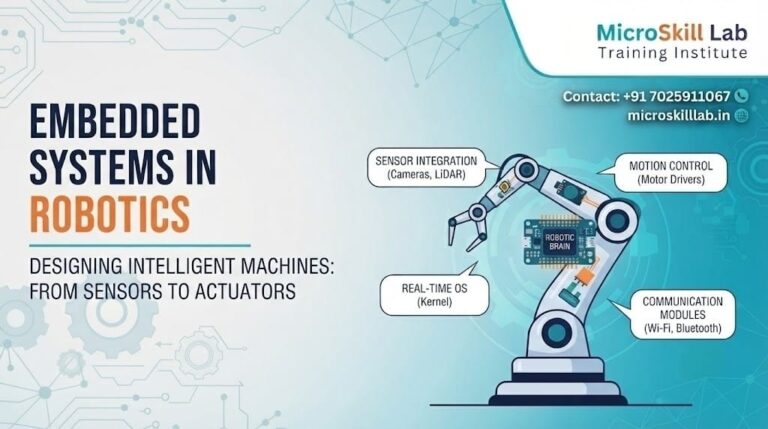
Embedded Systems in Robotics: Applications & Careers
Embedded systems in robotics are the specialised computing units that let a robot sense its environment, make decisions, and control motion in real time. For robotics students in Bangalore and across South India, mastering this field means learning how microcontrollers, sensors, and actuators work together inside every autonomous machine.
We train engineering graduates from Karnataka, Kerala, Tamil Nadu, Telangana, Andhra Pradesh, and Pondicherry to build these systems hands-on. This guide explains the core components, real applications, and career paths so you can plan your journey into robotics engineering with confidence and clarity.
⚡ Key Takeaways
- You will understand how embedded systems form the control brain of every modern robot.
- You will learn which microcontrollers, sensors, and actuators drive robotic motion and perception.
- You will discover real robotics applications across manufacturing, healthcare, and agriculture in India.
- You will see indicative INR salary benchmarks for embedded robotics roles in Bangalore.
- You will gain a clear roadmap to build job-ready skills through structured, project-based training.
What Are Embedded Systems in Robotics?
Embedded systems in robotics are dedicated hardware-software units that run a robot’s core functions without a general-purpose computer. They read sensor data, run control algorithms, and drive actuators through tight timing loops. Every robotic arm, drone, and autonomous rover depends on this hidden layer of computing to operate reliably.
This field sits at the intersection of electronics, firmware, and mechanical control. Students who understand it can build machines that perceive and act on their own. Demand for these skills is rising fast across Bangalore’s automation and product-engineering firms.
The Control Brain Behind Every Robot
We teach our students that the embedded controller is the true brain of any robot. It processes inputs from the physical world and converts them into precise electrical signals. This closed-loop behaviour is what separates a genuine robot from a simple remote-controlled toy.
Our trainers use live robotic kits so learners see this logic in action. A student in our lab can watch a motor respond to a sensor within milliseconds. That immediate feedback builds the deep intuition that classroom theory alone cannot provide.
Learning embedded systems in robotics this way makes abstract ideas concrete. Students stop memorising and start reasoning about cause and effect. This shift is the moment many learners truly fall in love with robotics.
Real-Time Behaviour and Determinism
Robots demand deterministic timing, meaning tasks must finish within strict deadlines. A late signal to a balancing robot can cause it to topple over instantly. This is why embedded programming for robotics differs sharply from ordinary app development.
We introduce real-time concepts early in our embedded systems training programme so students grasp determinism from day one. Learners practise writing timing-critical code on real boards. This foundation prepares them for the demanding pace of industrial robotics work in Bangalore.
Mastering timing is what makes embedded systems in robotics genuinely challenging. We break these hard concepts into small, achievable practice steps. Students build confidence with each successful real-time control exercise.
Core Components That Power Robotic Systems
Every robot combines a handful of essential building blocks that work in harmony. Understanding each component helps students design and debug complete robotic systems. We break these down clearly so learners see how the pieces fit together.
Grasping this architecture early prevents confusion later in complex projects. A student who knows each block’s job can trace faults quickly and confidently. This system-level thinking is exactly what employers in the Karnataka electronics corridor look for.
Microcontrollers and Processors
The microcontroller is the computational heart of most small and mid-sized robots. Popular choices include ARM Cortex-M chips, ESP32 modules, and Arduino-compatible boards. Larger robots often pair a microcontroller with a powerful single-board computer for vision tasks.
We guide students through hands-on work in our microcontroller programming course using industry-standard hardware. Learners flash firmware, read datasheets, and configure peripherals themselves. This practical grounding mirrors the exact tasks embedded engineers perform at firms across Whitefield and Electronic City.
Choosing the right microcontroller is itself a core engineering skill. We teach students to weigh processing power, memory, and cost for each robot. That judgement separates capable engineers from those who only follow tutorials.
Sensors and Actuators
Sensors give robots their perception, while actuators give them the power to act. Common sensors include ultrasonic, infrared, IMU, and camera modules for depth and vision. Actuators range from DC and stepper motors to servos and pneumatic systems.
The table below shows how these two categories differ in role and function within a robotic system.
| Category | Primary Role | Common Examples | Signal Direction |
|---|---|---|---|
| Sensors | Perceive environment | Ultrasonic, IMU, camera | Input to controller |
| Actuators | Produce movement | Servo, stepper, DC motor | Output from controller |
We train students to interface both types through standard protocols and drivers. Learners wire real sensors and motors to boards during every lab session. This hands-on practice mirrors the daily work of embedded engineers at Bangalore product firms.
Real-World Applications of Robotics in India
Robotics is transforming industries across Karnataka and the wider South Indian economy. From factory floors to hospital wards, embedded-driven robots now handle tasks once done manually. We show students where these systems create real value and jobs.
Seeing concrete applications helps learners connect theory to genuine outcomes. Each example below reflects work happening right now in and around Bangalore. This grounding motivates students and clarifies where their skills will apply.
Industrial Automation and Manufacturing
Bangalore’s manufacturing corridor uses robotic arms for welding, assembly, and quality inspection. Companies in the Karnataka electronics cluster deploy automation to boost precision and output. These robots rely entirely on embedded controllers for their repeatable accuracy.
We connect classroom concepts to this local industry reality in every session. Our IoT and automation programme covers the sensor networks that link factory robots together. Students learn how automation and connectivity combine on the modern shop floor.
Automotive suppliers around Bangalore lean heavily on robotic precision. Understanding these embedded control systems opens doors to well-paid manufacturing roles. We keep our examples rooted in the industries hiring near you.
Healthcare, Agriculture, and Service Robots
Beyond factories, robots now assist surgeons, spray crops, and deliver goods. Agricultural drones map fields across Andhra Pradesh and Telangana farmland. Service robots increasingly appear in Bangalore hospitals and warehouses.
These applications need reliable embedded software that never fails mid-task. We emphasise robust coding practices so student projects hold up under real conditions. This focus on reliability reflects what employers across South India truly demand.
Each new sector expands the demand for embedded systems in robotics talent. A single skill set now opens doors across farming, medicine, and logistics. That versatility makes robotics one of the most future-proof career choices today.
Ready to build robots that solve real problems? Our expert trainers guide you from your first line of embedded code to a working robotic capstone project. Explore our Embedded Systems Pro Programme →
The Role of ARM and IoT in Modern Robotics
Two technologies now dominate the robotics landscape: ARM processors and the Internet of Things. Together they enable smarter, connected, and more efficient robots. We ensure our curriculum reflects these industry-shaping shifts.
Understanding both gives students a decisive edge in a crowded job market. Many robotics roles in Bangalore now list ARM and IoT experience as essential. We build these competencies deliberately across our programmes.
Why ARM Architecture Dominates Robotics
ARM Cortex processors power the majority of embedded robotic controllers today. Their low power draw and strong performance make them ideal for battery-run robots. Nearly every major robotics platform builds on ARM-based silicon.
We teach ARM fundamentals so students can work across countless robotic boards. Our embedded Linux development course extends this to advanced ARM systems running full operating systems. This prepares learners for high-end robotics and autonomous vehicle roles.
ARM knowledge transfers directly to phones, cars, and industrial controllers. Investing in this skill pays off far beyond robotics alone. We frame ARM as a long-term foundation for any embedded career.
Connected Robots and the IoT Layer
Modern robots rarely work alone; they share data across networks. IoT connectivity lets fleets of robots coordinate and report status in real time. This trend drives huge demand for engineers who understand both robotics and IoT.
We blend these disciplines so our graduates stand out in the job market. Students build projects that stream sensor data to dashboards and cloud services. This connected mindset matches where Bangalore’s technology sector is heading.
Skills and Tools You Will Master
Becoming a robotics engineer requires a specific and practical skill set. We designed our training around the exact tools that industry teams use daily. Students leave with portfolios that demonstrate real, employable ability.
Practical fluency matters far more than theoretical familiarity in this field. Hiring managers across South India test candidates on real hardware, not textbooks. Our project-first method prepares students precisely for that reality.
Programming Languages and Frameworks
Embedded robotics work centres on Embedded C, C++, and Python for higher-level control. Students also learn communication protocols like UART, SPI, I2C, and CAN. These skills transfer directly to jobs at automotive and electronics firms.
The list below outlines the core competencies our robotics learners develop.
- Writing efficient Embedded C for microcontroller-based robots
- Interfacing sensors and actuators through standard protocols
- Debugging firmware using oscilloscopes and logic analysers
- Applying real-time control loops for stable robotic motion
- Building connected robots with IoT and cloud integration
Development Boards and Lab Practice
We equip our labs with the boards that reflect current industry usage. Learners work on ARM, ESP32, and Arduino platforms throughout the programme. Our Arduino programming course gives beginners an accessible entry into robotics.
Every module ends with a hands-on build rather than a written test. This project-first approach ensures skills stick long after the course ends. Employers repeatedly tell us this practical depth sets our students apart.
Working across multiple boards teaches adaptability, a prized trait in industry. Robotics teams rarely use just one platform for every project. Our graduates arrive ready to work with whatever hardware a company runs.
Career Opportunities and Salary Outlook
Robotics and embedded systems offer strong, growing career prospects across India. Bangalore alone hosts hundreds of firms hiring embedded and robotics talent. We prepare students to enter this market with genuine confidence.
The automation wave is expanding demand across automotive, defence, and consumer sectors. Karnataka’s electronics and IT strength makes Bangalore a natural robotics hub. Skilled embedded engineers remain scarce, which keeps opportunities plentiful.
In-Demand Robotics Job Roles
Graduates can pursue several distinct and well-paid career paths. These roles span product companies, startups, and research organisations. Each builds on the embedded foundation our training provides.
- Embedded Robotics Engineer
- Firmware Developer for automation systems
- IoT and Robotics Solutions Engineer
- Control Systems Engineer
- Robotics Automation Specialist
Salary Benchmarks in Bangalore and India
Embedded robotics roles offer competitive pay that rises quickly with experience. Freshers in Bangalore typically start around ₹4–6 LPA in this field. Mid-level engineers with three to five years often earn ₹8–15 LPA.
These indicative figures reflect general market observation and require verification before you rely on them. Senior robotics specialists in Karnataka can command significantly higher packages. Strong practical skills remain the biggest factor in earning potential across South India.
Pay varies widely by company, domain, and the depth of your portfolio. Product firms and defence-linked employers often pay above the general range. We coach students to build the exact skills that push salaries upward.
How to Start Your Robotics Journey
Breaking into robotics is achievable with the right structured guidance. We help students move from curiosity to job-ready capability step by step. The path is clearer than most beginners expect.
You do not need to master everything at once to begin. A staged approach builds confidence while steadily deepening your technical range. We map this journey so no learner feels lost or overwhelmed.
Building a Strong Foundation
Every robotics career begins with solid electronics and programming basics. We recommend students first master fundamentals before tackling complex robots. A weak base makes advanced topics far harder to grasp.
Our electronics fundamentals programme gives absolute beginners the grounding they need. Learners understand circuits, components, and signals before touching robotics code. This deliberate sequencing produces far stronger engineers.
Choosing the Right Training Path
The right institute combines practical labs, industry-aligned content, and real projects. Look for hands-on training rather than theory-heavy lectures alone. Personalised trainer support makes a genuine difference to your progress.
We invite aspiring robotics engineers across South India to visit us and see our labs. Reach out through our enquiry and admissions page to discuss your goals. Our team will help you choose the path that fits your background and ambitions.
Frequently Asked Questions
Do I need a degree to learn embedded systems in robotics?
A formal degree helps but is not strictly mandatory to start. Many successful embedded engineers come from diploma or self-taught backgrounds. What matters most is demonstrated practical skill and a strong project portfolio.
Which programming language is best for robotics?
Embedded C remains the foundation for most microcontroller-based robotics work. Python is valuable for higher-level control and rapid prototyping. Learning both gives you the widest range of career options.
How long does it take to become job-ready in robotics?
With focused, project-based training, many students reach job-readiness within several months. The exact timeline depends on your starting knowledge and practice consistency. Consistent hands-on building accelerates progress far more than passive study.