
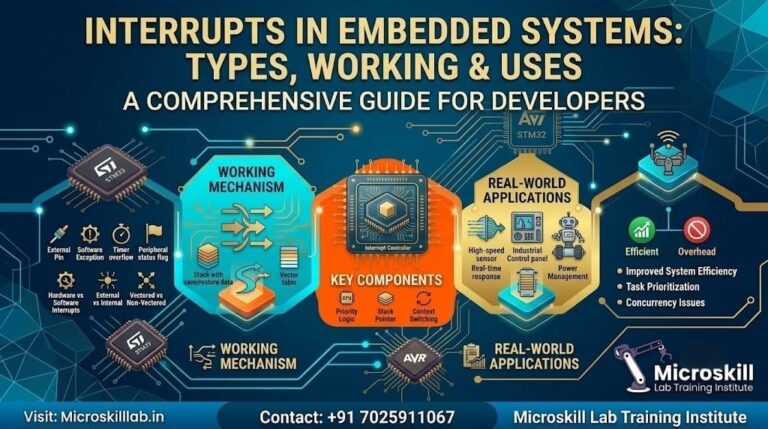
Interrupts in Embedded Systems: Types, Working & Uses
Interrupts in embedded systems are signals that pause a microcontroller’s normal program flow so it can respond instantly to a time-critical event. For engineering students learning embedded programming in Bangalore and across India, mastering interrupts is essential. They let a single processor react to buttons, sensors, timers, and communication data without wasting cycles on constant polling. At Microskill Lab Training Institute, our trainers treat interrupt handling as a core skill that separates hobby coders from job-ready embedded engineers. This guide explains interrupt types, the interrupt service routine (ISR), how ARM and RTOS systems manage priorities, and where interrupts appear in real hardware you will build in our labs.
⚡ Key Takeaways
- You will learn what interrupts are and why they beat polling for real-time responsiveness in microcontroller projects.
- You will understand the difference between hardware, software, maskable, and non-maskable interrupts with practical examples.
- You will grasp how an ISR works and the rules for writing safe, fast interrupt handlers.
- You will see how ARM Cortex-M and RTOS environments manage nested interrupts and priorities.
- You will connect theory to real applications like watchdog timers, motor control, and IoT sensor nodes.
- You will discover embedded career paths and indicative salary ranges in Bangalore’s electronics sector.
What Are Interrupts in Embedded Systems?
An interrupt is a signal that tells the processor to temporarily stop its current task and handle a higher-priority event. Instead of repeatedly checking whether a sensor has new data, the microcontroller continues its main loop until the event forces its attention. This mechanism makes embedded programming efficient, responsive, and power-friendly, which matters greatly for battery-driven IoT devices built across Karnataka’s growing hardware startup scene.
Our trainers explain interrupts using everyday analogies before moving to registers and datasheets. Think of a doorbell: you continue working until the bell rings, and that ringing is the interrupt while your response is the ISR. Students in our labs wire real push buttons and sensors to see this behaviour on an oscilloscope.
Interrupts Versus Polling
Polling means the processor asks a device “do you need me yet?” over and over, wasting clock cycles and battery life. Interrupts flip this model so the device raises its hand only when something happens. For real-time systems where a delayed response could crash a drone or misfire a motor, this difference is critical.
We teach both approaches in our Embedded Systems Pro Programme so students understand when polling is acceptable and when interrupts are mandatory. Bangalore employers like Bosch and Continental expect fresh engineers to justify this design choice during technical interviews. Getting it right signals genuine embedded maturity.
Interrupts vs Polling at a Glance
| Factor | Interrupts | Polling |
|---|---|---|
| CPU efficiency | High; CPU works or sleeps until event | Low; CPU constantly checks status |
| Response time | Near-instant, event-driven | Depends on loop timing |
| Power consumption | Low; ideal for battery IoT devices | High; CPU always active |
| Code complexity | Higher; needs ISR and flag handling | Lower; simple loop logic |
| Best use case | Real-time and low-power systems | Simple, non-critical checks |
Who Should Learn Interrupt Handling
Interrupt handling suits ECE, EEE, and CSE students who want careers in embedded design, robotics, automotive electronics, or IoT product development. Working professionals from IT backgrounds also learn interrupts when transitioning into firmware roles at Electronic City and Whitefield hardware companies. No prior firmware experience is required if you understand basic C programming.
Freshers across Kerala, Tamil Nadu, Telangana, Andhra Pradesh, and Pondicherry join our batches to build this foundation. Beginners start with core electronics and C before tackling interrupt-driven firmware in the full programme. This staged approach keeps the learning curve manageable and confidence high.
Types of Interrupts Every Engineer Must Know
Interrupts fall into several categories based on their source and how the processor treats them. Understanding these types helps you read a microcontroller datasheet and configure the interrupt controller correctly. Our curriculum drills these distinctions through hands-on register-level programming on real ARM Cortex-M boards.
The two broadest families are hardware interrupts, triggered by external pins or peripherals, and software interrupts, triggered deliberately by program instructions. Within these, engineers further classify interrupts as maskable or non-maskable depending on whether firmware can disable them. Each type has a specific place in production designs.
Hardware and Software Interrupts
Hardware interrupts come from physical events such as a timer overflow, an ADC conversion finishing, or a GPIO pin changing state. These are the most common interrupts in microcontroller work and drive most real-time systems. A software interrupt, by contrast, is invoked by an instruction and is often used for system calls in an RTOS.
Our trainers show students how UART, SPI, and I2C peripherals each raise hardware interrupts when data arrives. We build small projects in our Arduino Programming course where a serial byte triggers an ISR. Seeing the LED respond the instant a byte lands makes the concept stick far better than a lecture slide.
Maskable and Non-Maskable Interrupts
A maskable interrupt can be temporarily ignored by clearing an enable bit, which is useful when a code section must not be disturbed. Non-maskable interrupts (NMI) cannot be disabled and are reserved for critical failures like power loss or a watchdog timeout. Engineers must know which category each interrupt falls into before writing firmware.
We emphasise that misusing masking is a common bug source in student projects and industry code alike. During labs our trainers deliberately introduce a masking bug so learners debug it themselves. This experience-first teaching reflects the E-E-A-T principles that guide our entire curriculum.
How an Interrupt Service Routine Works
The interrupt service routine, or ISR, is the function the processor jumps to when an interrupt fires. When the event occurs, the CPU saves its current context, looks up the ISR address in the interrupt vector table, and executes that routine. Once the ISR finishes, the processor restores its context and resumes exactly where it left off.
Writing a good ISR is an art we teach carefully in our Bangalore labs. An ISR must be short, fast, and must not call blocking functions or heavy operations. Students learn to set a flag inside the ISR and do the real work in the main loop, a pattern used across professional embedded programming.
The Interrupt Vector Table
The vector table is a region of memory holding the addresses of every ISR the processor supports. When an interrupt triggers, hardware uses this table to find the correct handler in nanoseconds. On ARM Cortex-M devices, the vector table sits at the start of flash memory and is defined in the startup file.
Our trainers walk students through real startup code so they see how each interrupt maps to its handler. This demystifies the “magic” that beginners often fear. Learners then compare how different microcontroller families, such as PIC and ARM, handle vector tables side by side.
Rules for Writing Safe ISRs
Good ISRs follow a few strict rules that prevent subtle, hard-to-find bugs. Keeping these habits from day one makes you a more reliable firmware engineer in any Bangalore product team.
- Keep the ISR as short as possible; defer heavy work to the main loop.
- Declare shared variables as volatile so the compiler does not optimise them away.
- Avoid printf, delays, and dynamic memory allocation inside an ISR.
- Clear the interrupt flag correctly to prevent the ISR from firing endlessly.
- Protect shared data with brief critical sections when the main code touches it.
Following these rules separates production firmware from fragile hobby code. Our trainers review every student ISR against this checklist. This mirrors the code-review discipline students will meet at companies like Wipro and L&T Technology Services.
Interrupts in ARM and RTOS Environments
Modern embedded systems rarely run a single interrupt in isolation, so engineers must understand priority and nesting. ARM Cortex-M processors include a Nested Vectored Interrupt Controller (NVIC) that manages dozens of interrupt sources with configurable priorities. This hardware is central to nearly every 32-bit product built in India’s electronics industry today.
When an RTOS enters the picture, interrupts interact with the scheduler in careful ways. A high-priority interrupt can preempt a running task, and the ISR may signal a task to wake up. Our curriculum covers this interaction because real-time systems depend on getting it right.
Nested Interrupts and Priorities
Nesting lets a higher-priority interrupt interrupt a lower-priority ISR that is already running. The NVIC handles this automatically once priorities are configured, which is powerful but easy to misconfigure. Setting priorities wrongly can cause priority inversion, where an urgent task waits behind a trivial one.
Our trainers use real ARM boards to show nesting live on a logic analyser. Students in our Embedded Linux Development programme then see how larger systems layer interrupt handling above the kernel. Bangalore automotive and defence firms prize engineers who understand these layers deeply.
Interrupts and the RTOS Scheduler
In an RTOS, an ISR often uses a semaphore or queue to hand work to a task, keeping the ISR itself tiny. This deferred-processing pattern is the backbone of responsive real-time systems. The watchdog timer, a special interrupt source, resets the system if a task hangs, guaranteeing reliability.
We teach students to design this ISR-to-task handoff cleanly so the scheduler stays predictable. This skill is directly relevant to medical, industrial, and automotive products designed around Manyata Tech Park. Mastering it marks the transition from student to professional firmware developer.
Ready to master interrupt-driven firmware on real hardware? Our hands-on labs let you configure ISRs, the NVIC, and RTOS scheduling on industry-standard ARM boards. Every session is guided by trainers with real product experience. Enrol in the Embedded Systems Pro Programme →
Real-World Applications of Interrupts
Interrupts appear in almost every embedded product you use daily, from your washing machine to your car’s engine controller. Understanding these applications helps students connect classroom theory to the devices being designed across Karnataka’s manufacturing and IoT sectors. Our capstone projects deliberately use interrupts so learners finish with portfolio-worthy proof of skill.
The value of interrupts becomes obvious once you see how many systems would fail without them. A responsive, reliable product almost always relies on well-designed interrupt handling underneath. This is why interviewers probe this topic so heavily.
IoT Sensor Nodes and Motor Control
In IoT sensor nodes, interrupts wake a sleeping microcontroller only when a sensor detects change, saving enormous battery life. This low-power pattern powers the connected devices built in our IoT Programme. A temperature or motion sensor raises an interrupt, the MCU logs data, then returns to deep sleep.
Motor control offers another vivid example where timing is everything. An interrupt fires at precise intervals to update motor speed, and any delay causes vibration or failure. Our trainers demonstrate this on brushless motor kits so students feel the real-time constraint.
Watchdog Timers and Safety Systems
A watchdog timer is a dedicated interrupt that resets the processor if the main program stops responding. This safety mechanism is mandatory in automotive, medical, and industrial systems designed by Bangalore firms like Bosch and Siemens. Students learn to configure and “feed” the watchdog correctly so it protects without causing false resets.
We also cover how interrupts drive safety-critical alarms and emergency stops in factory automation. Designing these systems on our PCB Designing programme gives students end-to-end hardware experience. This blend of firmware and hardware skill is exactly what Karnataka’s electronics manufacturers seek.
Embedded Careers and Salaries in Bangalore
Interrupt handling is a gateway skill into India’s fast-growing embedded and IoT job market. Bangalore remains the country’s electronics and semiconductor hub, home to global R&D centres and a dense cluster of product startups. Engineers who master real-time firmware find strong demand across automotive, aerospace, medical, and consumer electronics.
Our placement-focused training aligns student skills with what these employers actually test in interviews. We keep our curriculum current by talking regularly with hiring managers across Electronic City and Whitefield. This industry connection keeps our graduates competitive.
Job Roles After Mastering Embedded Skills
Mastering interrupts and real-time programming opens several concrete career paths in the Indian market.
- Embedded Firmware Engineer working on microcontroller-based products.
- IoT Developer building connected sensor and gateway devices.
- RTOS/Real-Time Systems Engineer for automotive and industrial control.
- Firmware Test Engineer validating interrupt-driven systems.
- Embedded Linux Engineer for higher-end 32-bit and 64-bit platforms.
Each role builds on the interrupt fundamentals covered in this guide. Our trainers map every student’s strengths to the most suitable path. This personalised guidance reflects years of embedded teaching experience.
Salary Benchmarks and Growth
Entry-level embedded engineers in Bangalore typically earn around ₹4–7 LPA, with figures varying by company and skill depth. Experienced firmware engineers with RTOS and ARM expertise can command ₹12–25 LPA at established product firms. These indicative ranges require verification against current 2026 market data before you rely on them for planning.
Salaries rise sharply for engineers who combine interrupt-level firmware skill with domain knowledge in automotive or medical devices. To start your journey, speak with our team through our contact page about the right learning path. The embedded field rewards depth, and interrupts are where that depth begins.
Frequently Asked Questions
What is an interrupt in an embedded system?
An interrupt is a signal that pauses the processor’s normal execution so it can handle an urgent event, then resume where it left off. It lets a microcontroller respond instantly to sensors, timers, and communication without wasting cycles on polling. This makes embedded systems faster, more responsive, and more power-efficient.
What is the difference between an ISR and a normal function?
An interrupt service routine runs automatically when an interrupt fires, not when your code calls it. It must be short and fast, avoid blocking operations, and use volatile shared variables. A normal function, by contrast, runs only when explicitly called and has no such timing constraints.
Why are interrupts better than polling?
Interrupts let the processor sleep or do useful work until an event actually occurs, whereas polling wastes cycles constantly checking. This improves responsiveness and battery life, which is vital for real-time and IoT systems. Polling still suits simple cases, and our trainers teach when each approach fits best.
Do I need to know interrupts to get an embedded job in Bangalore?
Yes, interrupt handling is a core topic in nearly every embedded firmware interview across Bangalore. Employers expect you to explain ISR rules, priorities, and the interrupt-versus-polling trade-off confidently. Our hands-on training builds exactly this job-ready understanding.