
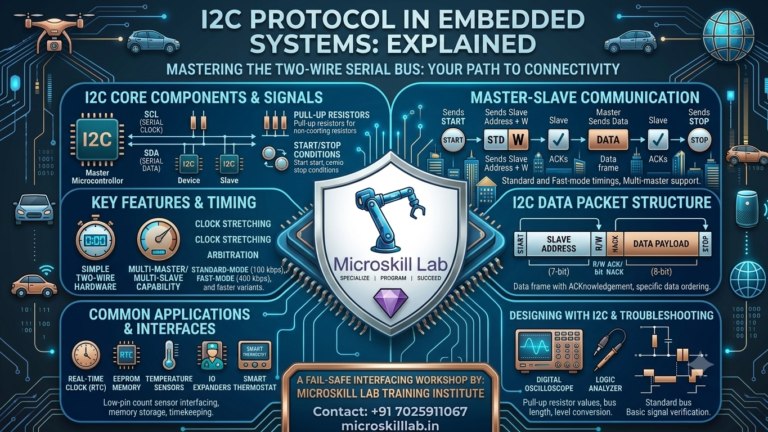
I2C Protocol in Embedded Systems: Working, Advantages, Uses
The I2C protocol in embedded systems is a two-wire serial communication standard that lets a microcontroller talk to multiple sensors and peripheral chips using just two shared lines. Engineering students in Bangalore, Kerala, and Tamil Nadu encounter I2C early because almost every sensor-based embedded project depends on it. This guide breaks down how I2C works, its architecture, advantages, limitations, and where it is used in real embedded hardware. By the end, you will know how to compare I2C against other communication protocols and choose the right one for your next project.
⚡ Key Takeaways
- Understand exactly how I2C protocol in embedded system design moves data over just two wires.
- Learn the start-address-data-stop sequence that every I2C transaction follows.
- Compare I2C against SPI and UART to pick the right communication protocol for your project.
- See real applications of I2C in consumer electronics, automotive, and industrial systems.
- Discover the skills and training path to build a career around embedded communication protocols in Bangalore.
What Is I2C Protocol in Embedded Systems?
I2C, short for Inter-Integrated Circuit, is a synchronous serial communication protocol developed by Philips Semiconductor in the 1980s. It allows a microcontroller to exchange data with multiple peripheral devices, such as sensors, EEPROMs, and displays, using only two wires. This makes it one of the most widely used communication protocols in compact embedded system designs across India’s electronics industry.
Unlike point-to-point protocols, I2C was designed from the start to support several chips sharing the same physical bus. That single design choice explains why the protocol has survived largely unchanged for more than four decades. Modern microcontrollers, from basic 8-bit chips to advanced ARM cores, still ship with dedicated I2C peripheral hardware.
Definition and Origin of I2C
I2C uses a shared data line and a shared clock line to connect several devices on the same bus. Our trainers introduce I2C early in the Embedded Systems Pro Programme because it forms the backbone of most sensor interfacing projects. Students in Electronic City and Whitefield labs typically build their first I2C project within the opening weeks of the course.
The protocol’s name reflects its original purpose: linking integrated circuits on the same circuit board without dedicating a separate wire pair to each chip. That design goal is still relevant today, since modern embedded boards pack more sensors into smaller footprints than ever before.
Who Uses I2C in Embedded Projects
Embedded engineers, IoT developers, and hardware hobbyists all rely on I2C for connecting low-speed peripherals. It suits projects where board space is limited and multiple sensors need to share the same microcontroller pins. Karnataka’s growing IoT and electronics manufacturing sector regularly hires engineers who can confidently implement I2C in embedded system firmware, particularly for wearable and smart-home product lines.
Diploma holders and final-year ECE or EEE students also use I2C heavily in academic mini-projects, since most low-cost sensor modules sold online communicate over I2C by default. This early exposure means most freshers arrive at interviews with some I2C familiarity, but employers still test depth beyond copy-pasted library code.
How I2C Protocol Works: Working Principle Explained
I2C communication follows a clearly defined sequence that keeps data transfer reliable even with multiple devices sharing one bus. The master device initiates every transaction, and the addressed slave device responds only when it recognises its unique address. This predictable handshake is what makes I2C dependable in production hardware, not just in classroom demonstrations.
Understanding this sequence at the signal level matters more than memorising library function calls. It is what separates a candidate who can debug a stuck bus from one who can only wire up a working demo.
Start, Address, Data, Stop Sequence
Every I2C transaction begins with a start condition, followed by a 7-bit or 10-bit slave address and a read/write bit. Once the correct slave acknowledges its address, data bytes move across the bus one at a time, each followed by an acknowledgement bit from the receiver. The transaction closes with a stop condition, freeing the bus for the next communication cycle.
Clock Synchronization and Data Transfer
The master generates the clock signal on the SCL line, and every connected device synchronises to that clock. Data on the SDA line changes only while the clock is low, and it is read only while the clock is high, which keeps the protocol resistant to timing errors. This clock-stretching capability lets slower slave devices pause a transaction when they need extra processing time before responding.
I2C Bus Architecture: Master, Slave, SDA, SCL Lines
The physical architecture of I2C is deliberately minimal, which is why it remains popular in space-constrained embedded boards. Just two bidirectional lines carry all communication between every device on the bus, regardless of how many sensors are connected.
SDA and SCL Lines Explained
SDA (Serial Data Line) carries the actual data bits, while SCL (Serial Clock Line) carries the timing signal. Both lines use open-drain outputs and require pull-up resistors to hold them high when idle. Our PIC Microcontroller Programming curriculum covers pull-up resistor sizing in detail, since incorrect values are a common source of bus errors on student prototype boards.
Choosing resistor values too high slows down signal transitions and can corrupt data at higher clock speeds. Choosing them too low draws excess current and can prevent devices from pulling the line low at all.
Multi-Master and Multi-Slave Configuration
I2C supports multiple masters and up to 128 addressable slave devices on a single bus in standard implementations. Arbitration logic prevents data collisions when two masters attempt to transmit at the same time on the same bus. This flexibility is why I2C in embedded system designs scales well from simple student projects to complex industrial control boards used across Karnataka’s electronics manufacturing units.
Typical devices connected over an I2C bus include:
- Temperature and humidity sensors
- Real-time clock (RTC) modules
- EEPROM memory chips
- OLED and LCD display drivers
- Accelerometers and gyroscopes
Advantages and Limitations of I2C Protocol
Every communication protocol involves trade-offs, and I2C is no exception. Understanding both sides helps engineering students choose the right protocol for a given embedded design instead of defaulting to whatever they learned first.
Interview panels at Bangalore embedded firms frequently ask candidates to justify a protocol choice for a given scenario, so knowing these trade-offs is as important as knowing the wiring diagram.
Key Advantages of I2C
I2C needs only two wires regardless of how many devices sit on the bus, which saves valuable microcontroller pins on compact boards. It also supports multiple masters and slaves natively, unlike simpler point-to-point protocols. Built-in addressing means engineers can add new sensors to an existing board without rewiring the entire circuit.
Limitations Engineers Should Know
I2C is slower than SPI, typically topping out around 3.4 Mbps in high-speed mode versus SPI’s tens of Mbps. Bus length is also limited by line capacitance, so long cable runs need careful pull-up resistor tuning to avoid signal errors. Our Embedded Linux Development sessions cover how driver-level I2C timeouts help manage these constraints in production hardware running Linux-based systems.
A single stuck slave device can also hold the SDA line low and freeze the entire bus, which is why robust firmware includes a bus-recovery routine. Students who skip this detail often struggle when a real sensor misbehaves in a live project demo.
I2C vs Other Communication Protocols
Choosing between I2C, SPI, and UART depends on speed requirements, wiring constraints, and how many devices need to communicate on the same bus. Engineering students often default to whichever protocol they learned first, but each one fits a different design scenario.
I2C vs SPI: Quick Comparison
SPI uses separate data lines for input and output plus a dedicated chip-select line per device, which makes it faster but more pin-hungry on larger boards. I2C shares two lines across every device, trading raw speed for simpler wiring. Projects with many low-speed sensors usually favour I2C, while high-speed data like display refreshes often favour SPI instead.
I2C vs UART: Quick Comparison
UART is asynchronous and typically connects only two devices point-to-point without any shared clock line. I2C’s addressing scheme allows dozens of devices on the same two wires, something UART cannot do natively without additional multiplexing hardware. Engineers building multi-sensor boards in Manyata Tech Park projects generally choose I2C over UART for exactly this reason.
| Feature | I2C | SPI | UART |
|---|---|---|---|
| Wire count | 2 (SDA, SCL) | 4 (MOSI, MISO, SCLK, CS) | 2 (TX, RX) |
| Typical speed | Up to 3.4 Mbps | Tens of Mbps | Up to 1 Mbps |
| Multi-device support | Yes, via addressing | Yes, via chip-select lines | No, point-to-point only |
| Clock signal | Shared (SCL) | Shared (SCLK) | None (asynchronous) |
| Common use case | Sensors, EEPROMs, RTC | Displays, SD cards, flash memory | Debug consoles, GPS modules |
Get hands-on with I2C, SPI, and UART on real hardware in our lab-based Embedded Systems Pro Programme. Our trainers guide learners from basic wiring through multi-sensor firmware projects using live oscilloscope debugging. Enrol in the Embedded Systems Pro Programme →
Real-World Applications of I2C in Embedded Systems
I2C appears in nearly every category of connected device, from wearables to factory automation panels. Its low pin count and predictable addressing make it a natural fit for compact, sensor-heavy designs that need to fit many components on a small board.
I2C in Consumer Electronics and IoT
Smartwatches, fitness bands, and smart home hubs use I2C to connect accelerometers, gyroscopes, and environmental sensors to a single processor. IoT product teams in Bangalore favour I2C when a device needs several low-power sensors on one small circuit board. Our IoT Programme includes a dedicated module on interfacing I2C sensors with cloud dashboards for real-time monitoring.
Battery-powered wearables also benefit from I2C’s low idle current compared with constantly polled protocols, which extends device runtime between charges. This makes I2C a natural fit for the compact, low-power product categories that dominate India’s growing consumer IoT market.
I2C in Automotive and Industrial Systems
Automotive infotainment systems use I2C to link display controllers, touch panels, and climate sensors within the dashboard cluster. Industrial automation panels in Karnataka’s manufacturing belt use I2C for connecting temperature and pressure sensors to PLC-adjacent microcontrollers. Reliability at these clock speeds is one reason I2C remains a standard choice in automotive-grade embedded boards today.
Common career-relevant applications of I2C include:
- Wearable device sensor fusion
- Smart home hub sensor networks
- Automotive dashboard sensor clusters
- Industrial process monitoring panels
- Robotics sensor arrays
Learning I2C Protocol: Skills, Career Scope, and Training in Bangalore
Mastering I2C protocol in embedded system design opens doors across IoT, automotive, and industrial embedded roles. Employers expect candidates to demonstrate hands-on debugging skills, not just theoretical knowledge of the protocol from a textbook.
Skills You Need to Master I2C
Strong C programming, oscilloscope-based signal debugging, and datasheet reading are the core skills behind confident I2C implementation. Familiarity with pull-up resistor calculations and bus arbitration also separates job-ready candidates from beginners who only understand the theory. Our Arduino Programming course builds these fundamentals before students move into advanced multi-sensor I2C projects using industrial-grade components.
Career Scope for Embedded Engineers in Bangalore
Embedded engineers with strong communication protocol skills are in steady demand across Bangalore’s IT and electronics manufacturing sector. Entry-level embedded roles involving I2C-based sensor interfacing in Bangalore are commonly reported in the range of ₹3.5–6 LPA. This figure rises with experience and specialised hardware debugging skills, though we flag it here for verification against current industry data before publication. Roles touching I2C-based sensor interfacing appear across IoT product companies, automotive electronics teams, and industrial automation firms in Karnataka, Tamil Nadu, and Telangana. Building verified project experience with I2C, SPI, and UART strengthens a fresher’s profile for these openings.
Skills employers look for in I2C-ready candidates:
- Reading device datasheets for register-level I2C addressing
- Debugging bus signals using a logic analyser or oscilloscope
- Writing and testing I2C driver code in C
- Troubleshooting pull-up resistor and bus contention issues
Ready to build job-ready embedded skills with real I2C hardware labs? Reach out to our admissions team to discuss the right learning path for your background. Contact Us →
Frequently Asked Questions
Is I2C faster than SPI?
No, SPI is generally faster than I2C. I2C tops out around 3.4 Mbps in high-speed mode, while SPI commonly reaches tens of Mbps because it uses separate data lines instead of a shared bus.
How many devices can I2C support on one bus?
Standard I2C addressing supports up to 128 devices on a single bus using 7-bit addresses. Practical limits depend on bus capacitance and pull-up resistor values chosen during board design.
Do I need pull-up resistors for I2C?
Yes, both the SDA and SCL lines need pull-up resistors. I2C uses open-drain outputs that only pull the line low, never high, so external resistors are required to restore the idle high state.
Is I2C used in Arduino projects?
Yes, Arduino boards support I2C through the Wire library. This makes it a common first protocol for students connecting sensors like RTC modules and OLED displays to their boards.
Which is better for beginners, I2C or UART?
UART is simpler for a single point-to-point connection between two devices. I2C is more valuable to learn early, though, because most multi-sensor embedded projects in real coursework depend on it.