
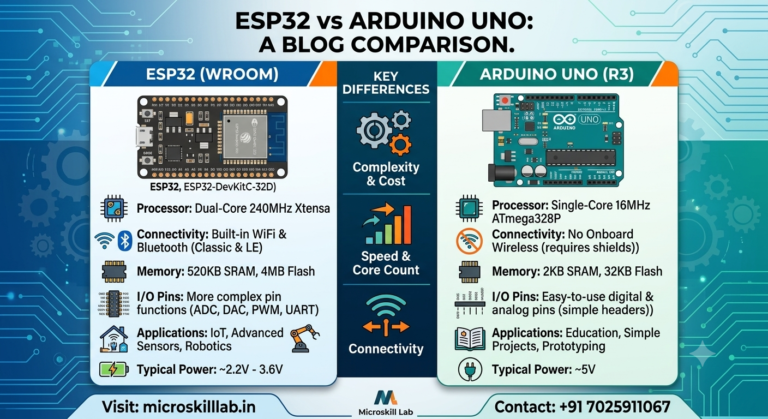
ESP32 vs Arduino Uno: Which Board Should You Choose?
The ESP32 vs Arduino Uno decision comes down to one question: does your project need wireless connectivity? Choose the Arduino Uno if you are learning electronics fundamentals, wiring your first circuits, or building offline projects. Choose the ESP32 if you need Wi-Fi, Bluetooth, more processing power, or plan to build IoT devices. For students and makers across Bangalore, Kerala, Tamil Nadu, and the rest of India, both boards remain excellent starting points. At Microskill Lab Training Institute, we teach both because professional embedded engineers work with both. This guide compares specifications, cost, ease of learning, and real-world project suitability.
⚡ Key Takeaways
- The Arduino Uno provides the gentlest learning curve for electronics and embedded systems fundamentals.
- The ESP32 delivers built-in Wi-Fi, Bluetooth, dual-core processing, and significantly higher performance.
- Both boards can be programmed using the Arduino IDE, allowing programming skills to transfer easily.
- The Arduino Uno uses 5V logic while the ESP32 uses 3.3V logic, affecting component compatibility.
- Bangalore’s growing IoT industry increasingly expects engineers to understand ESP32-class hardware alongside Arduino fundamentals.
- The best learning path is to master both boards rather than choosing one permanently.
What Is the Arduino Uno?
The Arduino Uno is one of the world’s most widely used development boards for beginners. It is based on the ATmega328P, an 8-bit microcontroller operating at 16 MHz, and remains the preferred starting platform for learning embedded systems fundamentals.
Why Beginners Start with Arduino Uno
The Arduino Uno is designed for simplicity. Its 5V logic makes it relatively tolerant of beginner wiring mistakes, and almost every electronics tutorial assumes you are using this board.
Students across Karnataka typically begin their embedded systems journey with Arduino Uno because it teaches essential concepts including:
- Digital input and output
- Analog sensing
- Pull-up and pull-down resistors
- GPIO programming
- Basic hardware debugging
These skills remain valuable regardless of which microcontroller platform you eventually specialise in.
Our Electronics Fundamentals Programme builds these concepts before students move into advanced embedded programming.
Where Arduino Uno Starts to Show Its Limits
The Arduino Uno includes:
- 32 KB Flash Memory
- 2 KB SRAM
- 16 MHz CPU
- No built-in wireless connectivity
As projects become more sophisticated, adding displays, multiple sensors, networking, or data logging, these hardware limitations become increasingly noticeable.
What Is the ESP32?
The ESP32 is a 32-bit microcontroller developed by Espressif Systems that integrates Wi-Fi and Bluetooth directly onto the chip, making it one of the most popular development boards for IoT applications.
Built-In Wireless Connectivity
Unlike the Arduino Uno, the ESP32 requires no external Wi-Fi shield or Bluetooth module.
It can:
- Connect directly to Wi-Fi networks.
- Host web servers.
- Communicate using Bluetooth Classic and Bluetooth Low Energy (BLE).
- Transmit sensor data to cloud platforms.
- Connect directly to mobile applications.
This wireless capability makes ESP32 ideal for modern IoT development.
Students interested in connected devices continue into our Internet of Things (IoT) Programme after learning Arduino fundamentals.
Performance Advantages
A typical ESP32 development board offers:
- Dual-core processor running up to 240 MHz.
- Approximately 520 KB SRAM.
- 4 MB Flash memory.
- More GPIO pins.
- Higher ADC resolution.
- Touch sensing.
- Real-Time Clock (RTC).
This significant increase in processing power enables far more advanced embedded applications.
ESP32 vs Arduino Uno: Feature Comparison
| Feature | Arduino Uno | ESP32 DevKit |
|---|---|---|
| Architecture | 8-bit AVR | 32-bit Xtensa |
| Clock Speed | 16 MHz | Up to 240 MHz (Dual Core) |
| SRAM | 2 KB | Approximately 520 KB |
| Flash Memory | 32 KB | Approximately 4 MB |
| Wi-Fi | No | Built-in |
| Bluetooth | No | Classic + BLE |
| Operating Voltage | 5V | 3.3V |
| Digital I/O Pins | 14 | Typically 34 (module dependent) |
| ADC Resolution | 10-bit | 12-bit |
| Programming | Arduino IDE | Arduino IDE, ESP-IDF, MicroPython |
| Best For | Learning electronics | IoT and wireless applications |
How to Read These Specifications
The ESP32 clearly offers superior hardware specifications. However, higher specifications do not automatically make it the best choice for every beginner.
If you are still learning voltage dividers, GPIO, and pull-up resistors, Arduino Uno remains the simpler and often more effective platform.
Ease of Learning: Which Board Is Better for Beginners?
Both development boards can be programmed using the Arduino IDE, making the programming experience very similar.
Learning with Arduino Uno
Most Arduino Uno problems are physical and easy to diagnose:
- Loose jumper wires.
- Incorrect resistor values.
- Reversed LEDs.
- Incorrect GPIO connections.
These visible problems help beginners develop practical troubleshooting skills.
Our Arduino Programming and Projects Course focuses heavily on building these debugging habits through hands-on lab work.
Learning with ESP32
ESP32 projects introduce more complex debugging scenarios, including:
- Wi-Fi configuration issues.
- Bluetooth pairing problems.
- Power supply brownouts.
- Boot configuration pins.
- Wireless communication troubleshooting.
These challenges teach valuable real-world engineering skills but generally require stronger fundamentals.
Build both offline embedded systems and cloud-connected IoT projects with expert guidance. Our trainers help you master Arduino Uno first, then transition confidently to ESP32 and advanced embedded development. Explore the Embedded Systems Pro Programme →
Cost and Availability in India
Both boards are affordable for students throughout India.
Board Cost
Clone versions of both Arduino Uno and ESP32 boards are widely available from Indian electronics suppliers, often making hardware cost a minor consideration compared to the cost of sensors and accessories.
Additional Components You’ll Need
Regardless of which board you purchase, budget for:
- Breadboard.
- Jumper wires.
- Basic electronic components.
- Sensors.
- Reliable USB data cable.
- Stable power supply.
ESP32 users should also plan for:
- 3.3V-compatible modules.
- Logic level shifters when using 5V components.
Which Board Should You Choose?
Choose Arduino Uno If
- You are completely new to electronics.
- You are building offline projects.
- You want maximum beginner tutorial support.
- You use standard Arduino shields.
- You want to understand embedded fundamentals before networking.
Choose ESP32 If
- Your project requires Wi-Fi connectivity.
- You need Bluetooth communication.
- You are building IoT devices.
- You require greater processing power.
- You plan to develop cloud-connected systems.
Most embedded engineers eventually become comfortable using both platforms because they solve different engineering problems.
Career Value in Bangalore’s Embedded Industry
Professional employers rarely hire engineers because they know a specific development board. Instead, they hire engineers who understand embedded programming concepts.
Skills That Transfer Between Boards
- C and C++ programming.
- GPIO programming.
- UART communication.
- I2C communication.
- SPI communication.
- Interrupt handling.
- Hardware debugging.
- Sensor interfacing.
These skills remain valuable whether you eventually work with Arduino, ESP32, STM32, PIC, or industrial embedded controllers.
Next Steps After Arduino and ESP32
Most learners progress through the following roadmap:
- Electronics Fundamentals
- Arduino Programming and Projects
- Internet of Things (IoT)
- PIC Microcontroller Programming
- Embedded Linux Development
- Embedded Systems Pro Programme
Entry-level embedded engineering salaries in Bangalore typically range between ₹3–6 LPA, with higher salaries available after gaining firmware, RTOS, and hardware design experience. These figures should be verified against current market data.
If you’re unsure which development board best matches your goals, contact our training team and we’ll help you choose the right learning path.
Frequently Asked Questions
Can I program ESP32 using the Arduino IDE?
Yes. Install the ESP32 board package through the Arduino IDE Boards Manager, and most Arduino programming concepts transfer directly.
Is ESP32 replacing Arduino Uno?
No. Arduino Uno remains one of the best teaching platforms for embedded fundamentals, while ESP32 focuses on wireless and IoT applications.
Can Arduino shields be used with ESP32?
Not always. Because ESP32 operates at 3.3V rather than 5V, some shields require additional hardware or level shifting.
Which board should beginners buy first?
Complete beginners are generally better served by the Arduino Uno. Learners with basic electronics knowledge who want to build IoT applications may choose ESP32 directly.
Does Arduino Uno support Wi-Fi?
Not by itself. Wi-Fi requires an external shield or module, unlike the ESP32 which integrates wireless connectivity directly onto the microcontroller.