
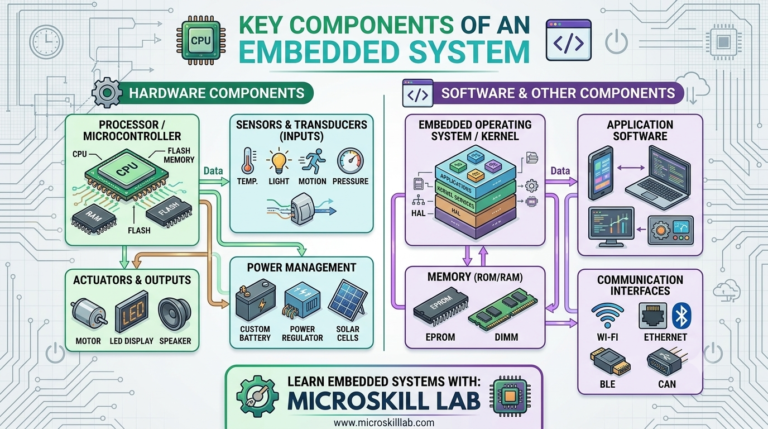
Components of an Embedded System: Everything to Know
The components of embedded system design fall into two groups: hardware parts like the microcontroller, memory, and sensors, and software parts like firmware and the real-time operating system. Together, these building blocks let a device sense, process, and act on the physical world without a full computer attached. For beginners in Bangalore and across India exploring electronics or IoT as a career path, learning these components of embedded system design is the first real step toward building working projects.
⚡ Key Takeaways
- You will learn the exact hardware and software components of embedded system design.
- You will understand how these components interact through embedded system architecture.
- You will see which tools and boards Bangalore’s electronics industry actually uses.
- You will get a clear starting point for choosing your first embedded systems course.
- You will learn where these skills lead in terms of Indian job roles and career paths.
What Are the Components of an Embedded System?
An embedded system is a combination of hardware and software designed to perform one or a few dedicated functions inside a larger device. Unlike a general-purpose computer, it does not run many unrelated applications. Instead, every component of embedded system design is chosen to do a specific job efficiently, using minimal power and space.
This makes embedded systems the hidden brains behind washing machines, cars, medical monitors, and industrial controllers used across Karnataka’s manufacturing belt. Once you understand the individual components of embedded system design, you can read almost any device’s internal architecture with confidence, whether it is a smart irrigation controller or a factory sensor node.
Most beginners first encounter embedded systems through consumer gadgets, but the same underlying components of embedded system design appear in far more demanding settings. A patient monitor in a Bangalore hospital and a motor controller on a factory floor share the same basic building blocks, just tuned for different power, safety, and timing requirements.
Hardware and Software Working Together
Every embedded system needs both layers to function. Hardware provides the physical platform, while software tells that hardware what to do and when. Neither layer is useful alone; a microcontroller without firmware is inert, and code without a processor to run on is just text.
This is why we teach the components of embedded system design as a single connected picture. Learners never lose sight of how a line of code eventually moves a physical part.
Why Beginners Should Learn Components First
Before touching any embedded project, we recommend understanding each component individually. Learners who skip this step often struggle later with debugging, because they cannot tell whether a fault sits in the hardware or the code.
Our Electronics Fundamentals programme is built specifically to close this gap for absolute beginners, walking through each component of embedded system design with real circuit boards before any coding begins.
Embedded System Hardware Components Explained
Hardware forms the physical backbone of any embedded design. Bangalore’s Electronic City and Whitefield clusters host dozens of companies that manufacture and test these exact embedded system hardware components daily, making hands-on hardware knowledge a genuine local hiring advantage.
Core Processing and Memory Units
The processor, typically a microcontroller or microprocessor, executes instructions and controls the rest of the system. Alongside it sit three memory types that beginners must understand clearly:
- ROM/Flash memory – stores the firmware permanently, even without power
- RAM – holds temporary data while the system is running
- EEPROM – stores small amounts of data that must survive power cycles, like calibration values
Each of these memory types plays a distinct role, and confusing them is one of the most common mistakes beginners make when first studying embedded system hardware components. Some designs also include external storage, such as an SD card or serial flash chip, when the application needs to log data over long periods, like a temperature logger running continuously on a factory line.
Sensors, Actuators, and Power Circuits
Sensors gather real-world data such as temperature, pressure, or motion, while actuators convert electrical signals back into physical action, like a motor turning or a valve opening. A stable power supply circuit, often a voltage regulator, protects these delicate components from fluctuations common in Indian grid conditions.
Our PIC Microcontroller Programming course covers interfacing sensors and actuators through real hardware labs, so you work with these embedded system hardware components on a breadboard rather than only reading about them in a textbook.
Embedded System Software Components Explained
Software is what gives embedded hardware its purpose. Without the correct embedded system software components, even the most advanced circuit board simply sits idle, unable to interpret sensor input or drive an actuator.
Firmware and Device Drivers
Firmware is low-level software permanently written to the device’s memory. It initialises hardware, manages interrupts, and provides the foundation everything else runs on. Device drivers sit just above firmware, translating generic software commands into hardware-specific signals so the same application code can work across different chips.
Learners often assume firmware and application code are the same thing, but distinguishing the two clearly is essential to understanding embedded system software components properly. In our labs, we ask beginners to trace a single button press from the interrupt handler in firmware up to the application logic that decides what happens next. This makes the distinction concrete rather than theoretical.
Operating Systems: Bare-Metal vs RTOS
Simple devices run bare-metal code with no operating system at all. More complex products, like industrial controllers or medical devices, need a Real-Time Operating System (RTOS) to manage multiple tasks with predictable timing.
Choosing correctly between bare-metal and RTOS-based embedded system software components depends entirely on your project’s response-time requirements, a topic we cover in depth in our Embedded Systems Pro Programme.
Embedded System Architecture: How Components Work Together
Embedded system architecture describes how hardware and software components are organised and how data flows between them. A typical architecture follows an input-process-output model: sensors capture data, the processor runs logic against that data, and actuators or displays deliver the result.
The Communication Layer
Components rarely work in isolation. They exchange data through communication protocols such as I2C, SPI, and UART for short-range links, and CAN or Ethernet for more demanding industrial setups. Karnataka’s automotive and industrial electronics sector relies heavily on CAN-based architectures for exactly this reason, and understanding this communication layer is central to grasping embedded system architecture as a whole.
Choosing the wrong protocol for a project is a common early mistake. I2C works well for connecting several low-speed sensors on a single pair of wires, while SPI suits faster displays or memory chips that need higher throughput. Learning when to pick each protocol saves significant redesign time later in a product’s development cycle.
Layered Design for Reliability
Professional embedded architecture is layered: hardware abstraction at the bottom, drivers above that, then the operating system or scheduler, and finally the application logic at the top. This layering means a change in one hardware component does not force a rewrite of the entire application, which is why layered embedded system architecture is now standard practice across Bangalore’s embedded product companies.
Hardware vs Software Components: A Quick Comparison
| Aspect | Hardware Components | Software Components |
|---|---|---|
| Examples | Microcontroller, sensors, actuators, memory chips | Firmware, RTOS, device drivers, application code |
| Changeable after deployment | Difficult, often requires physical rework | Often updatable via firmware upgrades |
| Cost driver | Component sourcing and PCB manufacturing | Development time and testing effort |
| Failure type | Physical damage, wear, power issues | Bugs, logic errors, timing failures |
| Skill needed to learn | Circuit design, PCB layout, electronics basics | C programming, RTOS concepts, debugging |
Get hands-on with both sides of embedded design before you ever step into a real project interview. Our trainers walk you through actual component-level builds, not just theory slides, so you leave with working hardware and code you wrote yourself. Explore our Embedded Systems Pro Programme →
Tools and Technologies You’ll Learn in Our Embedded Systems Courses
Learning the components of embedded system design in theory is only half the journey. Practical tool exposure is what employers in Bangalore’s electronics and IT-hardware sector actually screen for during interviews.
Development Boards and IDEs
Beginners typically start with development boards such as Arduino or PIC-based kits, paired with an IDE for writing and uploading code. These boards expose GPIO pins, communication interfaces, and onboard sensors in a beginner-friendly package, making them ideal starting points before moving to production-grade embedded system hardware components used in industry.
Debugging and Testing Tools
Professional embedded work also requires oscilloscopes, logic analysers, and in-circuit debuggers to trace faults across both hardware and firmware. Common tools and skills covered in our labs include:
- Arduino IDE and PIC development environments
- Basic oscilloscope and multimeter usage
- I2C/SPI protocol analysers for tracing communication between components
- Version control basics for managing firmware code
- RTOS task scheduling fundamentals
Our Arduino Programming course gives beginners direct access to this exact toolset under trainer supervision, reinforcing every component of embedded system design through repeated hands-on practice.
Career Opportunities After Learning Embedded System Components
A strong grasp of embedded system components opens roles across Bangalore’s electronics, automotive, and IoT sectors, alongside opportunities in Kerala, Tamil Nadu, Telangana, and Andhra Pradesh’s growing manufacturing and IT hubs.
Entry-Level Roles to Target
Typical starting roles include embedded hardware tester, junior firmware developer, and embedded QA engineer. These roles usually expect solid fundamentals in embedded system hardware components and software components rather than years of experience, making them realistic first jobs for course graduates.
Building Toward Specialist Roles
With experience, engineers move into specialist paths such as RTOS developer, embedded Linux engineer, or PCB design engineer. Companies hiring for these roles in Bangalore and across South India span product manufacturers, automotive electronics firms, and IoT solution providers.
We’d recommend verifying current salary ranges and specific hiring partner names directly before making career decisions. Compensation for embedded roles shifts with experience level, company size, and market conditions across Bangalore’s IT and electronics corridor.
Beyond core electronics firms, embedded skills are increasingly valued by IT services companies expanding into hardware-adjacent product lines, and by automotive suppliers scaling up electric vehicle programmes across South India. This broadens the realistic job market well beyond traditional electronics manufacturers alone.
How to Choose the Right Embedded Systems Training Institute in Bangalore
Not every training provider teaches the components of embedded system design the same way. Beginners should evaluate a few concrete factors before enrolling anywhere in Bangalore’s crowded training market.
What to Check Before Enrolling
Look closely at whether the curriculum covers both hardware and software components with equal depth. Check whether you get individual hands-on kits rather than shared demo boards, and whether trainers have real industry project experience rather than purely academic backgrounds.
Also ask how much lab time each learner actually gets. A course that spends most sessions on slides with only a short demo at the end will leave you weak on the practical side. This holds true no matter how good the theory content looks on paper. Documents typically needed for enrolment include:
- A valid photo ID for verification
- Proof of your highest qualification
- Passport-size photographs for institute records
- Contact details for course communication
Why Hands-On Practice Matters Most
Reading about a microcontroller’s registers is not the same as configuring one yourself. We structure every module around live component builds so you debug real circuits and real code, not simulations alone.
This hands-on approach is why our IoT Programme remains popular among working professionals across Bangalore looking to upskill without quitting their jobs. If you are ready to move from theory to a working prototype, reach out to our team to discuss which programme fits your current skill level.
Frequently Asked Questions
What are the main components of an embedded system?
The main components are the processor (microcontroller or microprocessor), memory (ROM, RAM, EEPROM), sensors, actuators, a power supply circuit, and software layers including firmware and, where needed, an RTOS.
Is embedded system hardware harder to learn than software?
Neither is inherently harder; they require different skill sets. Hardware demands circuit and electronics fundamentals, while software demands strong C programming and debugging discipline. Most learners find progress easiest when both are taught together.
Do I need a degree in electronics to start learning embedded systems?
No. Beginners from computer science, diploma, or even non-technical backgrounds can start with foundational courses that build electronics basics before moving into microcontroller programming and firmware development.
What is the difference between embedded system architecture and computer architecture?
Embedded system architecture is optimised for one dedicated task with strict power, cost, and real-time constraints, while general computer architecture is built for flexible, multi-application use with fewer resource limits.
Which programming language is used for embedded system software components?
C remains the dominant language for firmware and driver-level embedded software, with C++ used in more complex applications and Python occasionally used for prototyping and testing on Linux-based embedded boards.
How long does it take to learn the components of embedded system design as a beginner?
Most beginners can grasp the core hardware and software components within a few weeks of structured, hands-on training. Becoming job-ready for specialist roles like RTOS or embedded Linux development typically takes longer and benefits from guided project work rather than self-study alone.