
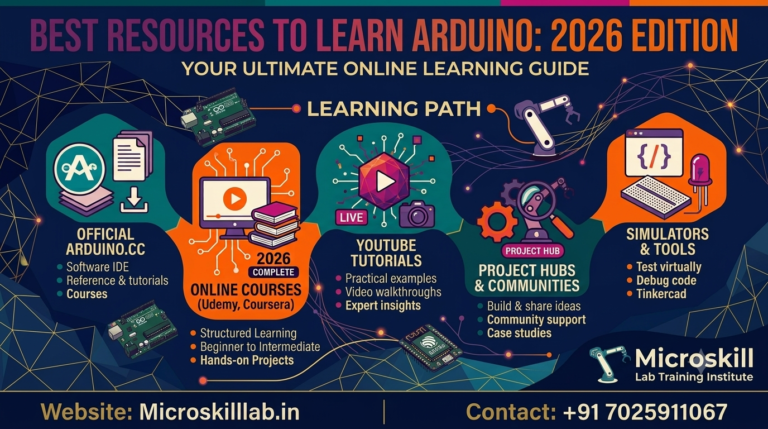
To learn Arduino programming online, start with three free tools: the official Arduino IDE, the Tinkercad Circuits simulator, and structured video tutorials. This guide maps the best resources for self-learners across Bangalore, Kerala, Tamil Nadu, and the rest of India who want to move from zero to real embedded projects. You do not need a hardware kit on day one, and you do not need an engineering degree. Our trainers at Microskill Lab Training Institute have taught these exact pathways to hundreds of beginners. We have organised the tools by cost, difficulty, and outcome so you never waste weeks on the wrong resource.
⚡ Key Takeaways
- You can learn Arduino programming online for free using the Arduino IDE and the Tinkercad simulator, with no hardware required at the start.
- Beginners get to real projects fastest by pairing one simulator with one structured video course rather than jumping between random tutorials.
- The ESP32 and Arduino Uno are the two boards worth learning first, because they cover both classic and Wi-Fi-enabled IoT projects.
- Embedded and IoT roles in Bangalore offer strong entry salaries, making Arduino a smart first step toward a hardware career.
- A guided programme shortens the self-learning curve by giving you feedback, live projects, and a clear order for the resources below.
What Does It Mean to Learn Arduino Programming Online?
Learning Arduino programming online means building embedded skills through digital tools instead of a physical classroom. You write code in the Arduino IDE, simulate circuits in the browser, and follow tutorials that teach you how sensors, motors, and microcontrollers talk to each other. This path suits self-learners because every core tool is free and runs on a modest laptop. Thousands of students across Karnataka begin exactly this way before enrolling in a structured programme.
Who This Learning Path Is For
This path fits engineering freshers from ECE, EEE, and CSE backgrounds who want hands-on skills their degree did not cover. It also fits working professionals in Bangalore’s IT corridor who want to move into embedded or IoT roles. Hobbyists and career changers benefit too, since Arduino asks for curiosity rather than prior hardware experience. Our trainers regularly see arts and commerce graduates succeed once they follow a clear order. If you can install software and follow instructions, you can start today.
What You Actually Learn First
You begin with the C and C++ style language that Arduino uses, focusing on the setup and loop structure that every sketch follows. Next you learn digital and analog input and output, which lets you read a sensor or blink an LED. From there you move to serial communication, timing, and simple libraries. These fundamentals unlock most beginner projects. For a structured start, explore our Arduino programming course built around the same progression self-learners follow online.
Why Learn Arduino Programming Online in Bangalore in 2026
Bangalore remains India’s electronics and IoT hub, and Arduino skills are a recognised entry point into that ecosystem. Firms across Electronic City, Whitefield, and Manyata Tech Park hire for embedded roles that begin with exactly these fundamentals. Learning online lets you build a portfolio before you ever attend an interview. Self-taught candidates who show real projects consistently stand out to hiring managers.
Career Momentum for Self-Learners
Embedded and IoT hiring in Karnataka has grown alongside the state’s strong electronics manufacturing push. Companies such as Bosch, Siemens, Wipro, and L&T recruit embedded talent in and around Bangalore. Entry-level embedded engineers in the city can earn roughly ₹4–8 LPA, while IoT-focused developers often reach ₹6–14 LPA as they gain experience. (These INR figures are indicative and should be verified against current market data before you rely on them.) Arduino is where many of these careers begin.
Online Learning Fits Indian Realities
India’s mobile-first, high-bandwidth learning culture makes online Arduino study practical and affordable. You can watch tutorials on a phone during a commute and simulate circuits on a laptop at home. This flexibility matters for students in Kerala, Tamil Nadu, Telangana, Andhra Pradesh, and Pondicherry who cannot easily reach a Bangalore campus. Our blended model was designed for exactly this audience. Browse more guides on our embedded systems blog to plan your path.
The Best Free Software to Learn Arduino Programming
The single most important free resource is the official Arduino IDE, the environment where you write and upload code. Pair it with a browser-based simulator so you can test logic without buying parts. Together these two tools remove almost every barrier to starting. Our trainers recommend installing both before you watch a single tutorial.
The Arduino IDE
The Arduino IDE is free, open source, and available for Windows, macOS, and Linux. It includes a code editor, a compiler, a serial monitor, and a library manager in one clean window. Beginners should start with the classic IDE 2.x version because its interface is stable and widely documented. Once installed, you can open example sketches and run them immediately. To go deeper on setup and workflow, see our embedded systems programme, which uses the same toolchain.
Browser Simulators Like Tinkercad
Tinkercad Circuits lets you build and simulate an Arduino circuit entirely in your browser, with no installation or hardware. You drag components onto a virtual breadboard, write code, and watch the simulation run in real time. This is the safest way to learn wiring before touching a real board. Wokwi is a strong alternative that also simulates the ESP32 and Wi-Fi behaviour. Both platforms are free for the projects most beginners build.
The Best Boards to Learn Arduino Programming On
Two boards cover almost everything a beginner needs: the Arduino Uno and the ESP32. The Uno is the classic learning board with a huge tutorial ecosystem. The ESP32 adds Wi-Fi and Bluetooth, which opens the door to IoT. Learning both prepares you for the widest range of projects and job requirements.
Arduino Uno for Fundamentals
The Arduino Uno is the board most tutorials assume, which makes troubleshooting easy for beginners. It has enough pins for LEDs, buttons, sensors, and small motors, so you can complete dozens of starter projects. Its widespread use means almost any error you hit has already been answered online. We recommend the Uno as a first physical board once you outgrow the simulator. It pairs naturally with the fundamentals in our electronics fundamentals course.
ESP32 for IoT Projects
The ESP32 is a low-cost board with built-in Wi-Fi and Bluetooth, making it ideal for connected projects. With it you can send sensor data to the cloud, control devices over a network, and build genuine IoT prototypes. Many Bangalore startups build products on this exact chip. Learning the ESP32 early gives your portfolio an IoT edge that hiring managers notice. Our IoT programme builds directly on these skills for learners across South India.
Free Tutorials, Courses, and Communities
Beyond tools, you need guidance, and the best free tutorials come from official documentation, structured video channels, and active communities. The official Arduino website hosts a language reference and a large library of example projects. YouTube offers full beginner series that walk you from installation to working projects. Communities give you answers when you are stuck at midnight.
Where to Find Reliable Tutorials
Start with the official Arduino documentation, which explains every function with clear examples. Supplement it with a single structured video series rather than scattered clips, so your learning follows a logical order. Written project sites and maker blogs then fill gaps with specific wiring diagrams. The goal is depth over variety. Below is a quick comparison of the main free learning formats.
Comparison: Free Arduino Learning Formats
| Format | Best For | Cost | Limitation |
|---|---|---|---|
| Official docs | Accurate reference | Free | Not a step-by-step course |
| Video tutorials | Visual, guided learning | Free | Quality varies widely |
| Browser simulators | Safe circuit practice | Free | Misses real hardware quirks |
| Community forums | Debugging help | Free | Answers can be inconsistent |
Learning With a Community
Online communities keep self-learners motivated and unstuck. The Arduino forum, relevant subreddits, and regional maker groups answer questions quickly and share project ideas. Many Bangalore and Kerala learners form small study groups to review each other’s code. Asking good questions is itself a skill that these spaces teach. Community feedback often catches mistakes that solo learners miss for days.
Ready to turn free tutorials into real, job-ready skills? Our trainers guide you from your first blink sketch to a live IoT project, with structured feedback you cannot get from scattered videos. Enrol in our Arduino Programming Course →
A Structured Path: From Free Tools to Real Projects
The fastest way to learn is to follow a fixed order instead of collecting random resources. Set up your tools, master the basics in simulation, then move to hardware and small projects. A clear sequence prevents the overwhelm that stalls most self-learners. This is the same progression our curriculum follows.
A Beginner-Friendly Learning Order
Follow these steps to avoid wasted effort:
- Install the Arduino IDE and open a few example sketches to see how code is structured.
- Rebuild those examples in Tinkercad so you understand the wiring behind the code.
- Learn digital output, analog input, and serial communication through small exercises.
- Buy an Arduino Uno starter kit and repeat your simulated projects on real hardware.
- Move to an ESP32 and build one connected IoT project to complete your beginner portfolio.
When to Move Beyond Self-Learning
Self-study takes you far, but a point comes where feedback accelerates you. If you are stuck on debugging, unsure how to structure larger projects, or aiming for a job, guided training pays off. Our trainers review your code, assign live projects, and connect fundamentals to industry practice. Learners who want microcontroller depth often continue with our advanced embedded tracks after mastering these Arduino foundations. Structure turns scattered practice into employable skill.
How to Choose the Right Arduino Learning Resource
With so many resources online, choosing well matters more than choosing many. Judge each resource by cost, structure, recency, and whether it leads to real projects. A free tool that teaches nothing new wastes time, while one good course can save you months. Use a simple checklist before committing to any resource.
A Simple Selection Checklist
Evaluate any Arduino resource against these points:
- It is current for 2026 and references the IDE 2.x version, not outdated software.
- It moves you toward building something, not just watching or reading passively.
- It fits your board, whether that is the Arduino Uno or the ESP32.
- It offers a way to get help, through a community, comments, or an instructor.
- It has a clear structure you can follow from start to finish without gaps.
Online Resources Versus Guided Training
Free online resources are unbeatable for exploring and getting started. Guided training wins when you need accountability, feedback, and a direct line to a career outcome. The table below compares the two honestly so you can decide what fits your goals and stage.
Comparison: Self-Learning vs Guided Training
| Factor | Self-Learning Online | Guided Training |
|---|---|---|
| Cost | Free or very low | Paid |
| Feedback | Community-dependent | Direct from trainers |
| Structure | You build it yourself | Provided and sequenced |
| Best for | Exploring and basics | Job-ready depth |
When you are ready to move from free tools to a structured, project-driven path, our team is happy to help you plan the next step. Reach out through our contact page to discuss which programme fits your goals.
Frequently Asked Questions
Can I learn Arduino programming online for free?
Yes, you can learn the fundamentals entirely for free. The Arduino IDE, the Tinkercad and Wokwi simulators, official documentation, and countless video tutorials cost nothing. You only need to spend money when you decide to buy a physical board and components. Many self-learners reach working projects before spending a rupee. Free resources are more than enough to discover whether Arduino is right for you.
How long does it take to learn Arduino programming?
Most motivated beginners grasp the basics in four to six weeks of consistent practice. Reaching confident, portfolio-ready projects usually takes three to six months, depending on your pace and background. Learners with a coding or electronics background often move faster. Structured guidance can meaningfully shorten this timeline. Consistency matters far more than long, occasional study sessions.
Do I need to buy hardware to start learning Arduino?
No, you do not need any hardware to begin. Browser simulators like Tinkercad and Wokwi let you build and test circuits virtually, which is perfect for the first few weeks. Once you understand the basics, buying an Arduino Uno starter kit is a worthwhile next step. Real hardware teaches lessons that simulation cannot. Most learners buy a board only after they are hooked.
Is Arduino enough to get an embedded systems job?
Arduino is an excellent starting point but usually not the whole picture. Employers in Bangalore also value knowledge of microcontrollers like PIC and ARM, communication protocols, and embedded C. Arduino gets you into the mindset and gives you a portfolio, which matters early on. Building on it with structured training strengthens your profile. Think of Arduino as the door, not the entire building.