
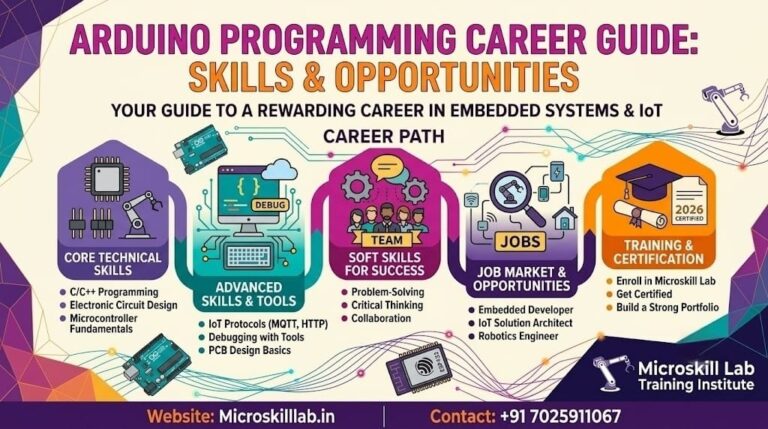
Arduino Programming Career Guide: Skills & Opportunities
Arduino programming is the entry point into embedded systems and IoT careers. It is one of the most practical skills for students and job seekers across Bangalore and India in 2026. If you can write C/C++ code for an Arduino Uno or an ESP32, wire up sensors, and debug hardware, you already hold the foundation that embedded product companies hire for. This guide explains the skills you need and the projects that build a portfolio. It also maps the real career paths Arduino opens across Karnataka, Kerala, Tamil Nadu, Telangana, Andhra Pradesh, and Pondicherry.
At Microskill Lab Training Institute, our trainers have watched hundreds of ECE, EEE, and CSE graduates turn basic Arduino knowledge into embedded engineering roles. The path is learnable, hands-on, and well suited to the mobile-first, project-driven way Indian learners study today.
⚡ Key Takeaways
- You gain a clear roadmap from Arduino basics to job-ready embedded systems skills.
- You learn which microcontrollers—Arduino Uno, ESP32, and beyond—matter most to Indian employers.
- You build a portfolio of IoT and embedded projects that hiring managers actually look for.
- You understand realistic salary bands in INR for embedded and IoT roles in Bangalore.
- You discover how structured training shortens the gap between college and your first job.
What Is Arduino Programming and Who Is It For?
Arduino programming means writing code, usually in a simplified C/C++ dialect, that runs on Arduino microcontroller boards to read sensors and control hardware. It is the most beginner-friendly route into embedded systems because the boards are cheap, the Arduino IDE is free, and the community is enormous. For students, it turns abstract electronics theory into working devices you can hold in your hand.
This skill suits engineering students, diploma holders, and self-taught hobbyists alike. Our trainers regularly guide learners from non-electronics branches into confident embedded developers through our Arduino programming course. If you enjoy building things and solving logic problems, Arduino is for you.
The Core Idea Behind Arduino
An Arduino board pairs a microcontroller with easy input and output pins, so you can connect sensors, motors, and displays without deep electrical engineering. You write a program, upload it over USB, and the board runs it instantly. This tight feedback loop is why beginners learn fast and why colleges across Karnataka use Arduino in labs.
The simplicity hides real depth. Underneath the friendly syntax sits genuine embedded C, timers, interrupts, and serial communication. Mastering these fundamentals is exactly what separates a hobbyist from an employable engineer, and it is where structured training adds the most value.
Who Should Learn Arduino in 2026
Final-year ECE and EEE students gain the most, since Arduino bridges their coursework and industry expectations directly. CSE students who want hardware exposure also benefit, especially as IoT blurs the line between software and devices. Career changers from IT or support roles use it to pivot into product companies.
Job seekers who feel their degree lacked practical work find Arduino especially powerful. A handful of working projects often matters more to a Bangalore startup than marks alone. A strong electronics fundamentals base helps absolute beginners get started before the coding deepens.
Why Arduino Skills Matter for Your Career in Bangalore
Bangalore is India’s embedded systems capital, home to Bosch, Siemens, Continental, and hundreds of product startups clustered around Electronic City and Whitefield. These firms constantly need engineers who understand microcontrollers, and Arduino is the fastest way to demonstrate that understanding. A strong Arduino foundation signals that you can move into professional embedded C without hand-holding.
The demand extends well beyond the metro. IoT adoption across Karnataka’s manufacturing MSMEs and Kerala’s growing tech parks means embedded talent is needed regionally, not just in the big campuses. Our trainers help learners position this skill for both product and services companies.
The Embedded and IoT Job Market in South India
Embedded systems roles in Bangalore have grown steadily as hardware startups and R&D centres expand around Manyata Tech Park and Electronic City. Companies increasingly want engineers who can prototype quickly, and Arduino-based prototyping is a common first-round expectation. This is true for automotive electronics, consumer IoT, and industrial automation alike.
Regional hubs matter too. Chennai’s automotive corridor, Hyderabad’s aerospace and defence electronics, and Kochi’s IoT ecosystem all recruit embedded talent. Building the skill in Bangalore gives you mobility across the whole southern belt through our embedded systems pro programme.
Salary Expectations in INR
Embedded systems freshers in Bangalore typically earn between ₹3.5 and ₹6 LPA, with strong project portfolios pushing offers higher. IoT and firmware engineers with two to four years of experience commonly reach ₹8 to ₹14 LPA. These figures are indicative and should be verified against current 2026 market listings before you rely on them.
Specialisation raises the ceiling considerably. Engineers skilled in ESP32-based IoT, RTOS, or embedded Linux command premium salaries as products grow more connected. Arduino is the on-ramp to all of these higher-paying tracks.
Course Curriculum: What You Learn at Microskill Lab
Our Arduino curriculum starts with electronics and C fundamentals, then moves methodically into sensors, actuators, communication protocols, and real IoT projects. We designed it so a complete beginner reaches job-ready competence, not just blinking-LED familiarity. Every module ends with hands-on work, because embedded skills are proven at the bench, not on paper.
The progression is deliberate and practical. Learners finish able to read a datasheet, wire a circuit safely, and write clean, debuggable firmware. Our trainers bring years of industry product experience to every session.
From Fundamentals to Firmware
The early modules cover voltage, current, GPIO, and the Arduino IDE workflow so nothing feels like magic. From there you learn digital and analogue I/O, PWM, serial communication, and timing with interrupts. These are the exact concepts that professional embedded interviews probe.
Mid-course, learners handle sensors, motor drivers, and displays while writing increasingly structured code. We introduce good practices—modular functions, comments, and version control—early. This discipline carries directly into deeper microcontroller work, whether on PIC or ARM-based boards.
Tools and Technologies You Master
By the end of training, learners are comfortable across a practical embedded toolkit. This breadth is what makes a resume stand out to Bangalore recruiters scanning for hands-on ability.
- Arduino IDE and the C/C++ programming language for microcontrollers
- Arduino Uno and ESP32 boards for both offline and connected projects
- Common sensors, actuators, and communication protocols like I2C, SPI, and UART
- Serial monitoring, debugging, and basic circuit troubleshooting
- Cloud connectivity fundamentals for IoT dashboards and data logging
Hands-On Projects That Build Your Portfolio
Projects are what convert Arduino knowledge into job offers, and our curriculum is built around them. A portfolio of working devices proves experience in a way certificates alone cannot, which matters enormously to the E-E-A-T-minded hiring managers of 2026. Each project deliberately layers new skills onto the last.
We guide every learner to a capstone they can demo in interviews. This live-project outcome is the single most common reason our learners report faster callbacks. Building visibly beats listing keywords.
Beginner and Intermediate Projects
Early projects cement the fundamentals while producing something genuinely usable. They build confidence and give you talking points for interviews. Good starter builds include:
- A temperature and humidity monitor using an Arduino Uno and a DHT sensor
- An automatic plant-watering system with a soil-moisture sensor
- A distance-measuring parking sensor using ultrasonic modules
- An RFID-based access control prototype
Advanced IoT and Embedded Projects
Advanced work usually shifts to the ESP32, which adds Wi-Fi and Bluetooth for true IoT builds. Learners create connected devices that push data to cloud dashboards, mirroring what product companies actually ship. This is where our IoT programme takes learners into industry-grade territory.
Typical advanced capstones include a home-automation hub, an air-quality monitoring station, or a smart-energy meter. These projects demonstrate networking, data handling, and reliability thinking. They are exactly the portfolio pieces that convert into interview shortlists.
Ready to turn Arduino curiosity into a real embedded career? Our hands-on training takes you from your first LED to a deployable IoT capstone, guided by trainers with genuine product experience. Enrol in our Arduino Programming course →
Career Paths and Roles After Learning Arduino
Arduino rarely ends at Arduino—it opens doors to a spread of embedded and IoT roles across Indian industry. Understanding these destinations helps you choose which skills to deepen next. The common thread is that every role rewards demonstrable hands-on ability.
Our trainers help each learner map a realistic next step based on their background. Some go straight into junior firmware roles, while others layer on embedded Linux or PCB design first. The routes are flexible and genuinely achievable.
Roles You Can Target
A solid Arduino-to-embedded foundation qualifies you for several entry points into the industry. These roles exist across product companies, R&D centres, and services firms throughout South India:
- Embedded systems engineer working on microcontroller firmware
- IoT developer building connected devices and dashboards
- Firmware engineer for consumer or industrial electronics
- Hardware prototyping and test engineer
- Technical roles in robotics and automation startups
Skills to Deepen Next
To grow beyond entry level, learners typically add embedded Linux, RTOS, or hardware design. Embedded Linux in particular unlocks higher-end product roles, which our embedded Linux development course covers in depth. This step often marks the jump from fresher pay bands into mid-level salaries.
Hardware-focused engineers frequently learn PCB design to own a product end to end. Our PCB designing programme suits learners who want to move from breadboards to manufacturable boards. Choosing a specialisation early accelerates career growth.
How to Choose the Right Arduino Training Institute in Bangalore
Not all training is equal, and the difference shows up in your first interview. The right institute prioritises hands-on lab time, current tooling, and trainers with real product experience over slide-heavy theory. In a project-driven field, how you are taught matters as much as what.
We encourage learners to evaluate any institute on outcomes, not promises. Ask to see the kind of projects past learners built. Genuine embedded training is visible in the hardware, not the brochure.
What to Look For
The strongest programmes share a few clear traits worth checking before you enrol. Use these as a practical checklist when comparing options across Bangalore:
- Substantial hands-on lab time on real Arduino Uno and ESP32 hardware
- Trainers with genuine industry product-development experience
- A structured path from fundamentals to a demonstrable capstone project
- Coverage of both offline and IoT-connected project work
- Support in building an interview-ready portfolio
Learning Formats Compared
Different learners thrive in different formats, so it helps to weigh the trade-offs honestly. The table below compares the three common routes into Arduino skills.
Table: Arduino Learning Formats Compared
| Factor | Self-Learning | Generic Online Course | Microskill Lab Training |
|---|---|---|---|
| Hands-on hardware time | Depends on you | Often limited | Structured lab access |
| Trainer support | None | Forum or email | Direct, in-person mentoring |
| Portfolio guidance | Self-directed | Minimal | Capstone-focused |
| Pace and structure | Easy to stall | Fixed video pace | Guided, question-friendly |
| Local job context | Generic | Generic | Bangalore-specific |
If you want structured, mentor-led training with a clear route into the embedded job market, talk to our team through our enquiry page to find the right starting point.
Frequently Asked Questions
Is Arduino programming enough to get an embedded systems job?
Arduino is an excellent foundation, but most roles expect you to build on it with embedded C, protocols, and a project portfolio. Employers hire on demonstrated ability, so pairing Arduino skills with two or three solid projects makes you genuinely competitive. Structured training helps you cross that threshold faster.
Do I need an electronics background to learn Arduino?
No, learners from CSE, IT, and even non-engineering backgrounds succeed with Arduino when they start from fundamentals. The boards and IDE are beginner-friendly by design. Our trainers routinely take complete beginners to project-ready competence.
Arduino Uno or ESP32—which should I learn first?
Start with the Arduino Uno to master the fundamentals, then move to the ESP32 for Wi-Fi and IoT projects. The Uno keeps early learning simple and hardware cheap. The ESP32 becomes essential once you build connected devices.
How long does it take to become job-ready?
With consistent effort and structured training, many learners reach job-ready competence in a few focused months. The timeline depends on your starting point and how much project work you complete. Building a demonstrable portfolio is what shortens the path to interviews.