
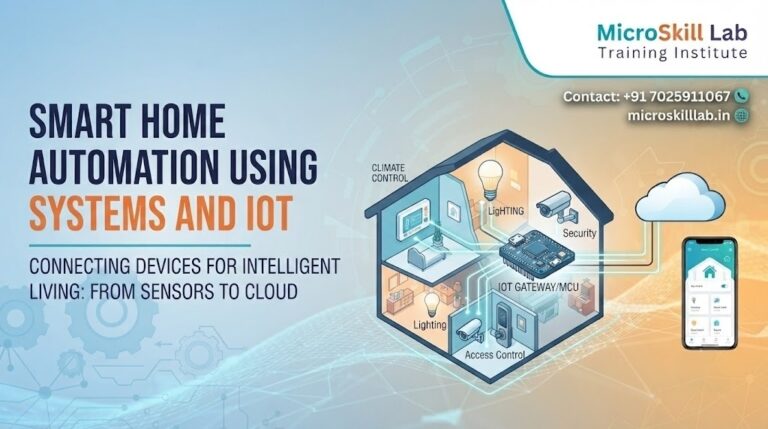
Smart home automation combines embedded systems and IoT to control lights, appliances, and security from one interface. At its core, a microcontroller such as the ESP32 reads sensor data, connects over Wi-Fi, and triggers actions automatically. For IoT enthusiasts across Bangalore and South India, this field blends hardware, firmware, and connectivity into a highly practical skill. Our trainers at Microskill Lab Training Institute teach learners to build working systems from scratch. This guide explains how the technology works, what you can build, and how to master it.
⚡ Key Takeaways
- You gain a clear understanding of how embedded systems and IoT power modern connected homes.
- You learn why the ESP32 and Wi-Fi connectivity sit at the centre of most automation projects.
- You discover the communication protocols that let sensors, boards, and apps talk to each other.
- You see realistic career paths and INR salary benchmarks for IoT roles in Bangalore.
- You get a practical roadmap to build your first project with genuine confidence.
What Is Smart Home Automation With Embedded Systems and IoT?
This technology uses connected electronics to monitor and control household devices without constant manual effort. Embedded systems provide the local intelligence, while IoT provides the network layer linking everything to the cloud and your phone. Together they turn ordinary appliances into responsive, programmable systems that react to real conditions.
The Role of Embedded Systems
An embedded system is a compact computer built into a device to perform a dedicated task. In a connected home, boards such as the ESP32 or Arduino read inputs from sensors and drive outputs like relays and motors. Our curriculum in the Embedded Systems Pro Programme trains learners to write firmware that handles these tasks reliably.
Every automation product, from smart bulbs to door locks, runs on embedded logic underneath the surface. Learning this layer first gives you the foundation the rest of the system depends on. It also explains why firmware skills remain in steady demand across the electronics industry.
Where IoT Fits In
IoT extends embedded systems by adding internet connectivity and remote access. A Wi-Fi enabled board sends sensor data to a cloud dashboard, and you send commands back from anywhere. This two-way flow is what separates a true connected home from simple local control.
Learners in our IoT Programme practise building these connected pipelines end to end. They configure boards, cloud brokers, and mobile access as one integrated system. That full-stack view is exactly what modern product teams expect from new engineers.
Why This Skill Matters for Your Career in Bangalore in 2026
Bangalore is India’s electronics and IoT hub, home to firms in Electronic City, Whitefield, and Manyata Tech Park. Demand for engineers who understand both embedded systems and IoT keeps growing across Karnataka’s hardware sector. This makes automation skills a strong entry point into a well-paid technical career.
Rising Industry Demand
Product companies and startups across Bangalore actively hire for embedded and IoT roles. Named employers such as Bosch, Wipro, and Tata Elxsi are often cited as recruiters here, though learners should verify current openings directly. Skills in ESP32 firmware, sensor integration, and Wi-Fi communication map directly to these job descriptions.
Our Electronics Fundamentals course builds the base these roles expect. It covers circuits, components, and measurement before you move into firmware. Starting here prevents the knowledge gaps that trip up many self-taught beginners.
Salary Benchmarks in INR
Entry-level IoT and embedded engineers in Bangalore can expect indicative salaries of roughly ₹4–8 LPA. With a few years of experience, this can rise to around ₹10–18 LPA in strong product roles. These figures are indicative and should be verified against current market data before you rely on them.
Even so, the trend is clear: connected-device expertise commands a premium in Karnataka’s tech economy. Building visible smart home automation projects is one of the most direct ways to prove that expertise. Recruiters consistently value candidates who can show working hardware over theory alone.
Core Hardware: ESP32, Arduino, and Sensors
The hardware layer is where every smart home automation project begins. Choosing the right board and sensors shapes what your system can do and how easily it connects. Most modern builds centre on the ESP32 for its built-in Wi-Fi and processing power.
Why the ESP32 Leads Connected Homes
The ESP32 pairs a dual-core processor with integrated Wi-Fi and Bluetooth, making it ideal for connected projects. It handles sensor reading, decision logic, and networking on a single low-cost chip. This integration is why it dominates hobbyist and professional automation designs alike.
Our trainers guide learners through ESP32 programming inside the Arduino Programming course. The Arduino framework runs cleanly on the board, so beginners move from simple LED control to full automation quickly. That gentle learning curve makes the ESP32 a superb first platform.
Common Sensors and Actuators
Sensors are the senses of a connected home, and actuators are its muscles. Temperature, motion, gas, and light sensors feed data to the microcontroller, which then decides what to do. Getting comfortable with these components early makes every later project easier.
Typical parts you will work with include:
- PIR motion sensors for security and lighting triggers
- DHT22 temperature and humidity sensors for climate control
- Relay modules for switching lights and appliances safely
- LDR light sensors for automatic day and night detection
- Gas and smoke sensors for essential safety alerts
Communication Protocols That Connect Everything
Every project depends on devices exchanging data reliably. Communication protocols define how sensors, boards, and cloud services talk to each other. Understanding these protocols is essential for building systems that stay stable and scalable.
Wired Protocols: I2C, SPI, and UART
Inside a device, boards talk to sensors using short-range wired protocols. I2C connects many sensors over just two wires, SPI offers high speed for displays and memory, and UART handles simple serial links. Each protocol suits a different job, and knowing when to use which is a core engineering skill.
Our PIC Microcontroller Programming course covers these protocols in depth. Learners wire real devices and read live signals rather than studying diagrams alone. Mastering this debugging skill helps them clear hardware faults that stall many beginner projects.
Wireless Protocols: Wi-Fi, MQTT, and BLE
For remote access, connected homes rely on wireless links. Wi-Fi carries data to the internet, MQTT provides a lightweight messaging layer for IoT, and BLE handles nearby low-power devices. The ESP32 supports Wi-Fi and BLE natively, which greatly simplifies the design.
Learners practise sending sensor data over MQTT so their projects reach real cloud dashboards. They also learn to secure these links, a step many tutorials skip entirely. This attention to reliability is what turns a demo into a dependable product.
Ready to build real connected devices instead of just reading about them? Our hands-on labs let you program the ESP32, wire live sensors, and deploy working automation with trainer support at every step. Explore the IoT Programme →
Building Your First Smart Home Automation Project
Turning theory into a working build is the best way to learn. A first project teaches wiring, firmware, connectivity, and debugging in one continuous flow. This practical experience is exactly what employers in Bangalore look for.
A Simple Automated Lighting System
A great starter build is a motion-activated light with remote override. You connect a PIR sensor and a relay to an ESP32, then write firmware to switch the light on movement. Adding Wi-Fi control lets you toggle the same light from a phone app.
This single project touches sensors, actuators, protocols, and connectivity at once. It gives you a complete, visible result in a short span of time. Finishing it builds the confidence needed to attempt larger, more ambitious systems.
Scaling to a Full Home System
Once one node works, you can expand into a multi-room system. Each room gets its own ESP32 node reporting to a central dashboard over MQTT. Coordinating several nodes introduces new challenges in timing and data handling.
Learners in our advanced tracks integrate these nodes into one coordinated system. This mirrors how commercial products are architected in the real world. The jump from single node to full network is where real engineering intuition develops.
Real-World Applications You Can Build and Sell
Smart home automation is not only an academic exercise; it solves everyday problems people pay for. Understanding practical use cases helps you design projects that impress recruiters and clients. Each application below maps to skills our learners practise directly on real hardware.
Energy, Comfort, and Convenience
Automated lighting and climate control are the most common starting points. An ESP32 reading temperature and occupancy can cut wasted power without any manual input. These systems appeal strongly in Indian homes where electricity costs and load management both matter.
Convenience features extend this further with voice control and app scheduling. Learners connect their boards to popular assistants and mobile dashboards during projects. This blend of comfort and savings is what makes automation genuinely marketable.
Security and Safety Systems
Security is one of the highest-value uses of connected electronics. Motion sensors, door contacts, and cameras feed an ESP32 that alerts your phone instantly. Gas and smoke sensors add a safety layer that protects families around the clock.
Our learners build these alert pipelines end to end using real sensors and cloud messaging. They handle the tricky parts, such as avoiding false alarms and ensuring reliable delivery. These are precisely the engineering details that separate a toy from a trustworthy product.
Comparing Learning Paths for Smart Home Automation
Choosing how to learn shapes how fast you progress and how far you get. Each route carries its own trade-offs in cost, support, and job readiness. The table below compares three common approaches so you can decide what fits your goals.
Structured Training Versus Self-Learning
| Approach | Hands-On Practice | Trainer Support | Job Readiness |
|---|---|---|---|
| Self-learning online | Limited by your own kit | None | Slow and uneven |
| Generic bootcamp | Some simulated labs | Occasional | Moderate |
| Microskill Lab programme | Real boards and sensors | Continuous mentoring | Strong and project-led |
What Structured Programmes Add
Self-learning can teach basics, but structured programmes add mentorship, real hardware, and a clear path. Our learners work on physical boards rather than simulations alone. This closes the gap between watching tutorials and building deployable systems.
For many beginners, that difference decides whether a project ever gets finished. Guidance at the right moment prevents small blockers from becoming quitting points. A structured route also keeps your learning ordered instead of scattered across random videos.
How to Choose the Right IoT Training Institute in Bangalore
Not every course delivers the same depth or the same outcomes. Picking the right institute in Bangalore protects both your time and your money. A few practical criteria help you compare your options fairly.
Criteria That Matter Most
The right provider should give you real practice, not just recorded theory. Weighing a handful of clear factors keeps your decision grounded and objective. Look closely before you commit your fees and months of effort.
When you evaluate a training provider, weigh these factors:
- Access to real hardware, not just online simulators
- Trainers with genuine industry and firmware experience
- A curriculum covering ESP32, sensors, and communication protocols
- Live project work you can show recruiters
- Ongoing support through your entire learning journey
Why Learners Choose Microskill Lab
Our institute has trained learners across Karnataka, Kerala, Tamil Nadu, and beyond. We focus on practical, hands-on outcomes rather than theory alone. Learners finish with real projects and a working grasp of embedded systems and IoT.
This project-led approach reflects what Bangalore’s product companies genuinely value. It also gives each learner something concrete to show at interviews. To start your journey, reach out through our enquiry and enrolment page.
Frequently Asked Questions
Do I need coding experience to start smart home automation?
No prior coding experience is strictly required to begin. Our beginner tracks introduce embedded C and the Arduino framework step by step. Most learners write their first working ESP32 program within the early sessions.
Is the ESP32 better than Arduino for a connected home?
The ESP32 is generally better for connected projects thanks to built-in Wi-Fi and Bluetooth. Classic Arduino boards need extra modules to add wireless features. That said, the Arduino framework runs on the ESP32, so you effectively learn both together.
What career roles can these skills lead to?
These skills open roles such as embedded engineer, IoT developer, and firmware engineer. Bangalore’s product companies actively hire for these positions across the electronics sector. Building visible automation projects strengthens your profile for such roles.
How long does it take to build a working project?
Most learners complete a first working build within a few weeks of focused practice. The starter lighting project can come together in a single guided session. Larger multi-node systems naturally take longer as complexity and integration grow.
Which board should a complete beginner start with?
The ESP32 is the most sensible starting board for a complete beginner today. Its built-in Wi-Fi removes the need for extra modules on early projects. Combined with the Arduino framework, it offers the smoothest path from idea to working device.