
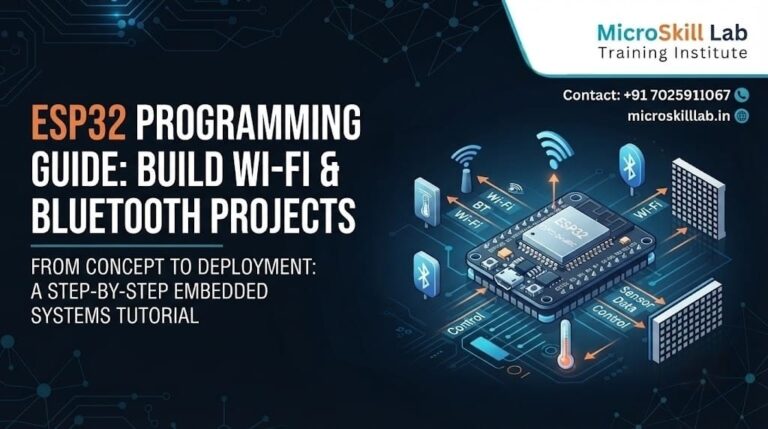
ESP32 programming lets you build Wi-Fi and Bluetooth embedded projects using a single low-cost microcontroller and the Arduino IDE. For IoT developers, students, and freshers across Bangalore and South India, it is the fastest route from breadboard prototype to a connected product. At Microskill Lab Training Institute, we teach ESP32 programming through hands-on labs where learners flash real firmware, read sensors, and push data to the cloud. This guide walks you through the chip, the toolchain, and the project workflow our trainers use every day. You will finish knowing exactly how to start your journey.
⚡ Key Takeaways
- You will understand what the ESP32 is and why it dominates hobby and industrial IoT projects.
- You will learn how to set up the Arduino IDE and flash your first ESP32 program.
- You will see how Wi-Fi and Bluetooth work together on one affordable microcontroller.
- You will discover practical IoT projects that build a job-ready portfolio.
- You will know the salary benchmarks and hiring demand for ESP32 skills in Bangalore.
- You will get a clear roadmap from beginner blink sketch to live cloud deployment.
What Is the ESP32 and Who Should Learn It?
The ESP32 is a low-cost, low-power microcontroller with built-in Wi-Fi and Bluetooth from Espressif Systems. It has become the default choice for connected devices because one chip replaces a separate processor and radio module. We see it everywhere in Bangalore startups building smart-home, agritech, and industrial monitoring products.
Learning ESP32 programming therefore means learning a genuinely job-relevant platform, not a toy. The chip appears in commercial products, student capstones, and rapid prototypes alike. That breadth is precisely why our curriculum treats it as a core embedded skill.
A Microcontroller Built for IoT
Unlike a bare Arduino Uno, the ESP32 packs a dual-core processor, generous memory, and wireless radios onto a single board. This combination makes it ideal for embedded programming projects that need internet connectivity from day one. The chip also includes plenty of input-output pins, analog channels, and hardware timers for real sensor work.
Our trainers value the ESP32 because it teaches modern IoT concepts without demanding an expensive lab setup. A learner can prototype a full connected device for a few hundred rupees. Our Arduino programming course starts learners here before advancing to production-grade firmware.
Who Benefits Most From ESP32 Skills
ECE, EEE, and CSE students gain the most, along with freshers targeting embedded roles in Electronic City and Whitefield. Working professionals upskilling from web development into hardware also find the ESP32 approachable. Anyone who has struggled with complex toolchains will appreciate how quickly this microcontroller gets results.
The ESP32 also suits hobbyists and final-year students building academic projects on tight budgets. Because the same skills transfer to industrial IoT roles, early practice pays off later. We have guided many South India learners from their first sketch to confident embedded work.
Why ESP32 Programming Matters for Your Career in 2026
Demand for embedded and IoT engineers keeps climbing across Karnataka’s electronics corridor. Companies building connected products need developers who can write firmware and handle wireless communication together. ESP32 programming sits at the exact centre of that valuable skill set.
Employers increasingly want engineers who understand both the hardware and the connectivity layer. A candidate fluent in ESP32 programming signals exactly that combined capability. This makes the skill a strong differentiator in a crowded fresher job market.
Bangalore's IoT Hiring Landscape
Firms around Manyata Tech Park and Electronic City recruit steadily for embedded and IoT talent. Product companies, automotive suppliers, and hardware startups all list microcontroller experience as a core requirement. Our trainers, drawn from this same industry, shape the curriculum around what these employers actually test.
Bangalore’s position as India’s electronics and IT hub means fresh openings appear regularly. The broader Karnataka manufacturing and MSME ecosystem adds further demand for practical hardware skills. Learners who master ESP32 programming position themselves well for this steady flow of roles.
Salary Benchmarks for ESP32 Developers
Embedded engineers in Bangalore with ESP32 and IoT skills typically earn between ₹4–9 LPA early in their careers. With a few years of experience, that range can rise toward ₹12–18 LPA depending on specialisation. These INR figures are indicative and vary by company, role, and interview performance, so verify current ranges before making career decisions.
Wireless and IoT expertise often commands a premium over pure firmware roles. Developers who can show live projects tend to negotiate better starting offers. Our IoT training programme is built to help learners reach that first embedded role.
Setting Up the Arduino IDE for ESP32
The Arduino IDE is the friendliest entry point into ESP32 programming for beginners. It hides much of the complexity while still giving you full control over the microcontroller. We start every foundation batch here so learners see results within the first session.
Because the IDE runs on modest laptops, it removes a common barrier for students. There is no costly software licence and no intimidating command-line setup to master first. This accessibility keeps early ESP32 programming momentum high for beginners.
Installing the ESP32 Board Package
You add a single board-manager URL, install the ESP32 package, and select your specific board. From there the familiar Arduino workflow of write, verify, and upload applies directly to the ESP32. This gentle path means learners spend time building, not fighting their tools.
Once installed, the IDE exposes dozens of example sketches tailored to the ESP32. These examples become a practical reference library as projects grow more ambitious. Our electronics fundamentals course ensures learners understand the hardware they are flashing.
Your First Blink and Serial Sketch
The classic blink sketch confirms your toolchain works before you touch wireless features. Next, printing sensor readings to the serial monitor teaches you how to debug embedded programming projects. These small early wins build the confidence needed for bigger builds.
We deliberately slow down on these first steps because good habits form here. Learners practise reading error messages, checking wiring, and interpreting serial output calmly. That disciplined foundation pays off when Wi-Fi and Bluetooth logic gets more complex.
Wi-Fi Programming on the ESP32
Wi-Fi is the ESP32’s headline feature and the reason it powers so many IoT projects. With a few lines of code, your microcontroller joins a network and talks to servers. This is where a simple sensor project becomes a genuine connected device, and where ESP32 programming truly shines.
Connecting to Networks and the Cloud
The ESP32 can act as a Wi-Fi client, a hotspot, or both at once for flexible deployments. Learners send temperature or humidity data to cloud dashboards and control outputs remotely over the internet. We guide each learner through a live capstone that pushes real sensor data online.
Along the way, learners meet lightweight protocols like MQTT that keep IoT traffic efficient. They also handle reconnection logic so devices survive real-world network drops. These are exactly the robustness details Bangalore product teams probe during interviews.
Building a Web Server on Your Board
The ESP32 can host its own web page to display readings or accept commands from a browser. This teaches the request-response fundamentals behind every IoT application. Learners quickly grasp how front-end controls translate into hardware actions.
Hosting a local server also removes the need for external infrastructure while prototyping. A single board becomes a complete demonstrable product for a project review. Our Embedded Systems Pro Programme extends these ideas into professional firmware architecture.
Ready to build real Wi-Fi and Bluetooth projects with expert guidance? Our Bangalore trainers take you from your first blink sketch to a live cloud-connected capstone. Explore the IoT Programme →
Bluetooth and BLE Programming on the ESP32
The ESP32 supports both Classic Bluetooth and Bluetooth Low Energy on the same chip. This lets developers build battery-friendly wearables, beacons, and phone-controlled gadgets. It is a skill Bangalore product teams increasingly expect from embedded hires.
Having both radios on one board keeps designs simpler and cheaper. Developers avoid juggling separate modules and their competing libraries. This integration is a major reason ESP32 programming feels so productive.
Classic Bluetooth Versus BLE
Classic Bluetooth suits continuous data streams like audio, while BLE excels at short, power-efficient bursts. Choosing correctly is a real engineering decision our trainers help learners reason through. Understanding both widens the range of IoT projects you can confidently take on.
BLE in particular unlocks long battery life for sensor nodes and wearables. That efficiency matters for the connected products increasingly built across South India. We make sure learners can justify their Bluetooth choices, not just implement them.
Phone-to-Board Communication Projects
Learners pair a smartphone with the ESP32 to send commands and receive sensor values wirelessly. This bridges mobile apps and hardware, a combination that stands out in a fresher’s portfolio. It also mirrors how many commercial IoT products are actually controlled through everyday ESP32 programming.
Building even a simple phone-controlled device teaches valuable debugging across two systems. Learners see how firmware and app behaviour must agree on data formats. Our PIC microcontroller course offers a useful contrast for learners comparing architectures.
Practical IoT Projects to Build Your Portfolio
Employers hire on demonstrated ability, so a project portfolio matters more than certificates alone. The ESP32 makes it easy to build varied, impressive projects on a modest budget. We ensure every learner leaves with tangible builds to show interviewers.
A strong portfolio turns abstract ESP32 programming knowledge into visible proof of skill. Interviewers in Bangalore consistently respond well to working demonstrations. We therefore treat project quality as seriously as classroom theory.
Beginner-Friendly Starter Projects
Good starting builds include a Wi-Fi weather station, a Bluetooth-controlled LED, and a smart-plug prototype. Each teaches a distinct microcontroller and sensor concept without overwhelming a newcomer to ESP32 programming. These projects map directly to questions asked in Bangalore embedded interviews.
As confidence grows, learners combine ideas into richer capstone builds. A home-automation node or a remote monitoring device shows real integration ability. We review each project so learners can explain their design decisions clearly.
Tools and Technologies You Will Master
Across our labs, learners work hands-on with a broad, industry-relevant toolkit:
- ESP32 development boards and the Arduino IDE toolchain
- Common sensors for temperature, motion, light, and humidity
- Wi-Fi protocols, MQTT messaging, and cloud dashboards
- Bluetooth and BLE for phone-to-board communication
- Serial debugging and basic firmware troubleshooting
How to Choose the Right ESP32 Training in Bangalore
Not every course delivers the practical depth that employers reward. The right institute balances strong fundamentals with real hardware time and career support. We built our programmes around exactly this balance for South India learners.
Choosing well early saves months of unfocused, frustrating self-study later. A good ESP32 programming course sequences concepts so each build feels achievable. That structure is what separates steady progress from stalled motivation.
What to Look for in a Training Institute
For ESP32 programming, prioritise hands-on lab access, trainers with real industry experience, and a project-driven curriculum. Beware courses that rely only on slides and simulators without real boards in learners’ hands. The eligibility and enrolment path should stay clear and beginner-friendly:
- Open to ECE, EEE, CSE, and diploma students across Karnataka and South India
- Suitable for freshers, final-year students, and working professionals
- Basic electronics awareness helps but is not mandatory to begin
- Enquire directly to confirm current batch dates and eligibility
Why Learners Across South India Choose Us
Students from Karnataka, Kerala, Tamil Nadu, Telangana, Andhra Pradesh, and Pondicherry train with us for practical, mentored learning. Our small batches and live projects mirror real workplace expectations. That personal attention helps learners move faster than they would alone.
We stay reachable throughout the learning journey, not just at enrolment. Trainers answer doubts the same day so momentum never stalls. Reach out through our enquiry page to discuss the right starting point for you.
ESP32 Programming: Course Comparison
The table below shows how guided training compares with learning entirely on your own.
| Factor | Self-Learning | Microskill Lab Training |
|---|---|---|
| Structured path | Scattered tutorials | Clear step-by-step curriculum |
| Hardware access | Buy everything yourself | Guided lab environment |
| Doubt support | Forums and delays | Mentored, same-day help |
| Live projects | Self-directed only | Trainer-reviewed capstone |
| Career readiness | Uncertain | Interview and portfolio focus |
Frequently Asked Questions
Is the ESP32 good for beginners?
Yes. The ESP32 pairs beginner-friendly Arduino IDE support with powerful Wi-Fi and Bluetooth features. Beginners see quick results while still learning production-relevant skills.
Do I need prior coding experience to learn ESP32 programming?
Basic familiarity helps, but our foundation batches start from the essentials. We guide complete beginners from their first sketch to a working IoT project. Structured ESP32 programming practice makes the learning curve genuinely manageable.
Can I learn ESP32 programming online in Bangalore?
Yes, we offer blended and onsite options for learners across Bangalore and South India. Hands-on hardware practice remains central to every format we run. You always work on real ESP32 boards, not simulators alone.