
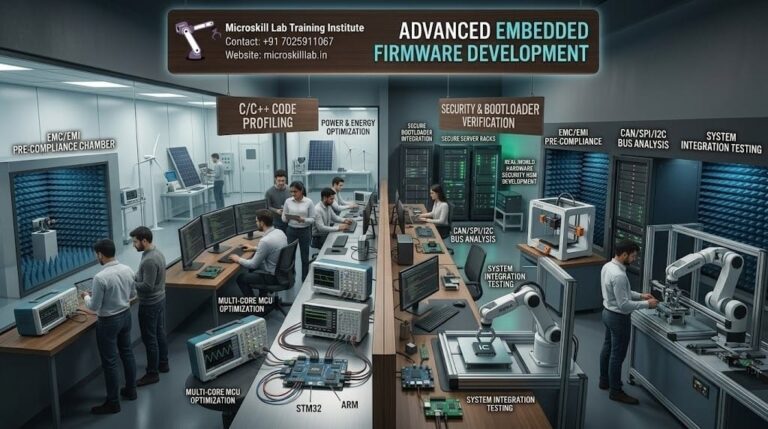
Embedded firmware development is the practice of writing the low-level software that runs directly on microcontrollers and controls physical hardware, from washing machines to electric vehicles. For engineering freshers and beginner firmware developers across Bangalore and India, this field offers one of the most stable and well-paid career paths in electronics. Firmware sits between the silicon and the application, telling the chip exactly what to do at every clock cycle. It is the reason a device wakes from sleep, reads a sensor, and acts on that data without any human involvement. At Microskill Lab Training Institute, our trainers teach this discipline through hands-on labs using real microcontrollers, embedded C, and industry-standard toolchains. This guide walks you through what firmware development is, the skills you need, the tools professionals use, and how to build a lasting career in it across South India.
⚡ Key Takeaways
- You will understand what embedded firmware is and how it differs from ordinary application software.
- You will learn the core skills every firmware developer needs, including embedded C, microcontroller architecture, and debugging.
- You will discover why ARM-based development and RTOS knowledge command premium salaries in Bangalore.
- You will see how bootloaders, memory management, and communication protocols fit into real products.
- You will gain a clear roadmap from beginner to job-ready embedded software engineer.
- You will know how to choose the right training path in Karnataka and South India.
What Is Embedded Firmware Development?
Embedded firmware development means writing the permanent software programmed into a microcontroller or embedded system to control its hardware functions. Unlike a mobile app that runs on top of an operating system, firmware often runs on bare metal, directly managing registers, timers, and peripherals. This software is typically stored in non-volatile memory such as flash and executes the moment the device powers on. Firmware is what makes a smart thermostat read temperature, a drone stabilise itself, and a car’s airbag deploy in milliseconds.
How Firmware Differs From Software
Ordinary software assumes an operating system handles memory, files, and scheduling for you. Firmware frequently has no such luxury and must manage every resource itself within tight constraints. A firmware developer thinks in kilobytes of RAM, microsecond timing, and direct hardware access rather than gigabytes and abstractions. Every byte of memory and every clock cycle is accounted for, which forces a discipline that many application programmers never develop. This mindset shift is the first thing our curriculum addresses, because it separates embedded engineers from general programmers. Understanding this distinction early helps beginners avoid the habits that do not translate to constrained devices.
Who Should Learn Firmware Development
This field suits ECE, EEE, and CSE graduates who enjoy working close to hardware and solving precise technical problems. Working professionals from IT backgrounds also transition into firmware to enter the growing embedded and IoT sector. Beginners with strong logical thinking and patience for debugging tend to thrive in embedded roles. If you like knowing exactly why a system behaves the way it does, firmware rewards that curiosity. Our beginner-friendly Embedded Systems Pro Programme is built precisely for these learners.
Core Skills Every Firmware Developer Needs
Firmware development rests on a handful of foundational skills that every beginner must build deliberately. The most important is embedded C, the language that dominates the industry because it balances low-level control with readability. Alongside coding, you need to understand microcontroller architecture, memory maps, and how peripherals communicate with the processor core. Debugging discipline, version control, and the ability to read a datasheet closely round out the essential toolkit. Our trainers in Bangalore structure lessons so each skill builds logically on the previous one, mirroring how real product teams onboard junior engineers. Mastery of these fundamentals is what employers in Electronic City and Whitefield look for first.
Embedded C and Programming Fundamentals
Embedded C extends standard C with concepts like volatile variables, bit manipulation, and direct register access. Beginners learn to write efficient code that fits within kilobytes and runs without wasting a single clock cycle. Pointers, structures, and memory-mapped input and output become daily tools rather than abstract theory. Learners also practise reading compiler warnings carefully, since a single overlooked bug can freeze an entire device. We reinforce these ideas through lab exercises on actual hardware, not just simulators. This hands-on approach is central to our Arduino Programming foundation track for absolute beginners.
Microcontroller and Hardware Understanding
A firmware developer must read datasheets and understand how a chip’s timers, interrupts, and communication buses work. You will study families such as 8-bit PIC and AVR devices before moving to more powerful 32-bit processors. Understanding clock configuration, power modes, and pin multiplexing turns abstract diagrams into working systems. Our PIC Microcontroller Programming course gives beginners a solid grounding in this hardware layer. This knowledge makes debugging far easier when real projects misbehave.
Understanding ARM Architecture and Its Importance
ARM has become the dominant processor architecture in modern embedded systems, powering billions of devices worldwide. Most smartphones, IoT gadgets, and automotive control units in India now run on ARM Cortex cores. For a beginner firmware developer, learning ARM opens doors to the highest-paying and most future-proof roles. India’s growing semiconductor push under national initiatives has further increased demand for engineers who understand this architecture deeply. Bangalore hosts design centres for many global semiconductor companies that specifically hire ARM-skilled engineers. This is why our advanced modules place strong emphasis on Cortex-M development.
Why ARM Dominates Modern Embedded Systems
ARM cores offer an excellent balance of performance, low power consumption, and cost that suits battery-powered devices. The Cortex-M family is designed specifically for microcontrollers and real-time control applications. A rich ecosystem of tools, libraries, and community support makes ARM approachable even for newcomers. Standardised interfaces mean skills learned on one Cortex-M chip transfer easily to another vendor’s part. Companies choose ARM because a single skill set scales from tiny sensors to complex gateways. Learning it early gives beginners a durable advantage in the job market.
Getting Started With ARM Cortex Development
Beginners typically start with an affordable ARM development board and a free professional toolchain. You will learn to configure clocks, drive peripherals, and step through code with a hardware debugger. Vendor tools generate startup code, which lets you focus on application logic while understanding what runs underneath. Setting breakpoints and watching registers change in real time turns confusing bugs into clear, solvable problems. Our trainers demystify this process so the transition from 8-bit chips feels natural. Practical ARM projects form a core part of our advanced embedded curriculum in Bangalore.
Bootloaders, RTOS, and Advanced Firmware Concepts
Once beginners master the basics, firmware development opens into powerful advanced topics that define professional work. Bootloaders let devices update their own firmware safely in the field, a critical feature for connected products. A real-time operating system, or RTOS, lets a single microcontroller juggle many tasks with predictable timing. Communication protocols such as I2C, SPI, UART, and CAN then tie these systems to sensors, displays, and other controllers. These concepts appear in almost every serious embedded product shipping from Indian companies today. Understanding them separates a hobbyist from an employable firmware engineer.
What a Bootloader Does
A bootloader is a small program that runs first and decides whether to load new firmware or start the main application. It enables over-the-air updates, which keep IoT devices secure long after they leave the factory. Writing a reliable bootloader teaches beginners about flash memory, memory partitioning, and safe update procedures. Good bootloaders also verify each new image before running it, so a corrupted download never bricks the device. This skill is highly valued because faulty updates can permanently disable expensive hardware. We cover bootloader design as part of our deeper embedded and Embedded Linux Development pathways.
Introduction to RTOS
An RTOS provides task scheduling, timing guarantees, and inter-task communication for complex embedded applications. Beginners learn concepts like tasks, semaphores, queues, and priority scheduling using popular open-source kernels. Real-time behaviour matters when a system must respond within strict deadlines, as in motor control or medical devices. Learners see how poor task design causes missed deadlines, and how careful priority assignment fixes them. Our curriculum introduces RTOS gradually so the ideas feel intuitive rather than overwhelming. This prepares learners for the multitasking firmware that modern products demand.
Career Scope and Salary Outlook in Bangalore
Bangalore is India’s undisputed embedded systems capital, home to design centres for automotive, aerospace, and consumer electronics firms. Demand for skilled firmware developers continues to grow as electric vehicles, IoT, and smart devices expand across the country. The rise of domestic electronics manufacturing and defence electronics has added even more roles for firmware talent in Karnataka. Beginners who build genuine hardware skills find that this field offers stability and long-term growth. Companies across Manyata Tech Park and Electronic City actively recruit firmware talent throughout the year. The salary outlook reflects this steady, specialised demand.
Salary Benchmarks for Firmware Engineers
Entry-level firmware developers in Bangalore typically earn around ₹4–7 LPA, with figures rising quickly as skills deepen. Mid-level engineers with ARM and RTOS expertise often command ₹9–16 LPA depending on domain and company. Specialists in automotive or safety-critical firmware can earn considerably more at senior levels. Domain knowledge in areas like electric vehicles or medical devices tends to push compensation toward the higher bands. These ranges are indicative and vary by employer, so treat them as a guide rather than a guarantee. Building a strong project portfolio is the fastest way to reach the upper end.
Roles You Can Target After Training
Completing structured training opens several distinct career doors for beginners entering the field. Common roles include:
- Firmware Developer building device software on microcontrollers.
- Embedded Software Engineer working on drivers and application layers.
- IoT Firmware Engineer connecting devices to cloud platforms through our IoT Programme.
- Embedded Systems Engineer handling both hardware and software integration.
Each role builds on the same firmware foundation, so early skills compound throughout your career.
How to Choose the Right Firmware Training in Bangalore
Choosing the right institute shapes how quickly a beginner becomes job-ready in embedded firmware. The best programmes prioritise hands-on hardware time over pure theory and lecture slides. Look for trainers with real industry experience and a curriculum that mirrors actual product development. A good institute also keeps batch sizes small so every learner gets personal attention during lab sessions. Placement support, live projects, and a strong South India alumni network add lasting value. Microskill Lab has trained learners from Karnataka, Kerala, Tamil Nadu, Andhra Pradesh, Telangana, and Pondicherry since its founding.
Comparing Learning Paths
Different learning approaches suit different beginners depending on time, budget, and discipline. The table below compares common options for firmware learners in India.
| Learning Path | Hands-On Hardware | Mentor Support | Job Readiness |
|---|---|---|---|
| Self-learning online | Limited | None | Slow and uneven |
| Generic online course | Minimal | Delayed | Moderate |
| Microskill Lab training | Extensive | Direct trainer access | Strong and structured |
What to Look for in a Curriculum
A strong firmware curriculum moves logically from electronics basics to advanced ARM and RTOS topics. Beginners benefit from starting with our Electronics Fundamentals before layering on programming. Ensure the course includes real debugging, communication protocols, and a capstone project you can show employers. A well-designed capstone lets you demonstrate genuine hardware experience during interviews, which matters far more than certificates alone. Ask whether hardware boards, tools, and one-to-one doubt clearing are part of the package. The right blend of theory and practice turns a curious beginner into a confident engineer.
Ready to build real, job-ready firmware skills? Our Bangalore trainers guide you from your first line of embedded C to a complete working project on actual hardware. Enrol in the Embedded Systems Pro Programme →
Frequently Asked Questions
Do I need an electronics background to learn firmware development?
A background helps, but it is not mandatory for motivated beginners. Many of our learners come from CSE or non-core branches and succeed with structured guidance. We start with electronics fundamentals so everyone builds on solid ground. Consistent practice matters far more than your original branch.
Which programming language should a beginner learn first?
Embedded C is the essential first language because it dominates real firmware work. Once you are comfortable, exposure to C++ and assembly deepens your understanding. Our curriculum begins with C and hardware basics before advancing. This sequence builds confidence without overwhelming newcomers.
How long does it take to become job-ready in firmware?
Most focused beginners reach a solid, employable level within a few months of consistent training. The exact time depends on your starting point and practice hours. Live projects and portfolio work accelerate readiness considerably. Our trainers help you set a realistic personal timeline.
Is firmware development a good career choice in India in 2026?
Yes, embedded and firmware roles remain in strong demand across Bangalore and India. Growth in electric vehicles, IoT, and semiconductors keeps opportunities expanding. Skilled firmware engineers enjoy stability and steady salary progression. It is one of the most durable paths in electronics today.
To start your journey, reach out through our contact page and speak with our team about the right beginner track for you.