
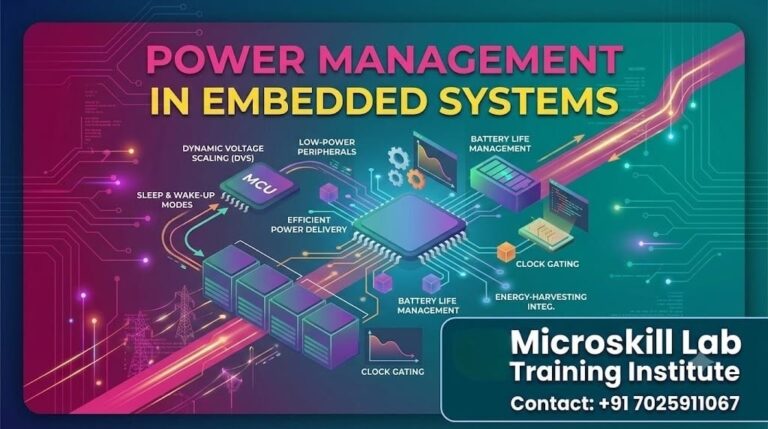
Power Management in Embedded Systems: Engineer's 2026 Guide
Power management in embedded systems is the practice of reducing the energy a microcontroller-based device consumes across active, idle, and sleep states without sacrificing performance. For embedded engineers across Bangalore, Kerala, Tamil Nadu, and the wider India electronics sector, mastering these techniques is now essential as battery-powered IoT products dominate the market. Our trainers at Microskill Lab Training Institute teach these methods through live hardware, from clock gating and dynamic voltage scaling to low-power firmware design on ARM Cortex-M and PIC microcontrollers. This guide explains the core techniques, the tools you will use, the career value in Karnataka’s growing hardware sector, and how structured training accelerates your path to a low-power design role.
⚡ Key Takeaways
- You will learn how active, sleep, and deep-sleep power modes cut battery drain in real embedded designs.
- You will understand dynamic voltage and frequency scaling as a practical energy-efficiency lever on ARM devices.
- You will see how firmware choices, not just hardware, determine the battery life of IoT devices.
- You will gain measurement skills using current profilers to validate low-power claims on real boards.
- You will discover how power-management expertise raises earning potential for embedded engineers in Bangalore.
- You will map a clear learning path from fundamentals to production-ready low-power firmware.
What Is Power Management in Embedded Systems?
Power management in embedded systems covers every technique that controls how much current a device draws while still meeting its functional deadlines. At its core, it balances three competing demands: responsiveness, battery life, and thermal limits. Engineers achieve this balance by switching the processor and peripherals between defined power states, scaling voltage and clock frequency, and shutting down unused hardware blocks. The discipline spans hardware selection, board design, and firmware, which means it touches nearly every stage of an embedded product’s development.
Who Needs These Skills?
This skill set matters most for engineers building battery-powered or energy-harvesting products, where every microamp affects the shipping design. Wearable devices, smart meters, agricultural sensors, and medical monitors all live or die by their power budgets. Our curriculum in the Embedded Systems Pro Programme trains freshers and working engineers to treat power as a first-class design constraint. Many of our learners across Karnataka and Telangana move into roles where low-power design is the primary hiring criterion.
Core Terminology You Must Know
Before optimizing anything, you need a shared vocabulary for the numbers that matter. Quiescent current describes what a device draws while doing nothing useful, and it often dominates the battery budget in sensor nodes. Active current, sleep current, and wake-up latency together define the trade-off space every low-power design navigates. Our trainers ground these terms in datasheet reading, because the ability to interpret an ARM Cortex-M power table separates confident engineers from guesswork.
Why Power Management Matters for Your Career in Bangalore in 2026
Bangalore has become India’s densest cluster of hardware and IoT product companies, and low-power expertise is in short supply. Firms across Electronic City, Whitefield, and Manyata Tech Park design connected devices where battery life is a headline feature. Engineers who can extend that battery life measurably command a real premium in salary negotiations. This demand cuts across product categories, from industrial IoT to consumer wearables to automotive electronics.
Salary Benchmarks for Low-Power Engineers
Embedded engineers in Bangalore with demonstrable low-power design skills earn indicative ranges of roughly ₹6–16 LPA in 2026, depending on experience and domain. Freshers typically start lower, while engineers with three to five years and proven battery-optimization work sit toward the upper band. These figures are indicative and should be verified against current job listings before you rely on them. What holds steady is the pattern: measurable power-optimization outcomes on your résumé strengthen your position with hiring managers.
Hiring Demand Across India's Hardware Sector
Companies such as Bosch, Siemens, Wipro, and a wide base of Karnataka electronics MSMEs recruit engineers who understand power budgets. India’s electronics manufacturing push under the Ministry of Electronics and IT has expanded local product design, increasing demand for low-power skills. Our IoT Programme directly targets this hiring gap with project work on connected, battery-driven devices. Graduates who show real energy-efficiency results tend to convert interviews at a noticeably higher rate.
Power Modes and Sleep States in Microcontrollers
Every modern microcontroller exposes a hierarchy of power modes, and choosing correctly among them is the single highest-impact optimization. These modes range from full active operation down to deep sleep, where only a wake-up source and minimal retention logic stay powered. The art lies in spending as much time as possible in the lowest viable state while still meeting timing requirements. Firmware structure determines whether a device actually reaches these low states or stalls at higher consumption.
Understanding Active, Sleep, and Deep-Sleep Modes
Active mode runs the CPU at full clock and draws the most current, so well-designed firmware minimizes time spent there. Sleep modes halt the CPU while keeping selected peripherals alive, which suits devices that must respond quickly to events. Deep-sleep and standby modes shut down almost everything, trading fast wake-up for dramatic current savings on ARM Cortex-M parts. Our trainers walk learners through configuring these states on real boards in the Embedded Systems Pro Programme.
Wake-Up Sources and Latency Trade-Offs
Choosing a wake-up source is where power strategy meets application requirements in a very concrete way. Timer interrupts, GPIO edges, and low-power comparators each offer different latency and current characteristics. An engineer must weigh how fast the device needs to respond against how much standby current each option costs. We teach this trade-off through measured experiments, so learners see the microamp consequences of each design choice directly.
Dynamic Voltage and Frequency Scaling Techniques
Dynamic voltage and frequency scaling, often shortened to DVFS, adjusts processor voltage and clock speed to match the workload at any moment. Since dynamic power rises with the square of voltage, small voltage reductions yield large energy savings. This technique lets a device run fast when work demands it and drop to an efficient low state otherwise. Modern ARM cores expose the control registers needed to implement DVFS in firmware.
How Clock Gating Reduces Waste
Clock gating disables the clock signal to peripherals and logic blocks that are not currently in use. Because a clock that is not toggling consumes far less dynamic power, gating unused blocks is a low-effort, high-return optimization. Our curriculum shows learners how to identify gateable blocks by reading the peripheral clock tree in the microcontroller reference manual. This habit of reading hardware documentation carefully is a core engineering discipline we build in every batch.
Voltage Scaling on ARM Cortex-M Devices
Voltage scaling lets firmware select a lower core voltage when the application does not need peak performance. Many ARM Cortex-M microcontrollers offer distinct voltage-range or power-scaling settings that trade maximum frequency for lower consumption. Engineers pair these settings with frequency choices to hit a target energy-per-task figure. In our PIC Microcontroller Programming and ARM sessions, learners benchmark the same task across voltage settings to see the savings.
Ready to design devices that run for years on a coin cell? Our hands-on labs put current profilers, real boards, and ARM datasheets in your hands from day one, guided by trainers with production embedded experience. Explore the Embedded Systems Pro Programme →
Battery Optimization and Low-Power Firmware Design
Battery life is decided as much in firmware as in hardware, a truth many engineers learn only after their first product ships early to empty batteries. Poorly structured code that polls sensors or busy-waits will keep a processor awake and drain a battery regardless of how capable the silicon is. Good low-power firmware is event-driven, spends its time asleep, and wakes only when necessary. This mindset shift is often the biggest single improvement an engineer can make.
Event-Driven Firmware Architecture
Event-driven design replaces continuous polling with interrupt-driven wake-ups that let the processor sleep between tasks. Instead of asking a sensor repeatedly whether new data exists, the firmware sleeps until the sensor signals an interrupt. This structure can cut average current by an order of magnitude in sensor-node designs. We teach this architecture on live hardware in our Arduino Programming and advanced embedded tracks.
Peripheral and Communication Power Budgets
Radios and communication peripherals frequently dominate the power budget of IoT devices, so managing them is critical. Duty-cycling a radio, batching transmissions, and choosing efficient protocols all reduce the energy each message costs. Engineers must also account for the current drawn by sensors, memory, and display peripherals across the full duty cycle. Our project work makes learners measure and defend a complete power budget for a working connected device.
Measuring and Profiling Power Consumption
You cannot optimize what you cannot measure, and power measurement is where many low-power projects succeed or fail. Accurate current profiling reveals the true cost of each firmware state and exposes surprises the datasheet never mentions. Engineers use dedicated current-measurement tools to capture microamp-to-milliamp swings across active and sleep transitions. Building measurement discipline early prevents the common trap of optimizing the wrong part of the system.
Tools for Current Profiling
A practical low-power engineer relies on a small set of measurement tools to validate every claim. Common instruments and techniques include:
- Precision current profilers that capture fast active-to-sleep transitions on real boards.
- Shunt-resistor plus oscilloscope setups for visualizing current waveforms directly.
- Multimeters with microamp ranges for steady-state sleep-current checks.
- Energy-per-cycle logging to compare firmware revisions objectively.
Our labs give learners hands-on time with these instruments so the skill transfers directly to the workplace.
Interpreting Measurement Data
Raw current traces mean little until an engineer can connect each feature to a firmware event. The skill lies in correlating a current spike with the exact line of code or peripheral action that caused it. This diagnostic loop, measure then attribute then fix, is the heart of practical power optimization. Our trainers coach learners through this loop on their own project boards until it becomes second nature.
How to Choose the Right Embedded Training Institute in Bangalore
Choosing where to build low-power expertise shapes how quickly you become employable in Bangalore’s competitive market. The best programmes teach power management on real hardware rather than slides, because the skill is fundamentally practical. Look for trainers with production experience, structured measurement labs, and project work that produces a defensible power budget. The right institute treats energy efficiency as a core competency, not an afterthought bolted onto a general syllabus.
What to Look For in a Curriculum
A strong low-power curriculum blends hardware, firmware, and measurement into one continuous thread. Key elements worth checking before you enrol include:
- Hands-on work with real ARM and PIC microcontrollers, not simulators alone.
- Access to current-measurement instruments during lab sessions.
- Project outcomes that require a documented power budget.
- Trainers who can explain trade-offs from shipping-product experience.
Our curriculum across the Embedded Linux Development and embedded hardware tracks is built around exactly these principles.
Comparing Learning Paths
Not every learner needs the same route, and the honest answer depends on your starting point and goals. The table below compares common paths for building power-management skill so you can weigh them clearly.
Learning Path Comparison
| Factor | Self-Study | Generic Online Course | Microskill Lab Hands-On Training |
|---|---|---|---|
| Real hardware access | Rare | Limited | Provided in every batch |
| Current-measurement labs | Usually none | Occasional | Core to the curriculum |
| Trainer feedback on your design | None | Minimal | Direct and project-based |
| Power-budget project outcome | Self-directed | Sometimes | Required deliverable |
| Local hiring-network relevance | Low | Low | Bangalore-focused |
If you want structured guidance and real measurement practice, reach out through our contact and enquiry page to discuss the right track for your goals.
Frequently Asked Questions
What is power management in embedded systems?
Power management in embedded systems is the set of hardware and firmware techniques that reduce a device’s energy use across active, idle, and sleep states. It combines power-mode selection, voltage and frequency scaling, clock gating, and event-driven firmware to extend battery life without hurting performance. Engineers apply it throughout design, from chip selection to final firmware tuning.
Do I need to know ARM assembly to build low-power systems?
No, most low-power work happens in C using vendor peripheral libraries and power-mode APIs rather than raw assembly. A solid grasp of the microcontroller reference manual and datasheet matters far more than assembly fluency. Our trainers focus on this practical, C-based workflow while explaining the underlying hardware behaviour.
How much can firmware alone improve battery life?
Firmware structure often changes average current by a large factor, sometimes an order of magnitude, in sensor-node designs. Moving from polling to event-driven, sleep-first firmware is frequently the single biggest improvement available. Hardware choices set the ceiling, but firmware determines how close a design gets to it.
Which microcontrollers are best for learning low-power design?
ARM Cortex-M families and low-power PIC parts are both excellent starting points because they expose clear, well-documented power modes. Learning on real, widely used hardware transfers directly to industry roles across Bangalore’s product companies. Our programmes use exactly this class of hardware in every batch.