
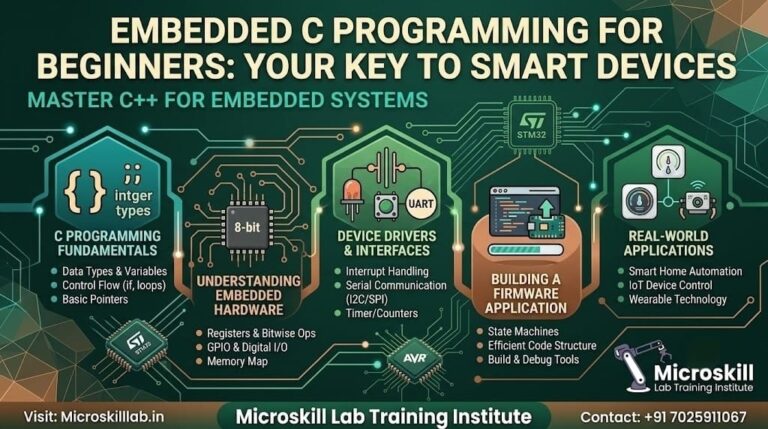
Embedded C programming is the skill of writing C code that runs directly on microcontrollers to control hardware like sensors, motors, and displays. For engineering students and beginners across Bangalore and India, it is the foundational language of firmware development and the single most in-demand skill for embedded systems roles in 2026. This guide walks you through what embedded C is, how it differs from standard C, and the exact path from writing your first LED blink program to building real firmware. Our trainers have taught this progression to hundreds of ECE, EEE, and CSE learners across Karnataka, Kerala, and Tamil Nadu. We have distilled that classroom experience into a practical roadmap you can follow at your own pace.
⚡ Key Takeaways
- You learn what makes embedded C different from desktop C and why it powers nearly every microcontroller-based product.
- You gain a clear beginner roadmap, from toolchain setup to writing your first working firmware.
- You understand the core concepts that hiring managers in Bangalore test for, including registers, memory, and interrupts.
- You see realistic 2026 salary benchmarks in INR for embedded C roles across South India.
- You get a structured comparison of self-learning versus a mentored programme to guide your next step.
What Is Embedded C Programming?
Embedded C is a set of extensions and conventions applied to the standard C language so that it can run on resource-constrained microcontrollers. Unlike desktop C, which runs inside an operating system with abundant memory, embedded C runs on chips with a few kilobytes of RAM and talks to hardware directly. Every beginner should understand this distinction first, because it shapes how you write, compile, and debug your code.
How Embedded C Differs From Standard C
The biggest difference is direct hardware access through memory-mapped registers. In desktop C you print to a screen, whereas in embedded C you write a value to a specific memory address that switches a physical pin on or off. This means you work with fixed-width data types, bit manipulation, and volatile variables far more often. Our curriculum introduces these differences with live hardware from day one, so learners see a real LED respond to their code rather than an abstract console output.
Another key difference is the absence of a full operating system on most microcontrollers. Your code often runs on bare metal, meaning it controls the chip directly without an OS managing resources for you. This makes efficiency and predictable timing far more important than in desktop programming. Beginners who grasp this early write leaner, more reliable firmware from the start.
Who Should Learn Embedded C
Embedded C is ideal for ECE, EEE, and CSE students, diploma holders, and career changers who want to build products rather than just websites. If you enjoy seeing physical results from your code, this field rewards you. Many of our learners in Electronic City and Whitefield start with zero firmware experience and move into junior developer roles within months. You can build the required foundation through our embedded systems training programme, which begins with C fundamentals before touching hardware.
Why Embedded C Matters for Your Career in 2026
Embedded C remains the backbone of the electronics and IoT industry because almost every smart device contains a microcontroller running C firmware. As India expands its electronics manufacturing under government-backed initiatives, demand for engineers who can write reliable firmware keeps climbing. For beginners in Bangalore, this is one of the clearest paths from college to a well-paid engineering role.
India and Bangalore Job Market Demand
Bangalore hosts the largest concentration of embedded and semiconductor teams in India. Firms like Bosch, Wipro, and Siemens, alongside countless product startups, hire firmware talent around Electronic City and Manyata Tech Park. The Ministry of Electronics and IT continues to push domestic chip design and product development, which widens the funnel of embedded roles. Beginners who master embedded C position themselves for this growing market rather than the crowded generic software pool.
Salary Benchmarks for Embedded Roles
Embedded C skills command strong pay because the talent pool is smaller than the web development pool. As an indicative benchmark for 2026, embedded firmware freshers in Bangalore typically earn ₹4–7 LPA, while engineers with two to four years of experience often reach ₹9–16 LPA. These figures are indicative and vary by company and skill depth, so treat them as directional. Our electronics fundamentals course builds the hardware literacy that helps you command the higher end of these ranges.
Mastering embedded C opens several distinct career paths in the Indian electronics sector. Common roles our learners target include:
- Embedded firmware engineer building device-level control software
- IoT developer connecting sensors and microcontrollers to the cloud
- Embedded systems test engineer validating firmware behaviour
- Automotive electronics engineer working on ECUs and control units
- Product R&D engineer at hardware startups and MSMEs
Core Concepts Every Beginner Must Master
Before writing serious firmware, you need a mental model of how a microcontroller executes your code. These core concepts appear in almost every embedded C interview and every real project. We teach them in a deliberate sequence so that each idea builds on the previous one. Skipping ahead usually creates confusion later, so we anchor every learner on these fundamentals first.
Registers, Memory, and Bit Manipulation
A microcontroller is controlled by reading and writing special registers, which are just memory addresses mapped to hardware functions. You set individual bits to configure a pin as input or output, and clear bits to change its state. Beginners often find bitwise operators intimidating, but they become intuitive with practice on real boards. Our trainers drill these patterns using structured exercises so learners gain fluency rather than memorising syntax.
Data Types, Pointers, and Volatile Variables
Embedded C relies on fixed-width types like uint8_t and uint32_t so your code behaves predictably across chips. Pointers let you access memory directly, and the volatile keyword tells the compiler that a value can change outside normal program flow, such as from an interrupt. These concepts trip up many self-taught learners because desktop tutorials rarely cover them. You can practise them hands-on through our Arduino programming course, which offers a gentle entry into hardware-level C.
Your Step-by-Step Beginner Roadmap
A structured path prevents the frustration that causes many beginners to quit. We break the journey into clear stages so you always know what to learn next. This roadmap reflects how we onboard complete beginners in our Bangalore batches.
Setting Up Your Toolchain and First Program
You begin by installing a compiler and IDE, connecting a development board, and writing a simple program that blinks an LED. This first success is deceptively important because it confirms your entire toolchain works end to end. From there you add serial output, read a button, and control multiple pins. Beginners in our programme reach this milestone in their first week using guided lab exercises.
At this stage you also learn to read compiler errors calmly and interpret what the board is actually doing. Small wins compound quickly, and each new peripheral you control builds real confidence. We keep the exercises short and frequent so that momentum never stalls. This early rhythm of practice is what separates learners who continue from those who give up.
Progressing to Sensors, Protocols, and Firmware
Once basics click, you move to reading sensors and using communication protocols like UART, I2C, and SPI to connect devices. This is where your code starts resembling real firmware that solves practical problems. You then structure larger projects and learn debugging discipline. Learners who want to reach production-grade firmware often continue into our PIC microcontroller programming course for deeper architecture exposure.
The table below outlines how a beginner typically progresses through skill stages. It reflects the sequence we use in our Bangalore batches so learners always know their next milestone.
Embedded C Beginner Skill Progression
| Stage | What You Build | Core Skills Gained |
|---|---|---|
| Foundation | LED blink, button input | Toolchain, GPIO, basic C |
| Intermediate | Sensor reading, serial output | Data types, UART, debugging |
| Applied | Multi-sensor project | I2C, SPI, project structure |
| Advanced | Capstone firmware | ARM basics, RTOS awareness |
Get job-ready with embedded C skills that Bangalore product firms actively hire for, taught by trainers who have shipped real firmware. We guide you from your first LED blink to a complete capstone project through structured, hands-on labs. Talk to our advisors about enrolling →
Tools and Technologies You Will Use
Embedded C sits at the centre of a broader toolkit that every practising firmware engineer relies on. Knowing these tools early helps you learn faster and communicate like a professional. Our curriculum introduces each one in context rather than as isolated theory.
Compilers, Debuggers, and Development Boards
Your daily tools include a C compiler, a debugger for stepping through code, and development boards built around popular chips. Beginners usually start on Arduino-class boards, then progress to ARM Cortex-M microcontrollers used widely in industry. Debuggers teach you to inspect memory and registers, which sharpens your understanding of what your code truly does. We provide guided access to these tools so you build real workflow habits.
The core toolkit every beginner gradually becomes comfortable with includes:
- A C compiler and toolchain such as GCC for ARM
- An IDE or code editor for writing and organising firmware
- A hardware debugger or in-circuit programmer for flashing chips
- Development boards ranging from Arduino to ARM Cortex-M
- Datasheets and reference manuals for each microcontroller you use
Learning these tools in context matters more than memorising them in isolation. Our trainers introduce each item exactly when a project needs it, so the purpose stays clear. This keeps beginners motivated because every new tool immediately solves a problem they can see on the bench.
Where RTOS and ARM Fit In
As projects grow, a real-time operating system, or RTOS, helps you run multiple tasks reliably on a single chip. ARM architecture dominates modern embedded products, so exposure to ARM Cortex-M is valuable for any beginner planning a long career. You do not need these on day one, but knowing where they fit keeps your learning goal-oriented. Learners aiming at connected products can extend their skills through our IoT training programme, which layers networking onto firmware.
Self-Learning Versus a Mentored Programme
Many beginners ask whether they can learn embedded C entirely on their own. You can start alone, but hardware debugging, structured feedback, and project review dramatically speed up progress. The comparison below reflects what we consistently see with our South India learners.
Comparison Table: Learning Paths
Embedded C Learning Paths Compared
| Factor | Self-Learning | Mentored Programme |
|---|---|---|
| Toolchain setup | Often frustrating alone | Guided from day one |
| Hardware debugging | Slow trial and error | Trainer-supported |
| Project feedback | Minimal | Structured reviews |
| Time to job-ready | Unpredictable | Structured and faster |
| Cost | Low upfront | Investment with support |
What to Look For in a Training Institute
When choosing a Bangalore training institute, prioritise hands-on lab hours, small batch sizes, and trainers with real industry firmware experience. Ask whether you build a capstone project and whether the curriculum covers ARM and communication protocols. A good programme should also support your placement journey. You can compare our approach and speak with our team through our enquiry and enrolment page.
Common Beginner Mistakes to Avoid
Most beginners lose time to a small set of avoidable mistakes. Recognising them early keeps your learning momentum intact. Our trainers flag these patterns constantly in early batches.
Skipping Fundamentals and Overreaching
Beginners often jump to complex projects before mastering registers and pointers, then get stuck debugging problems they cannot diagnose. Building a strong base in C and basic hardware saves months later. It is far better to fully understand a blinking LED than to half-copy a complex robot project. We deliberately slow learners down at the start so they accelerate later.
Ignoring Debugging and Documentation
New learners frequently avoid using a debugger and skip reading datasheets, which are the two habits that most separate professionals from hobbyists. Datasheets tell you exactly how a chip behaves, and debuggers show you what your code really does. Building these habits early makes every later project easier. Our labs require both from the first sensor exercise onward.
Frequently Asked Questions
Is embedded C hard for complete beginners?
Embedded C has a learning curve because it combines programming with hardware, but beginners with no experience learn it successfully every batch. With structured guidance and real boards, most learners write working firmware within a few weeks. The key is consistent hands-on practice rather than passive reading.
Do I need to know standard C before embedded C?
Basic C helps, but you do not need to be an expert first. Our curriculum revises essential C concepts before applying them to hardware, so beginners without a strong background can still follow along. What matters most is willingness to practise on real devices.
Which microcontroller should a beginner start with?
Most beginners start with Arduino-class boards because they simplify the toolchain and give quick results. Once comfortable, you progress to ARM Cortex-M chips used in industry. This staged approach builds confidence while still leading toward professional skills.