
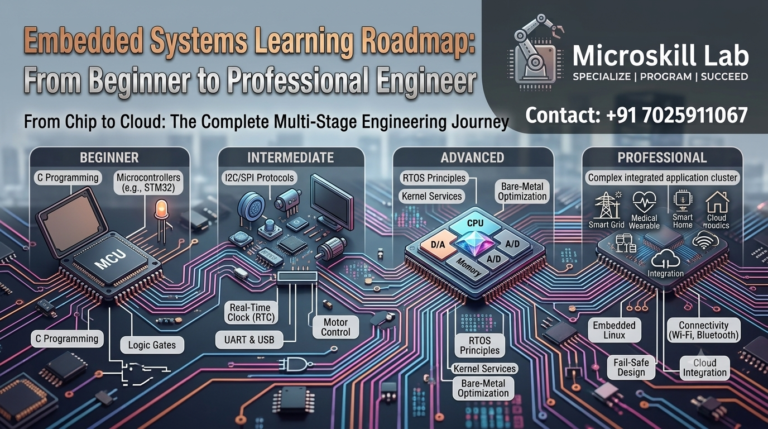
An embedded systems roadmap is a step-by-step learning path that takes you from electronics basics to professional-level microcontroller programming, RTOS design, and real product development. If you are a beginner in Bangalore or anywhere across South India, this guide shows you exactly what to learn, in what order, and how long each stage takes. At Microskill Lab Training Institute, our trainers have mapped this journey from years of teaching engineering students and freshers who now work across Karnataka’s electronics sector. You do not need prior coding experience to start. You need the right sequence, the right hardware, and steady practice. This roadmap gives you all three.
⚡ Key Takeaways
- You gain a clear, stage-by-stage path from zero electronics knowledge to job-ready embedded engineer.
- You learn which skills matter first: C programming, microcontrollers, then RTOS and communication protocols.
- You discover realistic timelines so you can plan learning around college or a full-time job.
- You understand the tools and hardware Bangalore employers expect fresh engineers to know.
- You see indicative salary benchmarks in INR for embedded roles across South India.
- You get a practical project checklist that makes your resume stand out to hiring managers.
What Is an Embedded Systems Roadmap and Who Is It For?
An embedded system is a dedicated computer built into a larger device to perform one specific task. Your washing machine, car dashboard, smartwatch, and EV charger all run on embedded systems. A roadmap simply orders the skills you need to build them, so you never feel lost. Embedded systems reward patience and a logical order of learning.
This structured path suits ECE, EEE, and CSE students, freshers, and career changers. It also helps working professionals in Bangalore who want to move from IT services into hardware-focused engineering roles.
Why Beginners Need a Structured Path
Many learners jump straight into Arduino projects without understanding the fundamentals. They stall the moment a project breaks and cannot debug it. A roadmap prevents this by building each concept firmly on the last.
Our trainers see this pattern constantly. Students who follow a proper sequence learn faster than those copying random tutorials. Structure beats speed every single time in embedded systems.
We designed this roadmap around that lesson. Each stage unlocks the next only once you can apply it. That discipline is what employers reward.
Who Should Follow This Roadmap
If you study at a Karnataka engineering college or have just graduated, this path fits you well. It also suits diploma holders and self-taught hobbyists ready to turn professional.
Our Electronics Fundamentals Programme is where most complete beginners start their journey with confidence.
Students from across Kerala, Tamil Nadu, and Andhra Pradesh join our Bangalore batches every term. Many arrive with no coding background at all. They leave with working projects and a clear direction. This roadmap is the same one our trainers use to guide every new batch.
Stage One: Electronics and C Programming Fundamentals
Every embedded engineer begins here. You cannot skip electronics basics or the C language and expect to succeed at higher stages. These two pillars support everything built above them.
Spend your first six to eight weeks on voltage, current, resistors, capacitors, and digital logic. Then move steadily into C programming.
Core Electronics You Must Know
Learn Ohm’s law, series and parallel circuits, and how to read a component datasheet properly. Understand diodes, transistors, and basic power supply design. Practice with a breadboard and multimeter before touching any microcontroller.
Our trainers in Electronic City run hands-on lab sessions where you wire real circuits yourself. This practical experience matters far more than theory alone for landing Bangalore hardware roles.
A solid grasp of electronics also saves you later. Most microcontroller bugs are hardware faults in disguise. Engineers who can read a circuit debug twice as fast.
Why C Is the Language of Embedded Programming
C gives you direct control over memory and hardware registers. Nearly every microcontroller worldwide is programmed in C. Master pointers, structures, bit manipulation, and memory management as early as you can.
Beginners often find pointers difficult at first. Our curriculum breaks them into small, practical exercises. You practise embedded programming on real problems, not abstract textbook puzzles that never appear on the job.
Expect to spend several weeks purely on C. This investment pays back across your whole career. Every microcontroller and RTOS you meet later assumes you know it well.
Stage Two: Microcontroller Programming Hands-On
Once your C is solid, you meet the microcontroller. This chip is the brain of every embedded product on the market. Learning to program one is the moment theory becomes real engineering.
Start with an 8-bit microcontroller before moving to powerful 32-bit ARM chips. Building simplicity first gives you lasting confidence.
Starting With Arduino and 8051
Arduino offers the gentlest entry point for any beginner. You blink an LED, read a sensor, and drive a motor within your first few days.
Our Arduino Programming Course covers these early wins with guided projects.
The 8051 and PIC families then teach you register-level control. This depth is what separates hobbyists from professionals. Employers across Whitefield value engineers who truly understand hardware at this lower level.
Register-level work feels slow at first. Soon it becomes second nature. This is the skill that turns a beginner into a real embedded programmer.
Moving to PIC and ARM Cortex
After the 8051, progress to PIC microcontrollers and then ARM Cortex-M chips like the popular STM32. ARM dominates modern embedded products, from medical devices to automotive control units built right here in Karnataka.
Our PIC Microcontroller Programming Programme bridges this crucial gap smoothly. You learn timers, interrupts, ADC, and peripheral configuration on genuine industry-standard hardware.
ARM is worth the effort you invest. The STM32 family alone runs in countless Indian products. Learning it opens doors across automotive, medical, and consumer electronics firms.
Stage Three: Communication Protocols and RTOS Concepts
Real products rarely use one chip alone. Components must talk to each other using standard protocols. Advanced products also need an operating system to juggle many tasks at once.
This stage moves you from simple single-task programs to complex, responsive, professional systems.
Mastering I2C, SPI, UART, and CAN
These four protocols connect sensors, displays, and controllers inside every device. UART handles simple serial links. I2C and SPI connect multiple peripherals efficiently. CAN runs the robust networks inside every modern car and truck.
Bangalore’s strong automotive electronics presence means CAN knowledge is highly valued by recruiters. Our trainers cover each protocol with live hardware demonstrations, never dry slides alone.
You wire real sensors and watch data move on a logic analyser. Seeing the signals makes the theory stick. This is how protocol knowledge becomes practical skill. Protocols and RTOS together mark the shift into professional embedded systems work.
Understanding RTOS Fundamentals
An RTOS, or real-time operating system, lets a microcontroller run many tasks with strict, predictable timing. FreeRTOS is the common starting point for learners. You study tasks, scheduling, semaphores, and message queues.
RTOS skills are a clear salary differentiator in the Indian job market today. Our Embedded Systems Pro Programme covers RTOS in real depth with hands-on projects on live boards.
RTOS is where beginners often plateau without guidance. Concepts like priority inversion trip up self-learners. Structured mentoring gets you past these hurdles quickly.
Stage Four: Real Projects and Embedded Linux Skills
Knowledge without projects rarely lands a good job. Employers want clear proof that you can build working products. This stage turns your accumulated skills into a strong portfolio.
Higher-end roles also expect Embedded Linux for devices like routers, gateways, and single-board computers.
Projects That Impress Bangalore Employers
Build a home automation system, a fitness tracker prototype, or a CAN-based vehicle monitor. Each project should solve a real problem and show clean, readable code.
Document every project carefully on GitHub. Our trainers review student capstone projects and coach you to present them exactly as hiring managers in Manyata Tech Park expect.
A strong portfolio beats a long resume. Two or three complete projects can win an interview. We help you pick problems that showcase real range.
Introduction to Embedded Linux
Embedded Linux powers complex devices that a bare microcontroller simply cannot handle. You learn the boot process, device drivers, and cross-compilation step by step. This advanced skill opens senior and better-paid roles.
Our Embedded Linux Development Course takes you from Yocto basics to writing simple device drivers on real single-board hardware.
Embedded Linux is a large field, so pace yourself. Treat it as a specialisation after the core roadmap. The extra effort reflects clearly in senior salary bands. Few beginners reach this level alone, which is exactly why the skill pays so well.
Ready to become a job-ready embedded engineer? Our structured curriculum takes you from electronics basics to live project deployment, taught by trainers with genuine industry experience across Bangalore’s hardware sector. Enrol in the Embedded Systems Pro Programme →
Career Scope and Salary Outlook in South India
Embedded systems offer stable, well-paid careers as India expands its electronics manufacturing base. Demand runs strong across Bangalore, Chennai, Hyderabad, and Kochi throughout 2026.
Roles range from junior firmware engineer to senior systems architect. Your earning ceiling rises with each new skill you add. Embedded systems careers reward continuous learning more than most fields.
Job Roles You Can Target
After completing this roadmap, you can confidently apply for several positions. The field rewards depth, so early specialisation genuinely pays off.
- Embedded Software or Firmware Engineer
- Microcontroller Programmer and Board Bring-Up Specialist
- IoT Product Developer
- Embedded Linux Engineer
- Hardware Validation and Test Engineer
Indicative Salary Benchmarks
Salaries vary widely by skill, company, city, and experience. The figures below are indicative only and should be verified against current market data before you rely on them.
Freshers in Bangalore typically start around ₹3.5–6 LPA. Engineers with strong RTOS and ARM skills often reach ₹8–15 LPA within a few years. Embedded Linux specialists frequently command higher packages still.
These ranges shift with demand and location. Product companies usually pay more than service firms. We flag all figures for your own verification before you plan around them.
How to Choose the Right Embedded System Course in Bangalore
Not every course delivers job-ready skills. Many teach heavy theory without real hardware. Choosing wisely saves you both time and money.
Look for hands-on labs, industry-standard tools, and trainers with genuine product experience behind them.
What to Look For in a Training Institute
Prioritise practical lab hours over long, impressive lecture lists. Ask whether you build real projects on real development boards. Check whether trainers have actually worked in industry, not only in classrooms.
Our curriculum at Microskill Lab reflects what Karnataka employers genuinely ask for. We update it continuously as the embedded industry shifts and new chips arrive.
Years of teaching freshers shape how we sequence topics. We know where beginners struggle and adjust for it. That teaching experience is itself part of the value.
Online Versus Offline Learning
Both formats work well, but they suit different types of learners. The comparison table below lays out your main options so you can decide with real clarity.
Comparison: Learning Formats for Beginners
| Factor | Self-Learning | Online Course | Offline at Microskill Lab |
|---|---|---|---|
| Hardware practice | Limited, self-funded | Remote, limited | Full lab access |
| Doubt clearing | None | Delayed | Immediate, in person |
| Structure | You build it | Fixed sequence | Guided and mentored |
| Project review | Self only | Sometimes | Trainer-led feedback |
| Best suited for | Hobbyists | Remote learners | Career-focused freshers |
Ready to begin your journey? Speak to our team through the Contact Us page to find a batch that fits your schedule.
Frequently Asked Questions
How long does it take to learn embedded systems?
Most beginners reach a job-ready level in six to twelve months with consistent study. The exact timeline depends on your starting point and weekly hours. A structured embedded system course shortens this considerably.
Do I need a degree to become an embedded engineer?
An engineering degree certainly helps but is not always mandatory. Practical skills and real projects often matter more to employers. Many successful engineers come from diploma and self-taught backgrounds.
Which programming language should I learn first?
Start with C without hesitation. It is the foundation of nearly all microcontroller programming worldwide. Once you feel comfortable, you can add C++ and Python for higher-level tasks.
Is embedded systems a good career in India in 2026?
Yes, strongly so. India’s push into electronics manufacturing and IoT keeps expanding demand every year. Bangalore, Chennai, and Hyderabad all show active hiring across this space. Embedded systems sit at the heart of India’s electronics manufacturing push, so the outlook stays strong.