
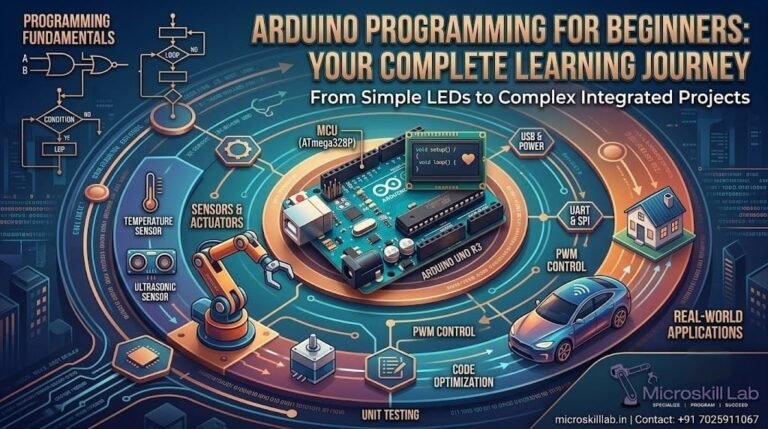
Arduino programming for beginners starts with one open-source board, one free software tool, and a willingness to experiment. If you are a student in Bangalore or anywhere across India learning to code hardware, Arduino is the fastest on-ramp into embedded systems. You write simple C++ instructions, upload them to an Arduino Uno, and watch real components respond on your desk. No prior electronics degree is needed to begin. Our trainers at Microskill Lab guide freshers from their very first blinking LED to full working projects. This guide walks you through the language, the Arduino IDE, the core coding concepts, and the beginner projects that build genuine, lasting skill.
⚡ Key Takeaways
- You will understand what the Arduino programming language is and why it suits complete beginners with zero coding background.
- You will learn to set up the Arduino IDE and upload your first sketch to an Arduino Uno board.
- You will grasp the core C++ building blocks that every Arduino program depends on.
- You will discover beginner-friendly Arduino projects that reinforce each new concept in order.
- You will see how these skills map to real embedded systems and IoT careers across Bangalore.
- You will know how to choose structured training that turns practice into placement-ready ability.
What Is the Arduino Programming Language?
The Arduino programming language is a simplified form of C++ built to control microcontroller boards. Many beginners assume it is a separate language, but it is standard C++ with a friendly library layer added on top. This design lowers the entry barrier dramatically for students who have never written a line of code. In Bangalore’s growing hardware ecosystem, that accessibility matters a great deal. Many first-year ECE and EEE students across Karnataka begin here before advancing to complex embedded work.
Think of Arduino as training wheels that never actually slow you down. It gives you full control over real hardware while hiding the intimidating parts until you are ready. That balance is why colleges and self-learners alike adopt it as a first platform.
C++ Roots Made Simple
Every Arduino sketch is C++ underneath the surface. The Arduino core wraps difficult register-level operations into readable functions like digitalWrite() and delay(). You focus on logic first, not on chip internals. This is exactly why our beginners write working code within their very first session. Mastering these basics also makes the later jump to raw embedded C far smoother.
Learners who want that deeper path often continue through our Embedded Systems Pro Programme, which builds directly on this foundation.
Who Should Start With Arduino
Arduino suits school students, engineering freshers, career changers, and hobbyists across South India. If you are in Kerala, Tamil Nadu, Telangana, Andhra Pradesh, or Pondicherry, this board is your practical entry into electronics. No degree gatekeeps your progress here. A curious mind and a basic laptop are genuinely enough to begin building. This is what makes Arduino the most democratic starting point in embedded learning today.
We regularly train commerce graduates and diploma holders alongside engineering students. The board does not care about your background, only your willingness to try. That inclusivity is a quiet strength of the whole Arduino ecosystem.
Why Learn Arduino Programming in 2026?
Learning Arduino in 2026 opens doors to IoT, robotics, and automation roles that Bangalore employers actively fill each quarter. The city’s Electronic City and Whitefield tech corridors host firms building connected products that depend on embedded talent. Arduino is where that career journey begins for most freshers.
Entry-level embedded engineers in Bangalore earn roughly ₹3.5–6 LPA, a range that should be verified against current market data before publication. These figures shift with skill, projects, and company tier.
The Bangalore Hardware Advantage
Bangalore anchors India’s electronics design and R&D sector. Companies clustered around Manyata Tech Park and Electronic City recruit embedded talent almost continuously. Firms such as Bosch, Wipro, and Siemens run large engineering teams that value hands-on prototyping ability. Arduino experience signals that you can actually build something, not just recite theory. That practical proof carries real weight in local interviews and screening tasks.
Hiring managers here often ask candidates to describe a project they built themselves. A working Arduino prototype answers that question instantly and memorably. It shows initiative that a certificate alone cannot convey.
Skills That Compound Over Time
Arduino quietly teaches transferable professional habits. You learn to read datasheets, wire circuits safely, and debug faulty logic step by step. These same skills carry directly into paid embedded work later.
Students who begin with Arduino frequently progress to dedicated microcontroller work through our PIC Microcontroller Programming Programme. That creates a clear, motivating skills ladder from hobby to profession.
Setting Up the Arduino IDE and Your First Sketch
The Arduino IDE is the free Arduino programming software where you write, compile, and upload your code. Setting it up honestly takes only a few minutes. You download the IDE, connect your Arduino Uno by USB, select the correct board and port, and you are ready to go.
Your first sketch will blink an onboard LED, the traditional starting point that every embedded learner remembers fondly. From there, complexity grows naturally.
The IDE handles compiling and uploading behind a single button. You write code, click upload, and the board runs it within seconds. That tight feedback loop keeps beginners engaged and learning fast.
Installing the Arduino IDE
Download the Arduino IDE from the official website for Windows, Mac, or Linux. Install it, launch it, and open the built-in Blink example sketch. Our trainers help students sidestep the common driver and port errors that frustrate self-learners in their first week. These small setup hurdles stop many beginners before they even start, so guided help matters here. Once configured, the same environment serves you for years.
Understanding the Board: Arduino Uno
The Arduino Uno is the most popular beginner board in the world. It carries digital pins, analog input pins, power pins, and a USB connection for uploading code. Understanding this simple layout is genuinely foundational to everything that follows.
We cover full board anatomy in depth within our Arduino Programming Course, so you never feel lost among the pins. Knowing your hardware makes your code far more intentional.
Core Coding Concepts Every Beginner Needs
Every Arduino program rests on a small handful of coding concepts drawn from C++. Master these few ideas and you can read most beginner projects with confidence. The two required functions are setup(), which runs once at startup, and loop(), which repeats forever. Around these two you use variables, conditionals, and loops to build real behaviour. Nothing here requires advanced mathematics or a computer science background.
We introduce each concept only when a project needs it. This just-in-time approach prevents the overwhelm that sinks many self-taught learners. You always understand why a concept matters before you use it.
Variables, Data Types, and Functions
Variables store values such as live sensor readings. Data types like int, float, and boolean define exactly what each variable can hold. Functions group reusable instructions into named, tidy blocks. These C++ fundamentals appear in every single sketch you will ever write.
We drill them patiently until they feel completely natural to you. That repetition is what separates guided learning from scattered tutorials.
Control Flow: Loops and Conditions
Conditionals like if and else let your board make real decisions. Loops like for and while repeat actions efficiently without endless copy-paste. Together they turn static instructions into responsive behaviour, such as a lamp that reacts to darkness.
This logic sits at the heart of all embedded programming, not just Arduino. Once it clicks, you begin thinking like an engineer rather than a copier of code.
Build real embedded skill with guidance that takes you from your first LED blink to deployable projects. Our Bangalore trainers mentor you through every error, so practice becomes genuine competence. Enrol in the Arduino Programming Course →
Beginner Arduino Projects That Build Real Skill
Arduino projects convert theory into ability faster than any lecture ever could. Beginners should always start small and layer complexity gradually. Each project should introduce exactly one new concept while reinforcing earlier ones. This project-based path closely mirrors how our capstone-driven curriculum is structured. You learn by building things that visibly work, which keeps motivation high through the tricky early weeks.
Starter Projects to Try First
Begin your journey with these approachable, confidence-building builds:
- Blinking LED to learn digital output and precise timing control.
- Push-button LED control to learn reading digital input signals.
- Light-sensing night lamp built around a simple photoresistor.
- Temperature display using an LM35 sensor and the serial monitor.
- Buzzer alarm that combines input and output logic into one project.
Progressing Toward IoT
Once you feel comfortable, you can connect Arduino to sensors and networks, edging naturally into IoT. This is a genuine stepping stone into our IoT Programme, where projects reach cloud dashboards and connected devices used across Indian industry.
Bangalore’s product firms increasingly hire for exactly these connected-device skills. Starting on Arduino gives you the vocabulary and confidence to enter that space prepared.
Even a simple sensor-to-cloud project teaches core IoT ideas. You learn about data, connectivity, and remote monitoring in miniature. Those same principles scale up to industrial deployments later.
Common Beginner Mistakes and How to Avoid Them
New learners repeat a set of predictable mistakes, and spotting them early saves weeks of frustration. Most errors have nothing to do with intelligence and everything to do with missing small conventions. Our trainers see these same slip-ups daily and correct them quickly. That fast feedback loop is a core advantage of guided learning over lonely trial and error.
Knowing the traps in advance keeps your momentum intact.
Syntax and Wiring Errors
Forgetting a semicolon, mismatching pin numbers, or reversing component polarity are the usual culprits. A single wrong wire can silently stop an entire circuit from working. We teach systematic debugging so you diagnose issues calmly instead of guessing at random. This discipline stays with you for your whole engineering career. Careful habits early on prevent expensive mistakes later.
We also teach you to read the serial monitor as a diagnostic tool. Printing values at key points reveals exactly where logic breaks. Learning Arduino programming this way builds true debugging intuition, not just fixes.
Skipping Fundamentals
Many beginners chase flashy projects before understanding the basics, and then they stall badly. A firm grip on core electronics prevents this common trap entirely.
Our Electronics Fundamentals Course gives you the circuit knowledge that makes your code actually work in the physical world. Voltage, current, and resistance are not optional details here. They are the ground your Arduino projects literally stand on.
How to Choose Arduino Training in Bangalore
Choosing the right Arduino training in Bangalore shapes how quickly you become genuinely job-ready. Look beyond endless video playlists toward mentorship, real hardware access, and tangible project outcomes. The right institute gives you a lab, a guide, and a clear path from raw beginner to embedded professional. This is where structured learning quietly outperforms scattered free content.
Your time is valuable, so spend it inside a system built to progress you.
Ask any institute how much time you spend actually holding hardware. Real Arduino programming skill comes from repetition on physical boards, not passive watching. Insist on lab access before you enrol anywhere.
What a Good Programme Offers
A strong beginner programme should reliably provide these essentials:
- Hands-on hardware kits, not just software simulations.
- Small batches that guarantee real trainer attention.
- Live projects that steadily build a genuine portfolio.
- A clear progression path into advanced embedded topics.
- Placement guidance aligned to Bangalore’s real hiring market.
Comparing Your Learning Options
| Factor | Self-Learning | Random Online Videos | Structured Institute Training |
|---|---|---|---|
| Trainer support | None | Limited | Dedicated mentors |
| Hardware practice | Self-arranged | Rarely included | Provided in lab |
| Project portfolio | Uncertain | Fragmented | Guided capstone |
| Career guidance | None | None | Placement support |
| Time to job-ready | Long | Variable | Structured and faster |
Ready to start your journey the right way? Explore your options and speak with our team through our Contact Us page to find the batch that fits you.
Frequently Asked Questions
Is Arduino programming hard for complete beginners?
No. The language simplifies C++, so beginners write working code quickly. With guided practice, most students build their first real project within a single week.
Do I need to know C++ before I start?
No prior C++ knowledge is required at all. You pick up the necessary C++ concepts gradually as you write sketches, which makes Arduino an ideal first language for hardware.
What can I build after learning the basics?
You can build sensors, small robots, home automation gadgets, and IoT devices. These skills also form a strong foundation for professional embedded systems and microcontroller careers.
Which Arduino board should a beginner buy first?
The Arduino Uno is the best starting board by far. It is affordable, widely supported, and covered in nearly every beginner tutorial and structured course.
Can these skills help me get a job in Bangalore?
Yes. Arduino builds the foundational embedded skills that Bangalore hardware firms value. Combined with structured training and a project portfolio, it strengthens your entry into embedded and IoT roles.