
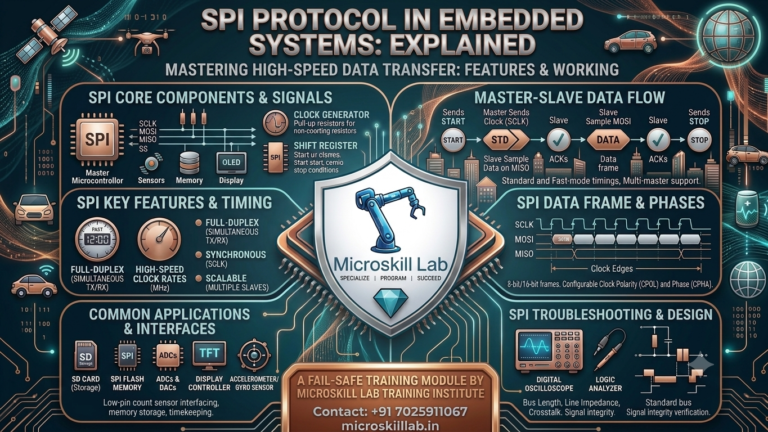
SPI Protocol in Embedded Systems: Features & Working
SPI in embedded system design is a high-speed, synchronous communication protocol used to connect microcontrollers with sensors, displays, and memory chips. It uses four wires and a master-slave structure to move data faster than I2C or UART.
Engineering students in Bangalore, Kerala, and Tamil Nadu learning embedded systems will meet SPI in nearly every microcontroller project.
From IoT sensor boards to industrial automation modules, SPI shows up wherever fast, short-distance data transfer matters. This guide breaks down how SPI works, where it fits among other communication protocols, and why mastering it matters for your embedded systems career in 2026.
⚡ Key Takeaways
- SPI is a full-duplex, synchronous protocol that transfers data faster than I2C or UART in most embedded systems.
- You will learn the four core SPI signal lines and how master-slave communication actually works on a microcontroller.
- SPI powers real Bangalore-industry applications, including sensor networks, display modules, and SD card interfaces.
- Understanding SPI alongside I2C and UART helps you choose the right protocol for any embedded systems project.
- Hands-on SPI programming is a core skill tested in embedded systems interviews across Karnataka’s electronics sector.
What is SPI Protocol in Embedded Systems?
SPI, or Serial Peripheral Interface, is a synchronous serial communication protocol that lets a microcontroller exchange data with one or more peripheral devices.
Unlike UART, SPI does not need matching baud rates because a shared clock line synchronises every transfer. This makes SPI in embedded system applications reliable for fast, short-distance communication.
Motorola originally developed SPI for microcontroller-to-peripheral communication. It remains one of the most widely taught communication protocols in embedded systems courses today.
Students encounter SPI early because most development boards, including Arduino and PIC-based kits, expose SPI pins directly on the header. This makes SPI a natural starting point before moving to more complex bus protocols.
Core Features of SPI
SPI supports full-duplex communication, meaning data flows in both directions at the same time. It also allows multiple peripheral devices on a single bus, each selected individually through separate chip-select lines.
Because SPI has no built-in addressing scheme like I2C, the master device manages every connection manually. This gives designers more control over timing but requires careful pin planning as the number of connected peripherals grows.
Who Should Learn SPI
Diploma holders, ECE and EEE students, and freshers preparing for embedded systems roles should learn SPI early. Our Embedded Systems Pro Programme introduces SPI alongside I2C and UART during the communication protocols module.
Working professionals switching into embedded roles from software backgrounds also benefit from structured SPI training, since interview panels in Bangalore routinely ask candidates to explain SPI timing diagrams from memory.
Self-taught learners can pick up SPI from datasheets alone, but guided lab time significantly shortens the debugging curve for beginners.
Why SPI Matters for Your Embedded Systems Career in Bangalore in 2026
Bangalore’s electronics sector, spanning Electronic City, Whitefield, and Manyata Tech Park, relies heavily on SPI-based designs for sensor interfacing and display control.
Companies building IoT devices, automotive modules, and industrial controllers expect engineers to configure SPI without step-by-step guidance from day one.
This expectation shows up early in campus placements and walk-in interviews, where a short SPI wiring or debugging question is common before a candidate even reaches the coding round.
Salary and Demand Context
Embedded engineers with strong communication protocol skills, including SPI, typically earn between ₹4 and ₹9 LPA as freshers in Karnataka’s electronics and IT-hardware firms, rising with experience. Recruiters in Bangalore frequently test SPI configuration during technical interviews.
Candidates who can demonstrate a working SPI project during interviews, rather than only textbook knowledge, tend to stand out in Bangalore’s competitive embedded systems hiring market. Product companies value engineers who can debug real timing issues on the bench.
Where SPI Skills Are Applied
Karnataka’s MSME electronics manufacturers and larger firms building embedded products use SPI for connecting flash memory, ADCs, and display drivers.
Our PIC Microcontroller Programming course covers SPI register-level configuration on real hardware, not just simulation software.
Beyond Bangalore, electronics design teams across Kerala, Tamil Nadu, and Telangana also rely on SPI-based designs for automotive, medical, and industrial products. Students from these states follow similar career pathways after training.
How SPI Works: Master-Slave Architecture and Signal Lines
SPI communication happens between one master device, usually a microcontroller, and one or more slave devices. The master generates the clock signal and controls when data transfer begins, giving SPI predictable, low-latency timing.
Each slave device stays idle until its dedicated chip-select line goes active, which prevents data collisions on shared MOSI and MISO lines. This design makes SPI easier to debug than protocols that rely on collision detection.
The Four SPI Signal Lines
SPI uses four dedicated lines to manage communication between devices:
- SCLK (Serial Clock): Generated by the master to synchronise every bit transfer.
- MOSI (Master Out, Slave In): Carries data from the master to the selected slave.
- MISO (Master In, Slave Out): Carries data from the slave back to the master.
- SS/CS (Slave Select / Chip Select): Activates a specific slave device for communication.
Clock Polarity and Phase Settings
SPI supports four clock modes formed by combining clock polarity (CPOL) and clock phase (CPHA). Our trainers walk students through configuring these modes correctly, since mismatched settings are a common cause of failed SPI communication on real boards.
Datasheets for SPI peripherals always specify which clock mode a device expects, so students learn to cross-check this value before wiring a new sensor or display. Skipping this step is one of the most common beginner mistakes we see in the lab.
SPI vs Other Communication Protocols in Embedded Systems
Choosing between SPI, I2C, and UART depends on speed requirements, wiring constraints, and the number of connected devices. Students often confuse these protocols until they configure each one hands-on during lab sessions.
Speed and Wiring Trade-Offs
SPI generally transfers data faster than I2C because it uses separate data lines instead of a single shared line. However, SPI needs more wires and a dedicated chip-select line for every additional slave device.
This wiring overhead makes SPI less practical than I2C for projects with many low-speed sensors, but ideal for a small number of devices that need fast, reliable data transfer.
Students often learn this trade-off the hard way, by running out of GPIO pins mid-project before switching a low-speed sensor over to I2C instead.
When to Choose SPI Over I2C or UART
Choose SPI when your embedded systems project needs high-speed data transfer over short distances, such as reading a camera sensor or writing to an SD card.
Choose I2C instead when your board has limited GPIO pins and needs to connect several sensors on one bus. Choose UART when you only need simple point-to-point communication, such as debugging output or a GPS module.
SPI vs I2C vs UART: Quick Comparison
| Feature | SPI | I2C | UART |
|---|---|---|---|
| Wires required | 4 (+1 per slave) | 2 | 2 |
| Speed | Very high (up to 10+ Mbps) | Moderate (up to 3.4 Mbps) | Low to moderate |
| Communication mode | Full-duplex | Half-duplex | Full-duplex |
| Multiple slave support | Yes, via chip-select lines | Yes, via addressing | No (point-to-point) |
| Common use case | Displays, SD cards, sensors | EEPROM, RTC modules | Debugging, GPS modules |
Real-World Applications of SPI in Embedded Systems
SPI appears across consumer electronics, automotive systems, and industrial equipment manufactured or designed in Karnataka’s electronics hubs. Recognising these applications helps students connect classroom theory to real hardware.
Many students first assume SPI is only a textbook concept, until they open a commercial product teardown and find the same four-wire interface controlling a display or memory chip.
Consumer and IoT Devices
TFT displays, SD card modules, and wireless transceivers in IoT products commonly use SPI for fast data exchange. Our IoT Programme includes SPI-based sensor projects that mirror what Bangalore product teams build.
Smart home devices, fitness wearables, and connected appliances designed by startups in Karnataka’s IT-hardware ecosystem frequently rely on SPI. It moves sensor data quickly between low-power microcontrollers and radio modules.
Automotive and Industrial Systems
Automotive control units use SPI to communicate with sensor arrays and flash memory at high speed, while industrial automation panels use SPI for reading data converters. Students working toward automotive embedded roles should master SPI timing diagrams.
Bangalore’s automotive electronics cluster, supported by both established manufacturers and newer EV startups, hires embedded engineers who understand SPI alongside CAN bus fundamentals for sensor fusion and diagnostics work.
Common SPI-Enabled Components:
- ADCs and DACs for sensor signal conversion
- SD card and flash memory modules
- TFT and OLED display drivers
- Wireless radio transceivers (nRF24L01, RFM modules)
Master SPI, I2C, and UART with guided, hands-on labs designed for Bangalore’s electronics job market. Our trainers take you from wiring diagrams to working code on real microcontroller boards. Enrol in the Embedded Systems Pro Programme →
Learning SPI: Curriculum and Hands-On Training at Microskill Lab
Reading about SPI is not enough; students need to configure registers, debug timing issues, and build working projects. Our curriculum is structured so every protocol is practised on physical hardware, not simulators alone.
What You Will Build
Students configure SPI communication between a microcontroller and peripherals such as displays, memory modules, and sensors during guided lab sessions.
Our Arduino Programming course includes beginner-friendly SPI exercises before students move on to PIC-based programming.
Each lab session ends with a working demo, such as a temperature reading displayed on an SPI screen, so students leave with a portfolio project rather than only theory notes.
Skills You Will Gain
By the end of the module, students can independently wire an SPI bus, configure clock modes, and troubleshoot communication failures.
These are the exact skills our trainers see tested during technical interviews at Bangalore product companies. Lab sessions are designed to mirror real interview scenarios, not only classroom exercises.
- Configuring SPI registers on PIC and ARM-based microcontrollers
- Reading datasheets to identify SPI pin assignments
- Debugging SPI communication using logic analysers
- Designing SPI-compatible PCB layouts for student projects
Students interested in hardware design can extend these skills further. Our PCB Designing programme covers routing considerations for high-speed SPI signal lines.
How to Choose the Right Embedded Systems Training Institute in Bangalore
Selecting a training institute affects how confidently you can apply SPI and other communication protocols during interviews and on the job. Look beyond marketing claims and evaluate the actual lab infrastructure offered.
What to Check Before Enrolling
Ask whether the institute provides individual hardware kits, real microcontroller boards, and instructor-led debugging sessions rather than only video lectures.
Also check whether protocols like SPI are taught with register-level detail or only through pre-built libraries. Interview panels usually expect candidates to explain what happens at the hardware level.
Eligibility and Enrolment Basics
Most embedded systems programmes, including ours, welcome diploma holders, BE/BTech students in ECE, EEE, or CSE, and career changers with basic electronics knowledge.
Students from Kerala, Tamil Nadu, Telangana, Andhra Pradesh, and Pondicherry regularly join our Bangalore-based batches, either travelling for intensive sessions or joining guided remote labs.
- Basic understanding of digital electronics and C programming
- A laptop for lab exercises and project documentation
- Willingness to attend hands-on sessions in Bangalore, either in person or via guided remote labs
- No prior microcontroller experience required for beginner batches
Our Electronics Fundamentals course is a strong starting point for students who want a refresher before tackling SPI and other protocols directly.
Students unsure which starting point suits them can speak with our team before enrolling, so the batch matches their current skill level rather than a generic default.
Frequently Asked Questions
Is SPI faster than I2C?
Yes, SPI generally transfers data faster than I2C because it uses separate lines for sending and receiving data instead of one shared line.
Can SPI connect multiple devices at once?
Yes, SPI supports multiple slave devices on one bus, but each device needs its own dedicated chip-select line from the master.
Do I need prior coding experience to learn SPI?
Basic C programming knowledge helps, but our beginner batches start with digital electronics fundamentals before introducing SPI register configuration.
Which microcontrollers commonly use SPI?
PIC, ARM Cortex-M, and Arduino-compatible microcontrollers all support SPI communication natively through dedicated hardware peripherals.
What happens if SPI clock modes do not match?
Mismatched CPOL and CPHA settings between the master and slave typically cause garbled or missing data, which is why checking the peripheral datasheet before wiring is essential.
Is SPI used in real Bangalore-based products?
Yes, SPI is widely used in Bangalore-designed IoT devices, automotive control modules, and industrial sensor systems, making it a practical skill for local job markets.
Ready to build real SPI projects on actual hardware? Contact our team to discuss batch timings and course structure for our embedded systems programmes.