
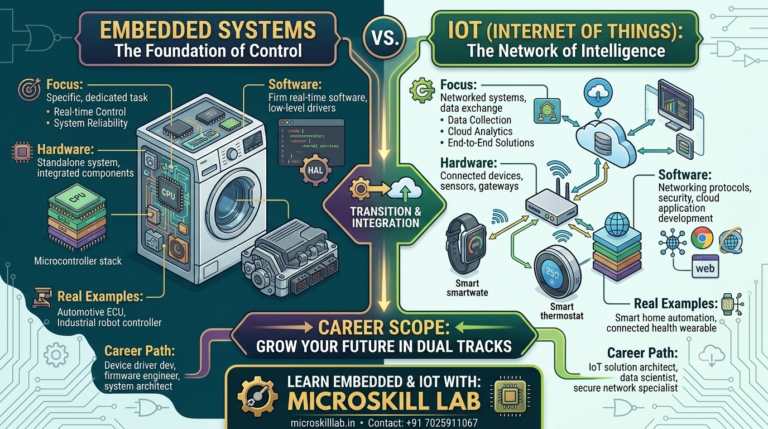
Embedded Systems vs IoT: Key Differences & Career Scope
Embedded systems vs IoT is one of the most common points of confusion for students entering electronics and computer engineering. In simple terms, an embedded system is a dedicated piece of hardware and software built for one specific task. IoT connects many such devices to the internet so they can share data and work together. For students and career seekers in Bangalore and across India, understanding this distinction is the first step toward choosing the right specialization.
⚡ Key Takeaways
- Embedded systems are single-purpose devices; IoT is a network of connected embedded devices working together.
- Every IoT device contains an embedded system, but not every embedded system is part of an IoT network.
- Microcontrollers and communication protocols like I2C, SPI, and MQTT form the technical bridge between both fields.
- Embedded systems careers focus on hardware-close programming; IoT careers add networking, cloud, and data skills.
- Bangalore’s electronics and IT corridors, including Electronic City and Whitefield, offer strong demand for both skill sets.
- Learning embedded system design first gives you a stronger foundation before specializing in IoT development.
What Are Embedded Systems and IoT? Understanding the Basics
Before comparing the two fields, we need clear definitions. Many students search for “embedded systems vs IoT” without realizing that IoT is actually built on top of embedded systems technology, not separate from it.
Defining Embedded Systems
An embedded system is a combination of hardware and software designed to perform a specific, dedicated function within a larger system. Think of the microcontroller inside a washing machine, a car’s anti-lock braking system, or a digital thermostat. These systems run fixed firmware, often without any network connection, and prioritize reliability, real-time response, and low power consumption. Our Embedded Systems Pro Programme covers this foundation in depth, from microcontroller architecture to real-time firmware development.
Defining IoT Devices
The Internet of Things refers to a network of physical devices embedded with sensors, software, and connectivity that allows them to exchange data over the internet. A smart irrigation controller, a fitness band, or a factory sensor reporting temperature to a cloud dashboard are all connected devices. Every connected device has an embedded system at its core, but it adds wireless connectivity, cloud integration, and often a mobile app layer on top.
For students in Bangalore, this distinction matters because many job postings blur the two terms. A recruiter looking for an “embedded engineer” usually wants strong C programming and hardware debugging skills. An “IoT engineer” posting usually adds networking and cloud requirements on top of the same base skill set. Understanding both descriptions helps you read job listings accurately and apply with confidence.
Embedded Systems vs IoT: Core Technical Differences
While related, embedded systems and IoT differ significantly in architecture, scope, and design priorities. Recognizing these differences helps students plan their learning path more effectively.
Architecture and Design Approach
A traditional embedded system is usually a closed, standalone unit. It reads sensor input, processes it locally, and produces an output, often without ever talking to another device. IoT architecture, by contrast, is distributed by design. Data moves from the device layer to a gateway, then to cloud servers, and finally to a dashboard or mobile app. This means IoT engineers must think beyond the microcontroller and consider network reliability, data security, and cloud scalability from day one.
Connectivity and Data Flow
Embedded systems may use wired protocols like UART, I2C, or SPI for communication between components on the same board, with no external internet requirement. Connected systems layer wireless protocols such as Wi-Fi, Bluetooth Low Energy, Zigbee, LoRa, and MQTT on top of these same embedded fundamentals to push data beyond the device. Students often ask which protocol to learn first. We recommend mastering I2C and SPI at the board level before moving to MQTT and wireless stacks, since the embedded fundamentals rarely change.
This layered approach also affects how engineers debug problems. A pure embedded engineer troubleshoots with an oscilloscope and logic analyzer, checking signal timing on the board itself. An engineer working on connected products must additionally check network logs, cloud dashboards, and API responses, since a fault could originate anywhere between the sensor and the server. Both skill sets are valuable, and most Bangalore employers expect at least basic familiarity with both debugging approaches.
Where Embedded Systems and IoT Overlap
Despite the differences, embedded systems and IoT share a strong technical overlap. This is exactly why many training providers in Bangalore teach both as a connected learning path rather than isolated subjects.
Microcontrollers as the Common Foundation
Every IoT device still relies on a microcontroller or microprocessor to manage sensors, process data locally, and control actuators before any information reaches the cloud. Whether you are building a standalone embedded project or a connected IoT product, the same core skills apply: register-level programming, interrupt handling, and power-efficient firmware design. Our PIC Microcontroller Programming course builds exactly this foundation, which transfers directly into IoT development.
Communication Protocols Bridging Both Worlds
Communication protocols are the technical glue connecting embedded devices to connected networks. I2C and SPI handle short-distance, chip-to-chip communication on a circuit board, while protocols like MQTT and CoAP handle longer-distance, internet-based messaging between devices and servers. A well-rounded engineer in 2026 understands both layers, since most real Bangalore-based connected-product projects still require solid embedded system design at the device level before any cloud connectivity is added.
Students sometimes assume that learning wireless protocols alone is enough for a connected-device career. In practice, most product bugs trace back to the embedded layer, not the wireless layer. A sensor that reports incorrect readings, a battery that drains too quickly, or a device that resets unexpectedly usually points to firmware or circuit issues rather than the network stack. This is why we structure our curriculum to build embedded fundamentals first.
Skills You Need: Embedded System Design vs IoT Development
Career seekers often ask us which skill set to prioritize. The honest answer is that embedded system design skills form the base layer for both career tracks.
Core Embedded Skills
Regardless of which direction you eventually specialize in, a strong embedded foundation makes every later topic easier to learn. Students preparing for either path should focus on the following foundational skills:
- Embedded C and C++ programming for microcontrollers
- Circuit reading, PCB basics, and hardware debugging
- Real-time operating system (RTOS) concepts for time-critical tasks
- I2C, SPI, and UART protocol implementation
- Power management and low-energy firmware design
IoT-Specific Skills
Once the embedded foundation is solid, adding connectivity and cloud skills becomes far easier. IoT roles typically require these additional skills:
- Wireless protocols such as Wi-Fi, BLE, Zigbee, and LoRa
- Cloud platforms like AWS IoT Core or Azure IoT Hub
- MQTT and RESTful API integration
- Basic data handling and dashboard visualization
- Security practices for connected devices
Career Scope in Bangalore: Embedded Systems vs IoT Roles in 2026
Bangalore remains India’s strongest hub for both embedded and IoT hiring, with companies across Electronic City, Whitefield, and Manyata Tech Park actively recruiting engineers for hardware-software roles. Career seekers relocating from Kerala, Tamil Nadu, Telangana, and Andhra Pradesh regularly choose Bangalore for this reason. The concentration of electronics and IT companies here creates far more openings than most other South Indian cities.
Embedded Systems Career Paths
Pure embedded roles include firmware engineer, embedded software developer, hardware-software integration engineer, and automotive embedded engineer. These positions are common in automotive, medical device, and industrial automation companies with a strong presence in Karnataka’s manufacturing and electronics belt. Entry-level roles usually expect strong C programming and microcontroller fundamentals, while senior roles add RTOS experience, board bring-up skills, and exposure to safety-critical design standards. Salary ranges for embedded engineers in Bangalore vary by experience level and specialization, and we encourage students to verify current figures directly with recruiters before making career decisions.
IoT Career Paths
IoT-focused roles include IoT developer, IoT solutions architect, connected product engineer, and IoT data analyst. These positions increasingly appear in smart city projects, industrial IoT deployments, and consumer electronics companies expanding their connected product lines from Bangalore. Many of these roles also value comfort with basic cloud services. Engineers are often asked to help set up device dashboards or troubleshoot connectivity issues alongside the core firmware work. Our IoT Programme is designed to prepare students for exactly these roles, combining embedded fundamentals with connectivity and cloud skills.
Get job-ready with hands-on training that covers both embedded fundamentals and IoT connectivity. Our trainers guide you from microcontroller basics to live connected-device projects. Enrol in the IoT Programme →
Industry Applications: Embedded Systems and IoT in Real Projects
Seeing where each technology is actually used helps students connect classroom concepts to real engineering work happening across India.
Embedded Systems in Automotive & Medical Devices
Automotive embedded systems control functions like engine management, anti-lock braking, and airbag deployment, where real-time response is non-negotiable and there is often no network connection at all. Medical devices such as infusion pumps and patient monitors rely on the same dedicated, fail-safe embedded design principles, prioritizing predictable behavior over connectivity. Bangalore’s automotive electronics and precision manufacturing companies, several of them based around Electronic City, continue to hire engineers with exactly this kind of dedicated firmware experience.
IoT in Smart Cities & Industrial Automation
Smart city projects use connected sensors for traffic monitoring, waste management, and street lighting control, streaming data continuously to central dashboards for city planners. Industrial automation applies similar principles on factory floors, where embedded sensors report machine health and production data to cloud platforms. This enables predictive maintenance and reduces downtime across manufacturing units in Karnataka and neighboring states. Whitefield and Manyata Tech Park host several IT and product companies actively building connected industrial solutions. This creates steady demand for engineers who understand both the device and the platform side of the work.
How to Choose Your Learning Path at Microskill Lab Training Institute
Choosing between embedded systems and IoT does not have to be an either-or decision, especially since one builds directly on the other. Before enrolling in either track, most students want to know the basic eligibility requirements. Typical eligibility criteria for our programmes include:
- Diploma, B.E., or B.Tech in Electronics, Electrical, Computer Science, or a related field
- Working professionals seeking to upskill in embedded or IoT technologies
- Final-year engineering students preparing for campus placements
- Basic familiarity with C programming is helpful but not mandatory for beginner tracks
Choosing Embedded Systems Track
If you enjoy working close to hardware, debugging circuits, and writing firmware that controls physical components directly, start with embedded fundamentals. Our Electronics Fundamentals and Embedded Linux Development programmes are well suited for students who want deep hardware expertise before moving toward connected systems.
Choosing IoT Track
If you are excited by connected products, dashboards, and devices talking to each other over the internet, plan to build embedded fundamentals first. Then layer IoT connectivity on top. This sequence matches how real Bangalore-based product teams are structured, where IoT engineers are expected to understand the embedded layer before touching the cloud layer.
Embedded Systems vs IoT: Quick Comparison Table
| Parameter | Embedded Systems | IoT |
|---|---|---|
| Primary Focus | Dedicated, single-purpose function | Network of connected devices |
| Connectivity | Often none, or local wired protocols | Wireless internet connectivity required |
| Data Processing | Local, on-device processing | Local processing plus cloud analytics |
| Common Protocols | I2C, SPI, UART | MQTT, CoAP, Wi-Fi, BLE, LoRa |
| Typical Examples | Washing machine controller, car ECU | Smart thermostat, industrial sensor network |
| Career Focus | Firmware, hardware integration | Connectivity, cloud, data platforms |
Frequently Asked Questions
Is IoT a part of embedded systems or a separate field?
IoT is built on top of embedded systems technology. Every IoT device contains an embedded system at its core, with added connectivity and cloud integration layered on top.
Which is better for a career: embedded systems or IoT?
Both offer strong career scope in Bangalore and across India. Embedded systems suits students who prefer hardware-close work, while IoT suits those interested in connected products and cloud-linked data.
Do I need to learn embedded systems before IoT?
Yes, we recommend building a solid embedded systems foundation, including microcontroller programming and communication protocols, before specializing in IoT development.
What communication protocols should I learn first?
Start with I2C and SPI for board-level embedded communication, then move to MQTT and wireless protocols once you begin working on IoT projects.
Can I switch between embedded systems and IoT roles later in my career?
Yes, since both fields share the same embedded foundation, engineers frequently move between embedded and IoT roles as projects and company needs evolve. Many professionals start in a pure firmware role and gradually move into connected-product work as they pick up networking and cloud skills on the job.
How long does it take to become job-ready in embedded systems or IoT?
This depends on your starting point and the depth of the programme, since students with a strong electronics or computer science background typically progress faster through hardware and protocol concepts. Working professionals upskilling part-time may need a longer timeline than full-time students. To plan a realistic learning path, get in touch with our team for guidance suited to your background and goals.