
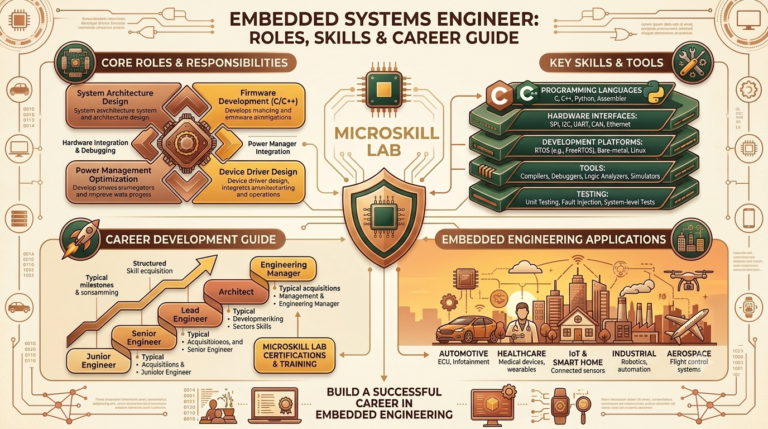
What Does an Embedded Systems Engineer Do?
An embedded systems engineer designs, codes, and tests the hardware-software combinations that run inside everyday devices, from washing machines to car airbags. For freshers in Bangalore and across India, this role offers a direct path into electronics, automotive, and IoT industries without needing a pure software background. We built this guide to cover the real day-to-day work, the skills recruiters expect, and the career path our students follow after training.
Many freshers confuse an embedded systems engineer with a general software developer, but the two roles rarely overlap in daily practice. This guide breaks down the actual job description, the tools you will use, and how a structured embedded systems engineer course prepares you faster than self-study alone.
⚡ Key Takeaways
- Understand the real responsibilities of an embedded systems engineer, not just the job title.
- Learn which programming languages and tools freshers must master first.
- See how embedded roles differ across automotive, medical, and consumer electronics sectors in India.
- Get a realistic view of entry-level salaries and hiring companies in Bangalore.
- Find out how a structured embedded systems engineer course shortens your job-readiness timeline.
- Discover the exact curriculum path we use to take freshers from basics to live projects.
Who Is an Embedded Systems Engineer?
An embedded systems engineer builds the intelligence inside dedicated devices — the microcontroller code in a fitness band, or the firmware that manages a car’s ABS module. Unlike general software engineers, embedded engineers work close to hardware, writing code that talks directly to chips, sensors, and actuators.
This makes the role different from typical IT jobs. It blends electronics knowledge, C programming, and real-time problem solving, which is exactly why freshers with an ECE, EEE, or CSE background find it a natural fit.
What Makes This Role Different From Software Development
Regular software engineers build applications that run on operating systems with abundant memory and processing power. Embedded engineers, by contrast, often work with a few kilobytes of RAM and must write efficient, low-level Embedded C code.
Timing matters more too. A regular app can tolerate a delay of a second; an airbag controller or anti-lock braking system cannot. This is where Embedded Systems Programming Course training becomes essential before freshers touch production code.
Who Should Consider This Career
This path suits engineering graduates from ECE, EEE, Instrumentation, and CSE streams who enjoy working with both hardware and code. It also suits diploma holders and working professionals in electronics manufacturing who want to move into design roles.
If you enjoyed physics, circuits, or basic C programming during your degree, embedded systems work will likely feel like a natural extension rather than a completely new subject. Freshers who feel rusty on core electronics often start with our Electronics Fundamentals course before moving into embedded-specific modules.
Working professionals from electronics manufacturing or QA backgrounds also transition into an embedded systems engineer role successfully, since much of the required electronics groundwork is already familiar to them from factory-floor or testing experience.
Why Embedded Careers Matter in Bangalore in 2026
Bangalore remains India’s largest hub for embedded and electronics hardware development, with clusters concentrated around Electronic City, Whitefield, and Manyata Tech Park. Global semiconductor and automotive electronics firms run design centres here, creating consistent fresher demand.
The Karnataka electronics manufacturing sector has expanded steadily as companies shift design work from overseas to Indian teams, particularly in automotive electronics and industrial IoT. This shift means more entry-level embedded roles are opening locally rather than only at senior levels.
The India Electronics Manufacturing Push
India’s electronics production has grown under national manufacturing incentives, and Karnataka’s IT/ITES and hardware ecosystem has absorbed a large share of this growth. Firms setting up local chip design and embedded R&D teams need engineers who already understand Embedded C, RTOS concepts, and microcontroller debugging.
This is a direct opportunity for freshers who complete a focused Embedded Systems Design Course rather than relying only on a general engineering degree, since most degree programmes do not cover hands-on firmware debugging in depth.
Why Freshers Specifically Benefit Right Now
Companies hiring for embedded roles in Bangalore increasingly prefer candidates who can demonstrate a working project, not just a transcript. A fresher who has built and debugged a real microcontroller project during training stands out immediately in interviews.
Our trainers structure every module around this expectation, so students leave with deployable projects, not just lecture notes, before they walk into their first interview.
Roles and Responsibilities of an Embedded Systems Engineer
Embedded systems engineer job descriptions vary by company size and sector, but the core responsibilities stay fairly consistent across automotive, medical device, and consumer electronics employers in India.
Most embedded roles fall into two broad categories: firmware/software-focused roles and hardware/design-focused roles. Many freshers start in one and move toward the other as they specialise.
Typical Daily Responsibilities
On a typical day, an embedded engineer writes and debugs Embedded C or C++ code, tests it on development boards, and works with oscilloscopes or logic analysers to trace hardware faults. They also collaborate with hardware teams to finalise schematics and component selection.
Documentation is a bigger part of the job than most freshers expect — writing driver documentation, test reports, and design specifications is standard practice, especially in automotive and medical device companies with compliance requirements.
Responsibilities also shift by industry. An embedded systems engineer in automotive electronics focuses heavily on safety-critical code and timing accuracy, since a delayed sensor reading in a braking system carries real consequences and demands stricter code review cycles. In medical device companies, the same role centres on firmware for patient monitors or infusion pumps, where reliability and traceable documentation matter as much as functionality.
Common Embedded System Jobs for Freshers
- Firmware Engineer — writes and tests Embedded C code for microcontrollers
- Embedded Software Engineer — builds application-layer code on RTOS or Embedded Linux
- Hardware Design Engineer — designs PCBs and selects components
- Test and Validation Engineer — verifies embedded products against specifications
- IoT Firmware Developer — connects embedded devices to cloud platforms via our IoT Programme
Freshers typically enter through the firmware engineer or test engineer route, since these roles have the most structured onboarding and the clearest skill checklist for beginners.
Consumer electronics and IoT firms, by contrast, often move faster and prioritise time-to-market alongside connectivity features, which changes the day-to-day pace an embedded systems engineer experiences compared to automotive or medical teams.
Key Skills You Need as an Embedded Systems Engineer
Recruiters screening freshers for embedded system jobs look for a specific, fairly predictable skill set. Getting these fundamentals right matters more than chasing every trending tool.
The core stack rarely changes: Embedded C, microcontroller architecture, basic electronics, and at least one communication protocol like I2C or SPI. Everything else builds on this foundation.
Programming and Firmware Skills
Embedded C remains the single most important language for entry-level roles, which is why our Embedded C Course focuses heavily on memory management, bitwise operations, and interrupt handling rather than just syntax.
Beyond C, familiarity with ARM Cortex-M architecture is increasingly expected, since most modern microcontrollers used in Indian industry are ARM-based. Our PIC Microcontroller Programming course gives freshers direct exposure to the exact chip families employers use.
Hardware and Tools Knowledge
Freshers also need comfort with basic lab equipment — multimeters, oscilloscopes, and logic analysers — plus the ability to read schematics and datasheets. This is where an Embedded Hardware Course fills the gap most engineering degrees leave open.
Practical exposure to development boards, debugging with JTAG, and hands-on PCB troubleshooting separates job-ready candidates from those who only know embedded systems in theory. Beyond technical ability, an embedded systems engineer needs strong documentation habits, since design specifications and test reports are reviewed by hardware, software, and compliance teams together.
What You’ll Learn in Our Embedded Systems Engineer Course
We designed our Embedded Systems Pro Programme specifically for freshers who need structured, project-based training rather than scattered online tutorials. The curriculum moves from electronics fundamentals to a full embedded product build.
Every module pairs theory with a lab session, so students are writing and flashing code from the first few weeks rather than only reading slides.
Curriculum Structure
The course covers Embedded C fundamentals, microcontroller architecture, communication protocols (I2C, SPI, UART), RTOS concepts, and a capstone embedded project. Students also get exposure to Embedded Linux basics through our Embedded Linux Development course for roles that require it.
Our trainers bring real industry project experience, and each cohort works on a live capstone project that students can present in interviews as demonstrable, hands-on proof of skill.
Ready to move from theory to a real embedded product build? Our trainers guide you from Embedded C fundamentals to a working capstone project you can showcase in interviews. Enrol in our Embedded Systems Pro Programme →
Tools and Technologies Covered
- ARM Cortex-M microcontrollers and development boards
- Embedded C and RTOS-based firmware development
- I2C, SPI, and UART communication protocols
- Oscilloscopes, logic analysers, and JTAG debuggers
- Embedded Linux fundamentals for connected devices
This tool list mirrors what Bangalore-based embedded teams actually use, which is why students transition from classroom exercises to real debugging tasks with minimal adjustment.
Salary, Job Roles, and Hiring Partners in India
Fresher embedded systems engineer salaries in Bangalore typically start in the range of ₹3.5–6 LPA, rising to ₹6–12 LPA with two to four years of firmware or RTOS experience, depending on the sector and company size.
Automotive electronics and semiconductor design roles generally pay at the higher end of this range, while consumer electronics and general IoT firms tend to start closer to the base range for freshers.
Companies Hiring Embedded Engineers in Bangalore
Bangalore-based automotive, semiconductor, and electronics companies — including firms like Bosch, Continental, and various IT/ITES majors with hardware divisions — regularly hire embedded freshers with demonstrable project experience.
Startups in the IoT and industrial automation space around Whitefield and Electronic City also hire embedded freshers directly, often valuing a strong capstone project over years of experience.
An embedded systems engineer with two to four years of RTOS or firmware experience typically moves into mid-level roles with higher pay bands, particularly on automotive or semiconductor projects. Freshers who start as a firmware engineer and pick up Embedded Linux or RTOS specialisation within their first two years often qualify for senior embedded systems engineer roles faster than those who stay purely generalist.
Comparing Embedded Career Tracks
| Career Track | Typical Entry Salary (India) | Core Skills Needed | Growth Path |
|---|---|---|---|
| Firmware Engineer | ₹3.5–6 LPA | Embedded C, microcontrollers | Senior Firmware / Lead Engineer |
| Embedded Software Engineer | ₹4–7 LPA | RTOS, Embedded Linux, C/C++ | Systems Architect |
| Hardware Design Engineer | ₹3.5–6 LPA | PCB design, schematics | Hardware Design Lead |
| IoT Firmware Developer | ₹4–7 LPA | Embedded C, connectivity protocols | IoT Solutions Engineer |
How to Choose the Right Embedded Systems Training Institute in Bangalore
Freshers evaluating training options should look past marketing claims and check for specifics: does the course include hands-on lab time, a real capstone project, and trainers with actual industry firmware experience.
A generic online course covering only theory rarely prepares freshers for the debugging and hardware troubleshooting questions asked in embedded interviews.
Questions to Ask Before Enrolling
Ask whether the course covers ARM Cortex-M boards specifically, since most current job openings list ARM experience as a requirement rather than a preference. Also confirm whether RTOS and communication protocol modules include lab exercises, not just slides.
Check whether the institute offers a capstone project you can describe in interviews, since recruiters consistently ask freshers to walk through a real project rather than recite theory.
Why Freshers Choose Structured, Bangalore-Based Training
Training delivered close to Bangalore’s embedded hiring hubs — Electronic City, Whitefield, and Manyata Tech Park — gives freshers easier access to industry-relevant lab equipment and trainers who understand local hiring expectations.
We built our programme around this local context, pairing every theory module with hands-on lab time so students graduate with a project, not just a certificate.
Enrolment requirements stay simple for beginner batches:
- Updated resume or academic transcript
- Government-issued photo ID for verification
- Passport-size photographs for institute records
- Basic familiarity with C programming (helpful but not mandatory)
Most freshers enrol right after their final semester or graduation. Our beginner batches assume no prior embedded experience.
Frequently Asked Questions
Is an embedded systems engineer a good career for freshers in 2026?
Yes. Bangalore’s automotive, semiconductor, and IoT sectors continue to hire embedded freshers who can demonstrate hands-on project experience alongside their degree.
Do I need a CSE degree to become an embedded systems engineer?
No. ECE, EEE, Instrumentation, and even diploma holders regularly enter embedded roles, since the field blends electronics and programming rather than requiring a pure software background.
Is Embedded C hard to learn for beginners?
Embedded C is more approachable than most freshers expect if taught with hands-on hardware practice rather than only syntax and theory, which is how we structure our beginner modules.
How long does it take to become job-ready as an embedded systems engineer?
Most freshers become interview-ready within a few months of structured, project-based training, though this varies by prior programming exposure and practice time.
Have more questions about starting your embedded systems career? Contact our team for a course counselling session.