
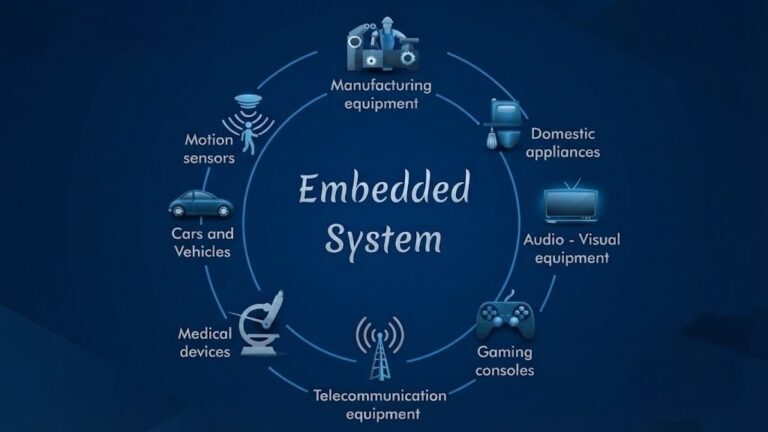
Embedded systems in consumer electronics are the microcontroller-driven circuits that give everyday gadgets their "smart" behaviour. Every smart TV, washing machine, fitness band, and voice assistant you use runs on embedded hardware and firmware working together. For beginners in Bangalore and across India exploring electronics as a career, understanding this field is the first step toward a role in product design, IoT, or embedded software.
An embedded system is a combination of hardware and software designed to perform one or two specific tasks inside a larger product, rather than running general-purpose applications like a computer does. In consumer electronics, this usually means a microcontroller reading sensor data, processing it, and triggering an output — like a washing machine sensing water level and adjusting the motor speed.
Unlike a laptop or smartphone processor, an embedded processor in a consumer device is purpose-built. It runs a fixed set of instructions stored in firmware, optimised for low power draw and real-time response. This is why your microwave responds instantly to a button press but doesn't need to "boot up" like a PC.
Embedded hardware is built around efficiency and reliability rather than raw computing power. A typical consumer electronics embedded system includes a microcontroller unit (MCU), memory, input/output pins, and a small set of sensors or actuators. This lean design keeps costs low, which matters when a manufacturer is producing thousands of identical units.
For beginners, the distinction to remember is simple. A general-purpose computer runs many unrelated programs; an embedded device runs one program, forever, for as long as the product is powered on.
Most learners in our Electronics Fundamentals course first encounter embedded systems applications through simple hobby projects — an LED blinking circuit, a temperature-controlled fan, or a basic alarm system. These small builds teach the same principles used in commercial consumer electronics: sense, process, act.
We structure our foundational modules around this sense-process-act loop because it is the mental model that carries through every embedded systems applications, from a doorbell to a dishwasher.
Every category of modern consumer electronics — kitchen appliances, entertainment systems, personal care devices — now includes some form of embedded control system. The shift from purely mechanical products to embedded consumer devices has accelerated sharply since 2018, driven by falling microcontroller prices and rising consumer expectations.
A modern rice cooker, for example, no longer just times cooking mechanically. It uses embedded firmware to monitor temperature curves and adjust heating in real time, producing more consistent results than older analog designs.
The microcontroller in consumer electronics is effectively the product's brain. It reads inputs from buttons, touchscreens, or sensors, runs logic defined in the embedded software, and controls outputs like motors, displays, or heating elements. Popular microcontroller families used in Indian product design include ARM Cortex-M series chips, PIC microcontrollers, and AVR-based chips found in many Arduino boards.
Our PIC Microcontroller Programming course walks beginners through exactly this kind of chip-level programming, using the same families of controllers found inside real consumer products sold in Indian retail stores.
Real-time embedded systems are designs where the timing of a response is as important as the response itself. A washing machine's motor controller, for instance, must react to a sudden imbalance within milliseconds to avoid damaging the drum. Delayed responses in real-time embedded systems can mean a burnt appliance, a failed safety sensor, or a frustrating user experience.
This is a core reason product companies test embedded firmware extensively before mass production — a lesson we emphasise heavily in project reviews at Microskill Lab.
Smart home embedded systems connect individual embedded devices — plugs, lights, locks, thermostats — into a coordinated network, usually managed through a hub or a smartphone app. Home automation embedded systems have grown fastest in urban Indian markets, including apartment complexes across Bangalore's Whitefield and Electronic City corridors, where residents increasingly install smart lighting and security systems.
The embedded control system inside a smart bulb, for example, still performs the same sense-process-act loop as any other embedded device — it simply adds a wireless radio module to communicate status and receive commands.
Home automation embedded systems rely on a layered stack: sensors gather data, a microcontroller processes it locally, and a communication module (Wi-Fi, Bluetooth, or Zigbee) sends relevant updates to the cloud or a local hub. This layered approach keeps embedded consumer devices responsive even during brief network outages, since core safety functions run locally rather than depending entirely on the cloud.
Students in our IoT course build exactly this kind of layered project, combining a microcontroller, a sensor array, and a Wi-Fi module to replicate how commercial smart home embedded systems actually work.
Smart appliance embedded systems have moved from premium imports to mainstream Indian brands over the past few years, with embedded controls now standard in mid-range refrigerators, air conditioners, and water purifiers sold across Karnataka, Kerala, and Tamil Nadu. This shift has created steady demand for engineers who understand both the hardware and firmware side of appliance design.
| Feature | Traditional Appliance | Embedded / Smart Appliance |
|---|---|---|
| Control mechanism | Mechanical timers, dials | Microcontroller-based logic |
| Responsiveness | Fixed, non-adjustable | Real-time sensor-based adjustment |
| Connectivity | None | Wi-Fi / Bluetooth (optional) |
| Energy efficiency | Lower, static operation | Higher, adaptive operation |
| Diagnostics | Manual inspection only | Firmware-based fault codes |
| Manufacturing cost | Lower per unit | Moderately higher per unit |
Wearable embedded systems — fitness bands, smartwatches, hearing aids — represent one of the most demanding categories of embedded product development because they combine tight power budgets with real-time sensing. A fitness band's embedded processor must track heart rate continuously while running for days on a single small battery charge.
IoT consumer devices extend this further by adding persistent connectivity, letting a wearable sync data to a smartphone app or cloud dashboard for long-term health tracking.
Embedded systems design for wearables prioritises three things: battery life, physical size, and heat dissipation. Engineers achieve this by choosing ultra-low-power microcontrollers and writing lean embedded firmware that spends most of its time in sleep mode, waking only to process sensor readings.
Beginners often assume embedded work means only "coding," but the field spans several specialisations connected to consumer electronics. Understanding these roles helps learners choose the right starting course.
Get hands-on with the same skills used to build real consumer electronics. Our trainers guide you from basic circuits to a complete embedded product prototype. Enrol in the Embedded Systems Pro Programme →
Building consumer electronics embedded systems requires a specific skill stack: circuit fundamentals, microcontroller programming, firmware debugging, and increasingly, basic PCB layout. Our curriculum is built around this exact sequence, so beginners move from theory into a working prototype rather than staying stuck on textbook exercises.
We designed our embedded systems applications projects around devices students recognise — a mini smart-home controller, a wearable-style heart-rate demo, and a sensor-based appliance simulator — so the learning maps directly to products they already use.
A structured embedded electronics course should progress logically rather than jumping straight into advanced topics. Our programme sequences learning so each module builds on the last.
By the midpoint of training, learners typically complete a working sensor-to-actuator project — for example, a temperature-triggered fan controller — before advancing to connected, IoT-enabled builds. This staged approach mirrors how real embedded product development teams work, moving from a bench prototype to a connected proof-of-concept.
Our Arduino Programming course is often the entry point for absolute beginners, since Arduino hardware lowers the barrier to writing and testing embedded firmware without needing expensive lab equipment.
Bangalore remains India's strongest hiring market for embedded and electronics engineers, supported by a dense cluster of product companies, semiconductor design houses, and appliance manufacturers headquartered or operating out of the city. Entry-level embedded roles typically require strong fundamentals in C programming, microcontroller basics, and circuit reading rather than a specific degree pedigree.
Entry-level embedded and consumer-electronics engineering roles in Bangalore commonly fall in an estimated ₹3.5–7 LPA range for freshers, rising with experience and specialisation. Companies across the electronics, appliance, and IoT hardware space in Bangalore's Electronic City and Peenya industrial areas continue to hire embedded talent at a steady pace.
Several sectors in and around Bangalore actively recruit embedded and consumer electronics engineers:
Hiring managers in Bangalore's electronics sector consistently favour candidates with demonstrable projects over certificates alone. A portfolio showing two or three complete embedded product builds — ideally including one IoT-connected device — carries more weight in interviews than a long list of completed modules.
We encourage every learner to document their capstone project with circuit diagrams, firmware code, and a short demo video, since this is exactly the format hiring managers ask to see.
Choosing a training institute is one of the most consequential decisions a beginner makes, since it shapes both technical foundation and job-readiness. Bangalore has many electronics coaching centres, but not all combine structured curriculum with genuine hands-on lab access.
Look closely at whether a programme includes physical hardware kits, real debugging practice, and project-based assessment, rather than lecture-only formats.
Before enrolling in any embedded systems or consumer electronics programme, beginners should ask a few direct questions of the institute.
We built our programmes around Bangalore's specific hiring landscape, combining microcontroller programming, PCB design, and IoT integration into project-based learning rather than isolated theory classes. Our trainers work directly with learners through each debugging cycle, since real embedded product development is rarely a clean, first-try process.
If you're evaluating options for embedded systems training in Bangalore, we recommend comparing curriculum depth and hands-on hours before comparing price alone.
An embedded system is the dedicated hardware-software combination inside a single device. IoT adds internet connectivity so that embedded device can share data with other systems or the cloud. Every IoT consumer device contains an embedded system, but not every embedded system is connected to the internet.
No. Many successful embedded engineers start with a structured, project-based course covering circuits, microcontroller programming, and firmware basics. A degree helps with theory depth, but hands-on project experience is what most Bangalore employers screen for first.
Most beginners start with Arduino-compatible boards because of their simple programming environment and low cost, before progressing to PIC or ARM Cortex-M microcontrollers used in commercial consumer electronics.
This varies by prior background, but most beginners with consistent practice reach an entry-level, project-ready skill level within a few months of structured, hands-on training.
Consumer appliance manufacturing, IoT hardware startups, automotive electronics, wearable/health-tech, and contract electronics manufacturing are among the most active hiring sectors in Bangalore.
Ready to move from theory to a working embedded product? Contact our team to discuss which programme fits your current skill level.