
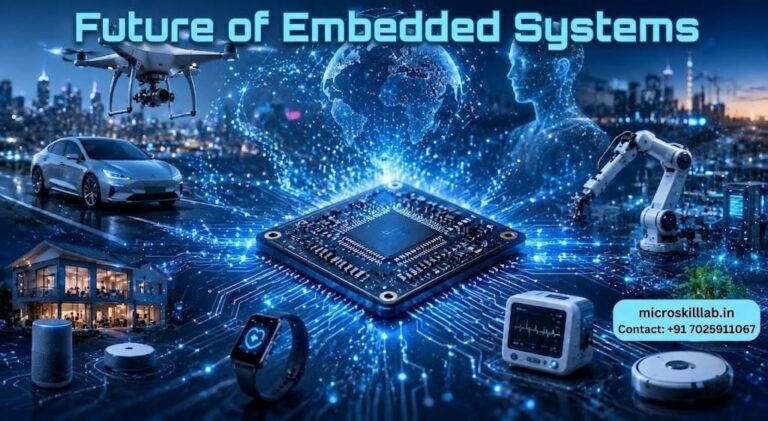
The future of embedded systems belongs to engineers who can merge AI, edge computing, and smart devices into a single design. For professionals in Bangalore and across India, this shift is redefining what an embedded engineer does daily. Devices no longer just sense and switch. They now infer, decide, and act locally on ARM-class silicon. This means embedded software must handle machine learning models, low-latency processing, and secure connectivity together. If you work in electronics, IoT, or firmware, the next five years reward those who upskill now. This guide maps that future and the skills it demands.
⚡ Key Takeaways
- Embedded systems are moving from simple control loops to on-device AI inference at the edge.
- ARM microcontrollers now run neural networks, opening new roles for embedded engineers.
- Edge computing cuts cloud dependency, improving latency, privacy, and reliability.
- Bangalore’s electronics corridor is hiring embedded talent across automotive and IoT sectors.
- Mastering embedded software plus tinyML positions you for higher-paying 2026 roles.
- Hands-on capstone projects at Microskill Lab bridge theory and industry practice.
What the Future of Embedded Systems Really Means
The future of embedded systems is defined by intelligence moving closer to the sensor. Instead of shipping raw data to the cloud, modern devices process it locally. This changes how we design hardware, firmware, and IoT architecture. The cloud still matters for training and analytics. But the moment of decision now lives on the device. That single shift touches every layer of the stack.
From Control Loops to On-Device Intelligence
Traditional embedded software ran fixed control loops on 8-bit chips. Today an embedded engineer deploys optimised models on ARM Cortex cores. Our trainers show how the same board can read a sensor and classify its output in milliseconds. This is the core shift powering smart devices across India.
A modern doorbell, glucose monitor, or drone now reasons at the edge. That reasoning once demanded a server rack. Now it fits in a coin-sized module. That miniaturisation is what makes smart devices ubiquitous. It also lowers the cost of intelligence dramatically. Products that were impossible five years ago now ship at scale.
Who This Future Is For
This future suits firmware developers, electronics graduates, and IT professionals pivoting to hardware. If you already know C or basic microcontrollers, the jump is realistic. You are not starting from zero. You are extending skills you already trust. That makes the transition faster than most expect.
Explore our Embedded Systems Pro Programme to build these skills structured for working professionals in Bangalore. We designed it for engineers who want depth without pausing their careers. Weekend and evening batches keep learning practical and sustainable. You apply each concept to a working device. Theory alone rarely lands a job. Practice is what convinces an interviewer.
Why Edge Computing Is Reshaping Embedded Design
Edge computing keeps computation on or near the device instead of a distant server. For embedded systems, this delivers lower latency and stronger data privacy. It is the backbone of the smart devices shaping India’s IoT boom. India is projected to host billions of connected devices this decade. Much of that intelligence must run locally to scale. Edge computing makes that scale affordable and private.
Latency, Privacy, and Reliability Gains
An autonomous factory robot cannot wait for a cloud round-trip. Edge inference on an ARM chip responds in real time. Our curriculum teaches how embedded software prioritises deterministic timing. This matters for automotive and industrial clients across Karnataka’s electronics corridor.
A dropped connection should never stall a safety function. Edge-first design keeps critical logic running offline. Our labs recreate exactly these failure scenarios. You learn to design for the worst case, not the ideal one. Robust firmware anticipates lost power and dropped links. That mindset defines a professional embedded engineer.
The Bangalore Edge Opportunity
Bangalore firms in Electronic City and Whitefield now build edge-first products. Embedded engineers here work on gateways, wearables, and vision sensors. Companies like Bosch, Siemens, Wipro, and L&T run active embedded teams, alongside numerous startups.
Each needs engineers fluent in edge computing and connectivity. The hiring pipeline stays consistently open. Our IoT Programme covers edge connectivity end to end. You learn MQTT, edge gateways, and secure provisioning. These skills map directly to open roles in Manyata Tech Park. Employers value candidates who have wired a full device-to-cloud path. Few beginners can show that end-to-end skill. Demonstrating it sets you apart quickly. It signals you can ship, not just study.
How AI Is Changing the Embedded Engineer Role
AI is no longer a data-centre-only discipline. TinyML lets neural networks run on microcontrollers with kilobytes of memory. This expands what an embedded engineer must know in 2026. The gap between AI and firmware teams is closing fast. Engineers who sit in both worlds are scarce. Bangalore employers actively compete for them.
TinyML and On-Device Learning
TinyML compresses models to fit constrained ARM devices. An embedded engineer quantises models, manages memory, and profiles power draw. Our trainers walk you through deploying a keyword-spotting model on a Cortex-M board. These are the exact tasks Bangalore product teams now interview for.
Interviewers probe memory budgets and inference latency. They also ask how you cut power without losing accuracy. Practising these trade-offs early builds real confidence. Confidence shows in technical interviews. It also shows on the job when deadlines press. We rehearse these pressures inside the programme.
New Skills the Market Demands
The role now blends firmware, data, and model optimisation. Employers want engineers who bridge hardware and machine learning. Building this mix early separates you from single-skill candidates.
Recruiters see many pure-firmware profiles. Far fewer combine firmware with model optimisation. That combination moves your resume to the top. Our PIC Microcontroller Programming course grounds the fundamentals first. Strong basics make advanced AI work far easier later. You cannot optimise a model on hardware you do not understand. We build that foundation deliberately.
ARM Architecture at the Heart of Smart Devices
ARM cores dominate the embedded landscape from wearables to cars. Understanding ARM is now non-negotiable for a future-ready embedded engineer. Most edge AI silicon builds on this architecture. From smartphones to sensors, ARM is everywhere. Its ecosystem of tools is mature and well documented. Learning it is a durable investment.
Why ARM Cortex Powers the Edge
ARM Cortex-M and Cortex-A cores balance performance and power efficiency. This makes them ideal for battery-driven smart devices. Our curriculum covers the ARM toolchain, memory model, and peripherals. Learners practise on real boards, not simulators alone.
Debugging live hardware teaches lessons no emulator can. You learn to read datasheets, wire peripherals, and trace faults. These are daily tasks in any embedded job.
Bridging Bare-Metal and Linux
Higher-end edge devices run embedded Linux on ARM Cortex-A. These devices juggle networking, storage, and AI at once. Bare-metal skills alone cannot manage that complexity. Linux fluency becomes essential at this tier. This unlocks networking, containers, and richer AI stacks.
Our Embedded Linux Development course prepares you for these gateway-class roles common in Bangalore. You configure kernels, write drivers, and manage boot flows. Gateway devices sit at the centre of most IoT deployments. Mastering them widens your career options considerably.
Ready to build the future, not just study it? Get hands-on with AI-enabled embedded projects guided by trainers who ship real hardware. Our Bangalore learners graduate with live capstone builds that hiring managers recognise. Enrol in the Embedded Systems Pro Programme →
Career Outlook for Embedded Engineers in India
Embedded roles are among the most durable in Indian tech hiring. As IoT and automotive electronics grow, demand for embedded software talent rises. Bangalore remains the national hub for these jobs. The city anchors India’s electronics and semiconductor push. Global R&D centres cluster here for talent. That concentration keeps opportunity high for skilled engineers.
Salary Benchmarks in 2026
Salary figures vary by experience and employer, so treat these as indicative ranges to verify. Entry-level embedded engineers in Bangalore typically earn ₹4–7 LPA. Mid-level engineers with edge AI skills often reach ₹10–18 LPA. These bands reflect Bangalore market observations, not guarantees.
Your actual offer depends on skills and portfolio. A strong capstone project noticeably strengthens your case. Specialists in embedded Linux and tinyML can command higher. Automotive and semiconductor firms often pay a premium for these niches. Always verify current figures against live job listings. Ranges shift with demand and your negotiation.
Roles You Can Target
The market offers a clear ladder for skilled professionals:
- Embedded firmware engineer
- Edge AI / TinyML engineer
- IoT systems developer
- Embedded Linux engineer
- Automotive electronics engineer
Our Electronics Fundamentals Programme is the ideal starting rung for career changers. It assumes no prior hardware background. From there you progress into microcontrollers and AI. The path is clear and stepwise. Each course builds on the last. You never face a skills cliff. Steady progress keeps motivation high.
Skills and Tools That Define the Next Decade
Future-ready embedded engineers need a broader toolkit than before. The blend of hardware, software, and AI is now standard. Building it deliberately keeps your career resilient. Single-skill roles are easiest to automate or offshore. Multi-domain engineers stay hard to replace. Breadth plus depth is the winning combination.
Core Technologies to Master
Focus your learning on the stack that hiring teams expect:
- C and C++ for firmware
- ARM Cortex microcontroller programming
- RTOS concepts and scheduling
- Communication protocols: UART, SPI, I2C, CAN
- Edge AI frameworks and TinyML
- Embedded Linux and device drivers
Hardware Design Still Matters
Software alone does not ship a product. Understanding PCB layout and signal integrity remains valuable. A brilliant algorithm fails on a noisy board. Knowing both sides prevents costly design mistakes. It also makes you a better collaborator with hardware teams.
Our PCB Designing Programme teaches design skills that complement firmware expertise for complete product engineers. You learn schematic capture, layout, and manufacturing basics. Engineers who understand both hardware and firmware are rare. That rarity is exactly what makes them valuable.
How to Prepare for This Future in Bangalore
Preparing means choosing structured, hands-on training over scattered tutorials. The right institute compresses years of trial into guided practice. Location and industry links matter for placement support. A Bangalore-based programme sits inside the hiring network. Trainers know what local firms actually test. That proximity shortens your path to a job.
Choosing the Right Training Path
A strong programme balances fundamentals, projects, and current tools. Look for real hardware, live projects, and trainers with field experience. Avoid courses that skip the AI and edge shift entirely. Outdated syllabi teach yesterday’s embedded world.
The market has already moved on. Your training should reflect where jobs are heading. The comparison below clarifies your options. We built the table from questions professionals actually ask us. It focuses on outcomes, not marketing claims. Use it to weigh your time and money honestly.
Comparing Your Learning Options
Below is a practical comparison for professionals weighing how to upskill.
| Factor | Self-Learning | Generic Online Course | Microskill Lab |
|---|---|---|---|
| Hands-on hardware | Limited | Rare | Included |
| AI / Edge coverage | Fragmented | Often outdated | Current 2026 stack |
| Trainer mentorship | None | Minimal | Direct, field-experienced |
| Live capstone project | No | Sometimes | Yes |
| Bangalore industry links | No | No | Yes |
Whichever path you choose, act while the skills gap is wide. Talk to our advisors through the Microskill Lab Contact Page to map your route.
Frequently Asked Questions
Is embedded systems a good career in 2026?
Yes. As IoT, automotive, and edge AI expand, embedded engineers stay in strong demand across Bangalore and India. The blend of hardware and AI skills is especially valued.
Do I need AI knowledge to work in embedded systems now?
Basic machine learning literacy increasingly helps. TinyML and edge inference are entering mainstream embedded software roles, so early exposure gives you an advantage.
Which is better for the future: embedded software or embedded hardware?
Both matter. The strongest engineers understand firmware, ARM architecture, and enough hardware to design complete smart devices rather than isolated modules.
Can working professionals learn embedded systems part-time?
Yes. Our programmes are structured for working professionals in Bangalore, with practical projects that fit alongside a full-time job.