
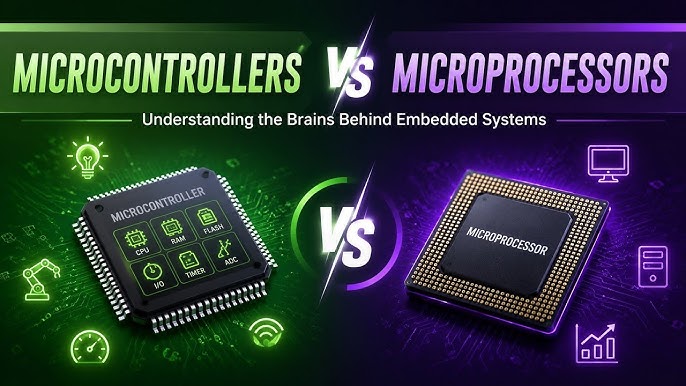
A microcontroller packs a CPU, flash memory, RAM, and I/O peripherals onto a single chip — making it the heart of nearly every embedded system hardware design. A microprocessor is a standalone CPU that depends on external memory and interface chips to function. If you are an ECE student or embedded learner in Bangalore trying to decide what to study first, this guide answers every question — with a feature-by-feature breakdown, programming context, and a clear picture of where each architecture takes your career in 2026.
A microcontroller is an integrated circuit that combines a processor core, program memory (flash/ROM), data memory (SRAM), and programmable I/O peripherals inside a single package. That integration is what separates it from everything else on the component list. You do not need a motherboard, a RAM module, or an external storage chip. The device powers up, executes your firmware, and controls physical hardware — all from a chip that may cost less than ₹50.
The most widely studied microcontroller families in Indian ECE programmes are:
Understanding the internal block diagram is the starting point for embedded system programming. A microcontroller’s core components include:
Our Embedded Systems Pro Programme trains learners to configure and use every one of these peripherals through live hardware projects — not simulations.
A microprocessor contains only the arithmetic logic unit (ALU), control unit, and a small set of registers. All memory and I/O must be added externally on the printed circuit board. This external architecture allows system designers to scale RAM into gigabytes and connect high-speed peripherals — capabilities that no standalone microcontroller can match.
Classic examples taught in Indian universities include the Intel 8085 and Zilog Z80. Modern microprocessors relevant to embedded engineering include the ARM Cortex-A series (used in Raspberry Pi, BeagleBone, and automotive SoCs) and RISC-V-based processors entering the embedded Linux market in 2025–2026.
Because microprocessors can run general-purpose operating systems such as Linux, Android, or Windows CE, they are chosen for applications that require:
Every Android smartphone manufactured by brands popular in India uses an ARM Cortex-A processor — typically a Qualcomm Snapdragon or MediaTek Dimensity SoC. In the industrial and automotive sectors, microprocessor-based systems run HMI panels, telematics units, and advanced driver assistance systems (ADAS).
Bosch, Continental, and Tata Elxsi — among the most active embedded recruiters in Bangalore — deploy ARM Linux-based microprocessor platforms for automotive and industrial products. Our Embedded Linux Development course teaches learners to cross-compile the Linux kernel, write device drivers, and deploy applications on ARM embedded boards — the direct skill set these companies test in interviews.
The table below maps the key technical and practical differences ECE students and embedded learners need to know.
| Feature | Microcontroller | Microprocessor |
|---|---|---|
| Integration | CPU + RAM + ROM + I/O on one chip | CPU only; all peripherals external |
| Typical cost (India, 2026) | ₹20 – ₹500 per unit | ₹200 – ₹5,000+ per unit |
| Power consumption | Ultra-low (single-digit mA) | Higher (hundreds of mA to several watts) |
| Processing speed | 8 MHz – 240 MHz (typical) | 1 GHz – 3 GHz+ |
| External RAM needed | No (on-chip SRAM) | Yes (DDR3/DDR4, megabytes to gigabytes) |
| OS support | Bare-metal or RTOS | Full OS (Linux, Android, RTOS) |
| PCB complexity | Minimal | Complex (RAM, eMMC, PMIC, regulators) |
| Boot time | Near-instant (microseconds) | Seconds (OS boot sequence) |
| Primary application | Dedicated control tasks | Computing and multimedia applications |
| Best entry point for students | ✅ Yes — start here | ⚠️ Higher learning curve |
The architecture decision comes down to three questions every embedded engineer asks at the design stage:
If the system runs web browsers, plays video, or runs Python applications, choose a microprocessor. If it reads a sensor and drives a motor, a microcontroller is sufficient.
Microcontrollers win here unconditionally. An ARM Cortex-M0+ can run on a coin cell for months in sleep mode. A microprocessor running Linux cannot approach that.
Real-time control — where an interrupt must be serviced within microseconds — is handled reliably on microcontrollers running bare-metal firmware or a real-time OS (RTOS) such as FreeRTOS. General-purpose microprocessors running Linux have non-deterministic interrupt latency by default.
In practice, many modern products use both: an ARM Cortex-M microcontroller handles real-time sensor data and motor control, while an ARM Cortex-A microprocessor manages the user interface and cloud connectivity. This architecture is called a heterogeneous embedded system and is increasingly common in smart home devices, industrial IoT gateways, and EV battery management systems manufactured in India.
An embedded system is a purpose-built computing system designed to perform one or a small set of dedicated functions within a larger mechanical or electrical system. Microcontrollers are almost universally its brain. The design flow is consistent regardless of the application domain:
This tight loop between hardware input and hardware output is what distinguishes embedded system programming from application software. Understanding microcontroller and embedded system design as a unified discipline — not two separate subjects — is the first mindset shift every ECE student must make.
Our PIC Microcontroller Programming Programme teaches this complete input-process-output loop on real PIC hardware, with projects covering ADC interfacing, UART communication, and LCD display driving.
The IoT layer in Industry 4.0 is almost entirely built on microcontrollers. A smart factory sensor node might use an ESP32 to read vibration data from an accelerometer, apply a Fast Fourier Transform algorithm, and transmit anomaly alerts over MQTT to a cloud dashboard. Karnataka’s industrial and electronics manufacturing policy is actively building this ecosystem — particularly around the Peenya and Bommasandra industrial areas outside Bangalore.
For embedded learners in Kerala, Tamil Nadu, Telangana, and Andhra Pradesh, the demand picture is equally strong. Electronics manufacturing clusters in Chennai, Hyderabad, and Kochi are scaling up, and every manufacturing line needs engineers who can commission and debug microcontroller-based control systems.
💡 Build real embedded products, not just lab circuits. Our trainers bring hands-on experience from Bangalore’s embedded product industry. Every course includes a live capstone project you can demonstrate in interviews. Explore the Embedded Systems Pro Programme →
Once you select a microcontroller or microprocessor, a set of hardware design decisions follow immediately:
Understanding these decisions is what separates an engineer who can write code from one who can build a shippable product. Our PCB Designing Programme covers schematic capture in KiCad, PCB layout rules, and DFM (design for manufacture) practices — skills that Bangalore electronics companies test explicitly during technical interviews.
Development boards accelerate the learning curve by providing a ready-to-use microcontroller environment with onboard USB-UART converters, voltage regulators, and pin headers. The most relevant boards for ECE students in India:
Embedded system programming is not a single discipline — it spans a spectrum from bare-metal register manipulation to Linux application development. The language and abstraction level shift depending on whether you are programming a microcontroller or a microprocessor:
On microcontrollers:
On microprocessor platforms (embedded Linux):
Knowing a language is necessary but not sufficient. Embedded engineers are assessed on their ability to navigate the complete toolchain from source code to running firmware. Skills that appear consistently in Bangalore job descriptions:
Our IoT course covers the complete IoT stack — from microcontroller firmware reading sensor data to MQTT publishing and cloud dashboard visualisation.
Embedded engineering is one of the most stable technical career paths in India. Unlike pure software roles that are being disrupted by AI-assisted coding, hardware-firmware integration requires physical systems knowledge and hands-on debugging skill that cannot be automated. Bangalore remains India’s embedded capital, with concentrations in Electronic City (Bosch, Siemens, Renesas), Whitefield (Tata Elxsi, Continental, Mphasis), and Manyata Tech Park (Texas Instruments, Qualcomm India).
Open roles for embedded engineers in 2026 include:
| Experience Level | Approximate Salary (Bangalore, 2026) |
|---|---|
| Fresher / Entry-level (0–1 yr) | ₹3.5 – ₹6 LPA |
| Junior Engineer (1–3 yrs) | ₹6 – ₹10 LPA |
| Mid-level Engineer (3–6 yrs) | ₹10 – ₹16 LPA |
| Senior / Lead Engineer (6+ yrs) | ₹16 – ₹28 LPA |
Our curriculum at Microskill Lab Training Institute is structured around one outcome: getting you hired. Our trainers are working embedded engineers with real project experience from Bangalore’s product and services companies. Every learner completes a capstone project — a functioning embedded product built from scratch — that serves as the centrepiece of their technical portfolio in interviews.
We cover the full hardware-to-software stack across our course portfolio:
Batches run regularly for learners in Bangalore. Learners from Tamil Nadu, Telangana, Andhra Pradesh, Kerala, and Pondicherry can enquire about weekend and online-blended options. Book a free counselling call with our team →
Yes. A microcontroller requires far fewer external components, costs less, and produces visible physical outputs — blinking LEDs, spinning motors, sensor readings on a screen — from your very first programme. That immediate hardware feedback accelerates learning in ways that software-only coding environments cannot replicate.
Start with the Arduino Uno (ATmega328P) for its large community and beginner-friendly IDE. Progress to ARM Cortex-M (STM32) once you understand GPIO, timers, UART, and ADC operation. That progression maps directly to what Bangalore companies expect from entry-level candidates.
Arduino knowledge demonstrates motivation, but it is rarely sufficient for a professional embedded role. Companies expect proficiency in C, hardware register-level programming, and at minimum one industry-grade IDE such as Keil or STM32CubeIDE. Our Embedded Systems Pro Programme fills those gaps systematically.
A general computer is designed to run arbitrary software and perform many different tasks. An embedded system is designed to run specific firmware and perform a fixed set of functions — reliably and repeatedly — inside a larger product. The software is typically not user-changeable after manufacture.