
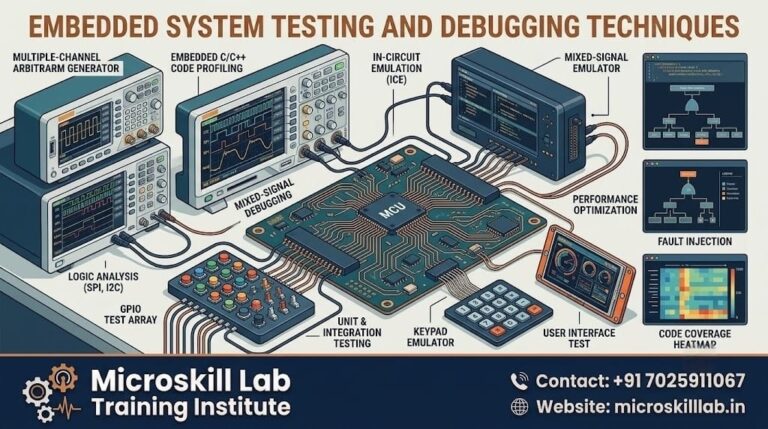
Embedded system testing and debugging techniques are the structured methods engineers use to verify firmware, catch faults early, and trace defects on real hardware. For embedded developers across Bangalore and India working on microcontrollers, ARM boards, and IoT devices, these skills separate hobby tinkering from production-grade work. At Microskill Lab Training Institute, our trainers teach learners to combine unit testing, JTAG-based hardware debugging, and disciplined troubleshooting into one repeatable workflow that scales to real products.
⚡ Key Takeaways
- You will learn how embedded software testing differs from ordinary application testing on constrained hardware.
- You will understand exactly where JTAG and SWD fit into real hardware debugging.
- You will gain a repeatable troubleshooting workflow that shortens defect-hunting time on any target.
- You will see the professional toolchain used in embedded programming across Bangalore product firms.
- You will discover realistic salary and career outcomes for skilled embedded test engineers in India.
What Is Embedded System Testing and Debugging?
Embedded system testing is the process of validating that firmware behaves correctly on its target microcontroller under real electrical, timing, and memory constraints. Debugging is the paired activity of locating and fixing the faults that testing exposes on that hardware. Our trainers stress that mastering both is essential before any embedded developer ships production firmware to the field.
How It Differs From Application Testing
On a desktop you enjoy generous memory, a full operating system, and rich logging tools out of the box. Embedded targets rarely offer these luxuries, so your testing must respect tight RAM, real-time deadlines, and raw hardware peripherals. A single blocked interrupt can freeze an entire device, which makes timing correctness matter as much as logical correctness.
We teach hardware-aware test design from the first week so learners think about constraints, not just code. This early habit prevents the vague, hard-to-reproduce faults that plague untested firmware. It also mirrors how professional teams across Bangalore approach validation on real products.
Who Needs These Skills
Embedded developers, firmware engineers, and IoT product teams all rely on structured testing to avoid costly field failures. Freshers from ECE, EEE, and CSE backgrounds gain a clear advantage when they can demonstrate real debugging ability in interviews. Working professionals moving from IT into hardware roles need these same techniques to stay competitive in Karnataka’s job market.
Our Embedded Systems Pro Programme builds this foundation step by step on real boards. Learners progress from simple test cases to full on-target validation over the course. That structured path is what converts theory into job-ready confidence.
Why Embedded Testing Matters for Your Career in Bangalore in 2026
Bangalore remains the centre of India’s embedded and product engineering industry, spanning Electronic City, Whitefield, and Manyata Tech Park. Firms such as Bosch, Siemens, Wipro, and L&T continuously hire engineers who can test and debug firmware under deadline pressure. Building these abilities early positions you strongly against the wider talent pool competing for the same roles.
Industry Demand and Salary Benchmarks
Embedded test and firmware engineers in Bangalore earn roughly ₹5–13 LPA depending on experience and domain. Automotive and safety-critical roles typically pay at the higher end of that indicative band, which requires verification before you rely on it. Senior engineers who master hardware debugging and validation frameworks command still higher packages.
The steady growth of India’s electronics manufacturing sector keeps this demand consistently strong. MeitY and Skill India initiatives have further pushed structured electronics training across the country. Our trainers map these market outcomes directly to the skills you build in class.
Reliability Expectations in Modern Products
A connected medical device or automotive controller cannot tolerate silent firmware faults in the field. Field failures are expensive to fix and quickly damage brand trust, so testing discipline is now a core hiring filter. Employers increasingly screen candidates on their ability to test rigorously rather than merely write code.
This shift rewards engineers who can prove real validation experience during interviews. We build that experience through live projects that mirror production reliability demands. Learners leave able to speak about testing with genuine authority.
Core Embedded Software Testing Techniques
Effective embedded software testing layers several methods, from isolated unit tests to full system validation on hardware. Each layer catches a different class of defect, and skipping layers is exactly how bugs reach the field. Our curriculum teaches learners to build this layered strategy deliberately rather than testing at random.
Unit and Integration Testing
Unit testing isolates individual functions and runs them on a host machine or simulator to verify logic quickly. Integration testing then checks that modules such as drivers, protocol stacks, and application logic cooperate correctly together. Frameworks like Unity and CMock make host-based unit testing practical even for constrained embedded programming projects.
We guide learners through writing testable, modular firmware from the very start. Well-structured code is far easier to test, debug, and hand over to teammates. This design discipline pays off across every later stage of a project.
Hardware-in-the-Loop and On-Target Testing
Some defects only appear when firmware runs on the actual board with real peripherals and timing. Hardware-in-the-loop testing exercises the target while feeding it controlled inputs, exposing timing bugs that simulators miss entirely. On-target testing then confirms the final binary behaves correctly under true production conditions.
Our Arduino Programming course introduces these on-target concepts using accessible, affordable hardware. Learners see real signals and real faults rather than idealised simulations. That grounding makes advanced testing far easier to grasp later.
JTAG, SWD, and Hardware Debugging
Hardware debugging interfaces give engineers direct visibility into a running processor when print statements are not enough. JTAG and its lighter cousin SWD let you halt the core, inspect registers, set breakpoints, and step through code. For ARM-based development this on-chip debugging is a daily tool rather than a last resort.
Using JTAG and SWD Effectively
JTAG provides a standardised way to access a processor’s internal state through a small set of dedicated pins. SWD reduces this to two wires, which suits the pin-constrained ARM Cortex-M devices common in IoT designs. With a debug probe you can flash firmware, halt on faults, and watch memory change in real time.
Our trainers show learners how to read this live data to pinpoint faults during troubleshooting. Interpreting register and memory state is a skill that grows quickly with guided practice. We drill it on the same boards that Bangalore product teams use daily.
Reading Registers, Breakpoints, and Watchpoints
Breakpoints pause execution at chosen lines so you can inspect the exact state that led to a fault. Watchpoints trigger when a specific memory address changes, which is powerful for catching elusive corruption bugs. Reading core and peripheral registers reveals whether hardware is truly configured as the code intends.
These techniques form the backbone of professional embedded debugging on ARM and other architectures. We practise them repeatedly until they feel natural rather than intimidating. That fluency is what separates confident engineers from anxious ones in real jobs.
Ready to master hardware debugging on real ARM boards? Our trainers guide you from your first breakpoint to full system validation using industry-standard JTAG and SWD tools. Explore the Embedded Systems Pro Programme →
A Practical Troubleshooting Workflow
A repeatable troubleshooting workflow turns chaotic bug-hunting into a calm, evidence-driven process. Rather than guessing, skilled engineers narrow the fault systematically through observation, isolation, and verification. Our trainers teach this workflow so learners stay productive even under interview-style pressure.
Step-by-Step Fault Isolation
Strong troubleshooting follows a clear sequence rather than a flurry of random changes. The core steps our trainers teach include:
- Reproduce the fault reliably before attempting any fix.
- Read the evidence from logs, LEDs, and debug registers.
- Isolate the smallest code or hardware section that still shows the bug.
- Form one hypothesis and test it with a single change.
- Verify the fix and confirm no new fault was introduced.
Following this order prevents the common trap of changing many things at once. It also produces a clear record that helps teammates review and trust your work. Over time the sequence becomes an instinct rather than a checklist.
Common Firmware Bug Categories
Recognising familiar bug patterns speeds up diagnosis considerably on any target. Frequent categories in firmware testing include:
- Race conditions between interrupts and main-loop code.
- Stack overflows on memory-constrained microcontrollers.
- Uninitialised peripherals producing intermittent behaviour.
- Timing violations on protocols such as I2C and SPI.
- Memory corruption from pointer or buffer errors.
Our Embedded Linux Development course extends this diagnostic thinking to complex Linux-based platforms. Larger systems add their own fault classes around memory and concurrency. Learning to categorise bugs early makes these advanced targets far less daunting.
Essential Tools for Embedded Debugging
The right toolchain makes embedded programming and debugging far more efficient in practice. Professional engineers combine debug probes, analysers, and software tools into one fluent workflow. Our curriculum introduces each tool in context so learners understand when and why to reach for it.
Debug Probes and Logic Analysers
A debug probe connects your computer to the target’s JTAG or SWD port for flashing and live debugging. A logic analyser captures digital signals over time, which is essential for verifying protocol timing on buses. Together these instruments turn invisible electrical behaviour into readable, actionable data.
We give learners hands-on time with both so the tools feel familiar before their first job. Seeing real waveforms demystifies protocols like SPI, I2C, and UART quickly. That practical exposure is difficult to gain from reading alone.
Software Tools and IDEs
Modern IDEs integrate compilers, debuggers, and register views into one environment for ARM and other targets. Tools such as GDB and OpenOCD let engineers step through code and inspect state without leaving their workflow. Static analysers catch whole classes of bugs before code ever runs on hardware.
Our PIC Microcontroller Programming course shows how these tools apply across different microcontroller families. Understanding one toolchain deeply makes learning the next one much faster. We focus on transferable habits rather than a single vendor’s buttons.
How to Choose the Right Embedded Training Institute in Bangalore
Choosing where to build embedded testing and debugging skills shapes your entire early career. The best programmes combine real hardware, experienced trainers, and a curriculum tied to what Bangalore employers actually need. Our trainers bring years of product-engineering experience into every single session.
What to Look For in a Programme
A strong embedded programme should offer plenty of hands-on lab time rather than slides alone. Look for real debug probes, ARM boards, and live projects that genuinely mirror industry conditions. Trainer credentials and student outcomes matter far more than glossy marketing claims.
We encourage every prospective learner to visit and see our labs before deciding. Direct observation reveals whether a programme’s hardware and teaching match its promises. That transparency reflects the confidence we have in our own curriculum.
Comparing Learning Paths
Learners often weigh self-study, generic online courses, and structured institute training against each other. Each path suits different budgets, timelines, and levels of self-discipline. The table below compares these options on the factors that matter most for embedded developers.
Table: Comparing Embedded Learning Paths
| Factor | Self-Study | Generic Online Course | Structured Institute Training |
|---|---|---|---|
| Hardware access | Limited to what you buy | Rarely included | Full lab with probes and boards |
| Trainer feedback | None | Minimal | Direct, hands-on mentoring |
| Debugging practice | Ad hoc | Simulated only | Real on-target debugging |
| Job-readiness | Variable | Partial | Aligned to Bangalore hiring needs |
If you want structured, hardware-first training, connect with our team through our enquiry and enrolment page to plan your path. Our advisors help you choose the right starting point for your background. Taking that first step early keeps your career momentum strong.
Frequently Asked Questions
Do I need prior electronics knowledge to learn embedded testing?
Basic electronics and C programming help, but our foundation modules bring motivated beginners up to speed. Freshers from ECE, EEE, and CSE backgrounds regularly start here and progress well. Our trainers adjust pacing so no learner is left behind.
Is JTAG still relevant for modern ARM development?
Yes, JTAG and the two-wire SWD variant remain central to ARM Cortex-M debugging in 2026. Almost every professional embedded workflow uses on-chip debugging for flashing and fault analysis. Learning these interfaces is a core part of embedded programming today.
What salary can an embedded test engineer expect in Bangalore?
Indicative ranges sit around ₹5–13 LPA depending on experience and domain, though these figures require verification. Automotive and safety-critical roles tend to pay at the higher end of that band. Skills in debugging and validation strongly influence your final package.
How long does it take to become job-ready?
With consistent hands-on practice, many learners reach interview-readiness within a few focused months. The exact timeline depends on your starting point and the effort you invest. Our curriculum is structured to build practical confidence steadily.