
VLSI vs Embedded Systems: Which Career Is Better in 2026?
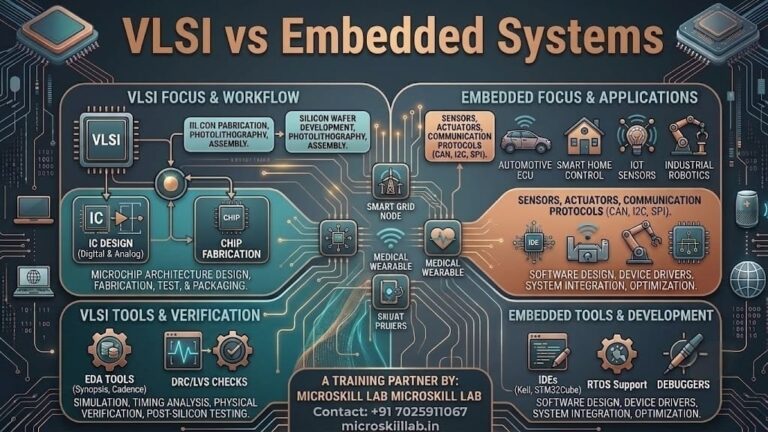
VLSI and embedded systems are two of the most in-demand engineering career paths in India, but they suit different kinds of learners. VLSI focuses on designing the silicon chips themselves, while embedded systems focuses on programming the hardware and software that run inside real-world products.
If you enjoy chip-level design and a longer, research-heavy learning curve, VLSI may suit you. If you want faster industry entry, hands-on projects, and broad job opportunities in Bangalore, an embedded systems course is usually the quicker path.
Engineering students across Karnataka, Kerala, Tamil Nadu, Telangana, Andhra Pradesh, and Pondicherry ask this question every placement season. The honest answer: neither field is universally “better.” The right choice depends on your academic background, your timeline to a first job, and the work you actually enjoy.
⚡ Key Takeaways
- Understand the core difference between VLSI (chip design) and embedded systems (product-level programming).
- Compare job roles, hiring demand, and entry barriers for both fields in India.
- See realistic salary ranges for freshers and experienced professionals in Bangalore.
- Learn which skills and tools each career path actually requires.
- Get a simple decision framework to choose the right path for your engineering background.
- Find out how to start with a structured embedded systems course at Microskill Lab Training Institute.
What Is VLSI and What Is an Embedded System?
VLSI stands for Very Large Scale Integration, the process of designing integrated circuits by placing millions of transistors on a single silicon chip. VLSI engineers work on chip architecture, layout, verification, and fabrication-ready designs using tools like Cadence and Synopsys. This work sits at the foundation of every electronic device, from smartphones to automotive control units.
An embedded system, on the other hand, is a combination of hardware and software designed to perform a specific task inside a larger product. Our embedded systems course teaches students to program microcontrollers, interface sensors, and build working prototypes rather than design the silicon itself.
VLSI in Simple Terms
VLSI engineers care about what happens inside the chip: transistor placement, power efficiency, and signal timing. The output of their work is a chip design file, not a finished product. This makes VLSI a specialised, design-first discipline that typically requires strong analog and digital electronics fundamentals.
Embedded Systems in Simple Terms
Embedded systems engineers care about what happens around the chip: how a microcontroller reads a sensor, controls a motor, or communicates over Wi-Fi. Students in our IoT and embedded curriculum build complete working devices, which gives them visible project outcomes within weeks.
VLSI vs Embedded Systems: Key Differences Explained
The core difference between VLSI and embedded systems is the layer at which each engineer works. VLSI engineers design the chip, while embedded systems engineers program and build around the chip.
Both fields are essential to India’s electronics ecosystem, but they demand different skill sets, tools, and career timelines.
VLSI design cycles are long, often spanning months for a single chip tape-out, and entry-level roles are concentrated in a smaller number of semiconductor design companies. Embedded systems work is project-based and iterative, with shorter development cycles and demand spread across automotive, industrial, IoT, and consumer electronics companies operating in Bangalore’s Electronic City and Whitefield corridors.
Tools and Technical Depth
VLSI professionals work with hardware description languages like Verilog and VHDL, along with EDA tools for simulation and layout. Embedded systems professionals work with C and C++, RTOS platforms, and hardware debugging tools like oscilloscopes and logic analysers. Our Embedded Systems Pro Programme covers all of this hands-on.
Learning Curve and Entry Barrier
VLSI typically requires a strong analog and digital electronics foundation before students can contribute meaningfully to real design work. Embedded systems has a gentler entry point for ECE, EEE, and even CSE graduates, since the field rewards practical coding and hardware interfacing skills over deep semiconductor theory.
Career Scope and Job Roles: VLSI vs Embedded Systems in India
Career scope in VLSI is concentrated but high-value. Roles include design engineer, verification engineer, physical design engineer, and DFT engineer, largely based in semiconductor design hubs. Embedded systems career scope is broader, spanning firmware engineer, embedded software developer, IoT engineer, hardware-software integration engineer, and product engineer roles across multiple industries.
Bangalore’s electronics manufacturing and IT-hardware ecosystem, including companies in Karnataka’s growing semiconductor and IoT sector, hires actively for both disciplines. However, embedded systems roles are typically more numerous at the fresher level because nearly every connected product, from smart appliances to industrial automation panels, needs embedded firmware.
Government-backed initiatives under the Ministry of Electronics and IT have also expanded electronics manufacturing across South India, indirectly boosting demand for engineers trained in hardware and embedded product development.
- VLSI career roles: design engineer, verification engineer, physical design engineer, analog layout engineer.
- Embedded systems career roles: firmware engineer, embedded software engineer, IoT developer, hardware-software integration engineer, test and validation engineer.
- Shared adjacent roles: product engineer, R&D engineer, technical support engineer for electronics companies.
Industry Demand in Bangalore and South India
Bangalore remains India’s largest hub for both VLSI and embedded systems hiring, with additional embedded systems demand emerging from Kerala, Tamil Nadu, and Telangana’s growing automotive and industrial automation sectors. Karnataka’s electronics policy push has also increased demand for engineers who can work across both hardware and firmware layers.
Students based in Pondicherry and Andhra Pradesh increasingly relocate to Bangalore for embedded systems roles, since the city has the highest density of product companies and R&D centres. This makes Bangalore the most practical base for networking and early-career growth in either field.
Which Field Has More Job Openings for Freshers?
Embedded systems generally offers more fresher-level openings because the skill set applies across consumer electronics, automotive, medical devices, and industrial automation. VLSI roles exist in strong numbers too, but they are more concentrated in semiconductor design companies, which means fewer entry points per hiring cycle compared to embedded systems.
This broader demand is one reason many ECE and EEE students complete a focused embedded system course before graduation. It lets them apply for firmware and product engineering roles as soon as they finish their degree, instead of waiting for narrower design-team openings.
Salary Comparison: VLSI Engineer vs Embedded Systems Engineer in Bangalore
Fresher VLSI engineers in Bangalore typically start in a similar or slightly higher range than embedded systems freshers, reflecting the specialised nature of chip design work. Embedded systems freshers often see faster salary growth in the first three to five years. They can move across firmware, IoT, and product engineering roles more easily than VLSI specialists, who stay within a narrower design track.
| Career Stage | VLSI Engineer (Bangalore) | Embedded Systems Engineer (Bangalore) |
|---|---|---|
| Fresher (0–1 yrs) | ₹4–7 LPA (indicative) | ₹3.5–6 LPA (indicative) |
| Mid-level (3–5 yrs) | ₹8–14 LPA (indicative) | ₹7–13 LPA (indicative) |
| Senior (7+ yrs) | ₹18–30 LPA (indicative) | ₹15–25 LPA (indicative) |
Why Embedded Systems Salaries Grow Faster in Some Cases
Embedded systems engineers who add IoT, cloud connectivity, or embedded Linux skills to their base firmware knowledge often qualify for higher-paying architecture roles sooner. VLSI career progression, by contrast, is tied more closely to years of design-cycle experience.
Factors That Affect Both Salary Tracks
Salary in both fields depends on company size, product domain, and specialisation depth. Engineers who complete a structured, project-based embedded Linux and firmware training alongside their degree often negotiate better starting offers because they can demonstrate working prototypes during interviews.
Location also plays a role. Bangalore-based roles in both VLSI and embedded systems typically pay more than similar roles in smaller South Indian cities. The concentration of design centres and product companies drives stronger salary competition among employers.
Skills, Curriculum, and Course Requirements for Each Path
VLSI education typically requires postgraduate specialisation or long internal training programmes at semiconductor companies, since undergraduate curricula rarely cover chip design tools in depth. Embedded systems skills, by contrast, can be built through a focused, practical embedded system course alongside or shortly after an undergraduate degree in ECE, EEE, or CSE.
Our curriculum at Microskill Lab Training Institute is built around this reality. Students move from electronics fundamentals into C programming, microcontroller interfacing, RTOS concepts, and IoT integration, so they graduate with deployable project skills rather than theoretical knowledge alone.
- Eligibility for our embedded systems course: ECE, EEE, or CSE students, diploma holders, and working professionals seeking a career shift into embedded technology.
- Tools and technologies covered: C/C++, ARM microcontrollers, RTOS, I2C/SPI protocols, sensor interfacing, and IoT connectivity.
- Documents typically needed for enrolment: latest academic marksheet, government ID proof, and a passport-size photograph.
What VLSI Study Requires
VLSI study generally requires a strong grasp of semiconductor physics, digital logic design, and hardware description languages. This is best pursued through a postgraduate programme or a company-sponsored design track after a core electronics degree.
Most students strengthen this foundation through elective coursework in analog design, VLSI testing, or CMOS fabrication in their final undergraduate years. Very few colleges offer full hands-on chip design labs at the undergraduate level.
What an Embedded Systems Course Requires
An embedded systems course requires comfort with basic programming logic and a willingness to work hands-on with hardware kits. Our PIC microcontroller and embedded training is structured so ECE, EEE, and CSE students with no prior microcontroller experience can still complete real projects by the end.
Diploma holders and working professionals switching careers also join this track, since the curriculum builds from electronics fundamentals rather than assuming prior embedded programming exposure. This makes it one of the more accessible entry points into Bangalore’s hardware and IoT job market.
Ready to move from theory to a working project portfolio? Our trainers guide you from electronics fundamentals to live embedded projects, with practical exposure that Bangalore employers actively look for. Enrol in our Embedded Systems Pro Programme →
Which Career Should You Choose? A Decision Framework for Engineering Students
Choosing between VLSI and embedded systems depends on three factors: your comfort with abstract chip-level theory, your timeline to start earning, and the kind of daily work you enjoy. Students who enjoy working close to hardware, seeing projects come to life, and entering the job market faster tend to gravitate toward embedded systems.
Students who are drawn to deep semiconductor theory, don’t mind a longer specialisation path, and are open to pursuing a postgraduate VLSI programme may find that track more rewarding long-term. Neither path is objectively better; the right choice depends on your academic background, patience for theory-heavy learning, and career timeline.
Choose Embedded Systems If You Want Faster Industry Entry
If you want to build real projects and apply for firmware roles within months, an embedded system course is the fastest route into the job market.
Choose VLSI If You Want Chip-Level Specialisation
If you are fascinated by transistor-level design and are open to an M.Tech or dedicated VLSI track, this path can lead to strong long-term rewards in India’s semiconductor sector.
How to Start Your Embedded Systems Career with Microskill Lab Training Institute
Most engineering students exploring VLSI vs embedded systems are really asking one question: which path gets me job-ready faster? For the majority of ECE, EEE, and CSE students, our answer is a structured, project-based embedded system course that builds real hardware-software skills without requiring years of additional specialisation.
At Microskill Lab Training Institute, our trainers combine electronics fundamentals with hands-on microcontroller, IoT, and embedded Linux training. Bangalore-based and South Indian students graduate with a project portfolio they can show employers directly.
What Makes Our Embedded Systems Course Different
Our curriculum is built around live project work, not just lecture-based theory. Students complete hands-on assignments using real microcontroller boards, sensors, and communication protocols, which mirrors the actual day-to-day work of an embedded systems engineer in industry.
Take the Next Step
If you have decided embedded systems fits your goals better than a long VLSI specialisation path, the next step is simple. Reach out to our team to discuss batch timings, curriculum details, and how our embedded systems course fits your engineering background. Contact our team to get started →
Frequently Asked Questions
Is VLSI or embedded systems better for a CSE student?
CSE students often find embedded systems more accessible, since it leans on programming skills they already have, while VLSI requires deeper electronics and semiconductor theory.
Can I switch from VLSI to embedded systems later, or vice versa?
Yes, engineers do move between the two fields, though embedded systems is generally easier to transition into from VLSI than the reverse, since it relies less on specialised chip-design tools.
Do I need a postgraduate degree for a VLSI career?
Most VLSI design roles prefer or require postgraduate specialisation, while embedded systems roles are commonly accessible directly after an undergraduate degree combined with a focused embedded system course.
Which field has better long-term growth in India?
Both fields have strong long-term growth in India, but embedded systems offers broader industry demand, while VLSI offers deeper specialisation rewards within the semiconductor design sector.
How long does it take to become job-ready in embedded systems?
With a structured, project-based embedded systems course, most ECE, EEE, and CSE students can build a job-ready project portfolio within a few months of consistent, hands-on training and mentorship.